
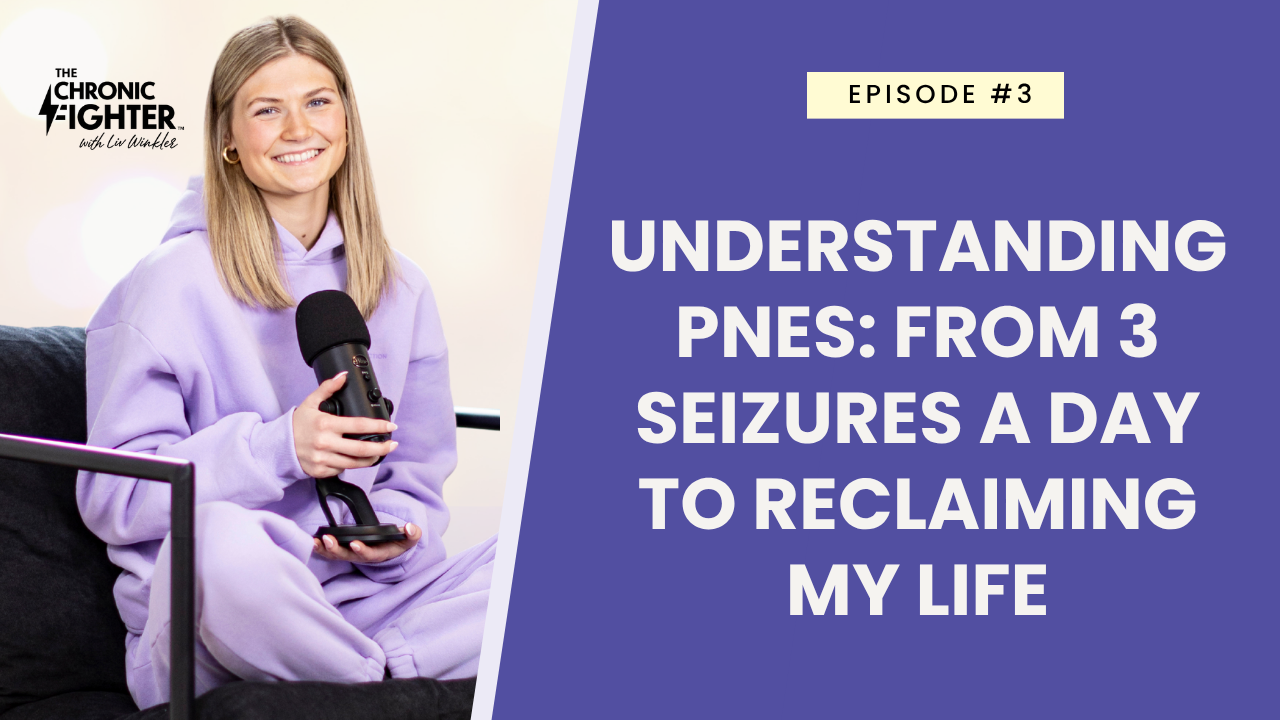
PNES: What It Is, Common Triggers, Symptoms, and How to Move Forward
If you've ever experienced seizure-like episodes but been told that your tests don't show epilepsy, you may have been left with more questions than answers.
What is happening to my body?
Why am I having seizures if I don't have epilepsy?
Is PNES real?
Can stress really cause physical symptoms this intense?
And perhaps most importantly: Will I ever feel like myself again?
I understand those questions because I've lived them.
At 19 years old, I began experiencing psychogenic non-epileptic seizures (PNES). At the worst point, I was having three or more seizures a day, sometimes each lasting 25 to 45 minutes. There were periods when my parents felt like I was practically in a seizure all day.
Today, I rarely experience full seizures.
That doesn't mean my health journey was simple or that there was one magic solution. My recovery involved medical evaluation, professional support, understanding my nervous system, addressing underlying health issues, learning my triggers, and finding practical ways to respond when symptoms appeared.
In this guide, I'll explain what PNES is, what PNES symptoms can look like, why stress can play such an important role, what the "stress bucket" can teach us about triggers, and some of the strategies that helped me regain more control over my life.
Important: This article is based on my personal experience and work as a health coach. It is not medical advice or a substitute for professional care. If you are experiencing seizure-like symptoms, seek evaluation from a qualified healthcare professional.
What Is PNES?
PNES stands for psychogenic non-epileptic seizures.
The term can be confusing because PNES can look very similar to epileptic seizures, but the underlying mechanisms are different.
Epileptic seizures are associated with abnormal electrical activity in the brain. PNES episodes are not caused by that type of abnormal electrical activity.
PNES is considered a type of functional neurological disorder (FND).
You may also hear PNES described using terms such as:
- Functional seizures
- Dissociative seizures
- Functional dissociative seizures
- Conversion disorder with seizures
One of the most important things to understand is that non-epileptic does not mean imaginary.
PNES symptoms are real.
The person experiencing them isn't pretending, exaggerating, or simply choosing to have an episode. The symptoms can be incredibly disruptive and frightening, particularly when someone doesn't yet understand what is happening.
Why Is PNES So Misunderstood?
Part of the confusion comes from the word "psychogenic."
Many people interpret this to mean that PNES is simply psychological or that someone can stop an episode by thinking differently.
That's not how I experienced it.
Mental and emotional stress can certainly contribute to symptoms, but physical stress can matter too. Illness, pain, inflammation, lack of sleep, inadequate nutrition, overstimulation, and other physical stressors can all place additional demands on the nervous system.
For me, this distinction was incredibly important.
My PNES symptoms were at their worst while I was dealing with undiagnosed Crohn's disease. My body was experiencing significant physical stress, pain, exhaustion, inflammation, and not getting enough nourishment.
Understanding that helped me stop separating "mental health" and "physical health" into two completely different categories.
The body experiences stress as a whole system.
What Do PNES Symptoms Feel Like?
PNES can look different from person to person.
For some people, symptoms may involve full seizure-like episodes. For others, symptoms may be more subtle or may change over time.
My symptoms have changed significantly since I first developed PNES.
Initially, I experienced full seizures. Today, I rarely have those. Instead, I may experience what I describe as a dizzy spell or "weird feeling."
For me, this can include:
- Feeling disconnected from my body
- Feeling like my head is spinning
- Brain fog
- Blurred vision
- Shaking
- Difficulty staying present
- Difficulty responding during a conversation
- Feeling overstimulated
Other people may experience symptoms such as weakness, stiffness, changes in awareness, difficulty speaking, unsteadiness, eye movements, racing heart, or shortness of breath.
This is one reason it's important not to assume that everyone with PNES will experience the exact same symptoms.
PNES vs. Epilepsy: Why Getting Evaluated Matters
Because PNES can resemble epilepsy, seizure-like symptoms should be medically evaluated.
If someone is experiencing seizures for the first time, it is important to rule out epilepsy and other neurological conditions rather than assuming the symptoms are PNES.
A neurologist may recommend testing such as an electroencephalogram (EEG), which measures electrical activity in the brain.
Video EEG monitoring can be particularly helpful because it records both brain activity and what is happening physically during an episode.
I went through this process myself, including EEG testing at Mayo Clinic in Rochester, Minnesota.
Getting medically evaluated didn't make my symptoms disappear.
But it gave me something I desperately needed: an explanation.
When I knew that epilepsy had been ruled out and I had a better understanding of what was happening, the episodes became less frightening.
That matters because fear itself can add another layer of stress to an already overwhelmed nervous system.
What Causes PNES?
There isn't necessarily one single cause of PNES.
For many people, episodes may be associated with a combination of psychological, emotional, physical, and environmental stressors.
This is where my experience taught me something important:
Stress Isn't Always Emotional
When people hear that stress can trigger PNES, they may immediately think of anxiety, work, school, relationships, or trauma.
Those things can matter.
But physical stress can matter too.
Your body may experience stress from:
- Chronic illness
- Pain
- Inflammation
- Infection
- Lack of sleep
- Not eating enough
- Dehydration
- Overexertion
- Changes in routine
- Hormonal changes
- Sensory overload
In my case, physical illness was a major part of the picture.
My PNES was particularly severe while I had undiagnosed Crohn's disease. Once my physical health improved, my PNES symptoms improved dramatically as well.
That's why I think it can be helpful to look beyond the question, "What am I stressed about?"
Sometimes the better question is:
"What is putting stress on my body right now?"
Can Excitement Trigger PNES?
This was one of the most surprising things for me to learn.
Not every nervous-system trigger feels negative.
Excitement can also create a significant increase in nervous-system activation.
For example, I once flew across the country to surprise my childhood best friend at her soccer game. I was incredibly excited. But my body experienced such a surge of activation that I ended up having a PNES episode the following day.
This doesn't mean excitement is bad.
It means that a nervous system that is already highly sensitive or overloaded may have difficulty distinguishing between different types of intense activation.
That's also why positive changes can sometimes require pacing.
Starting a new routine, changing your diet, introducing a new supplement, beginning a new medication, traveling, attending a big event, or making another major change can all require your body to adapt.
I've learned that my body often needs me to make changes more gradually than other people might.
The Stress Bucket: A Simple Way to Understand PNES Triggers
One of the concepts that helped me understand PNES was the idea of a stress bucket.
Imagine your body has a bucket.
Every stressor adds a little more to it.
Maybe today you're dealing with poor sleep.
Then you don't eat enough.
Then you have a stressful appointment.
Then you're in pain.
Then you push through when your body is asking for rest.
Then you get sick.
Individually, none of those things may seem like enough to cause a seizure.
But together, they can fill the bucket.
Eventually, it overflows.
Why You May Not Have One Obvious Trigger
Before I understood this concept, I would often try to identify the one thing that caused an episode.
Sometimes there simply wasn't one.
There was usually a final event that seemed to happen right before symptoms appeared, but that didn't necessarily mean it was the only cause.
The bucket had already been filling.
This changed the way I think about prevention.
Instead of only asking:
"What triggered my seizure?"
I can ask:
"What has been filling my bucket lately?"
That question gives me much more information.
It encourages me to look at my sleep, food, physical health, emotional stress, schedule, energy levels, and overall environment rather than blaming one isolated event.
How Does the Nervous System Fit Into PNES?
When the body perceives that it is under threat, the nervous system can activate a survival response.
This is often described as the fight-or-flight response.
Stress hormones such as adrenaline and cortisol can increase. Heart rate may rise. Muscles can become tense. Digestion can change. Your body begins prioritizing immediate protection rather than rest and recovery.
This response is incredibly useful when you actually need to escape danger.
But what happens when the nervous system becomes overwhelmed or stays activated too often?
The body can begin responding to everyday situations as though they require the same level of protection.
For me, learning about nervous system regulation gave me a completely different perspective on my symptoms.
Instead of thinking:
"Why is my body doing this to me?"
I started thinking:
"What is my body trying to communicate?"
That shift didn't mean ignoring my symptoms.
It meant learning how to respond to them differently.
What Can Help During a PNES Episode?
There isn't one universal strategy that works for everyone with PNES.
The right approach should be discussed with your healthcare team, particularly if you're newly experiencing symptoms.
Some strategies I've found helpful include calming sensory input, distraction, breathing exercises, and other techniques that help my body feel safer.
- Cold Sensory Input
One strategy that has been particularly helpful for me is cold exposure.
When I notice symptoms beginning, I may use ice on my wrists or an ice cap.
For me, this can help shift my physical state quickly.
- Reduce Overstimulation
If I'm becoming overwhelmed, stepping away from a noisy or stimulating environment can help.
Sometimes the best thing I can do is go somewhere quiet, sit down, and give my body a chance to settle.
- Use Familiar Distractions
Simple activities can give my brain something predictable to focus on.
That might be a familiar television show, a simple game, music, or another comforting activity that doesn't require a lot of mental effort.
- Practice Breathing Before You Need It
Breathing exercises can be difficult to use effectively when you're already overwhelmed.
That's why practicing them when you're feeling relatively well can be useful.
The goal isn't to wait until a crisis to learn the skill.
It's to make regulation part of your everyday routine.
- Stay Calm When Possible
One of the biggest things I've learned is how much the response surrounding an episode can matter.
When everyone becomes frightened and panicked, it can make the situation feel even more threatening.
Instead, I try to remind myself:
"I am safe. This will pass."
And when other people are with me, it helps when they remain calm and reassuring rather than treating the episode like an emergency when my care plan indicates otherwise.
Of course, safety comes first, and seizure-like episodes should always be taken seriously, particularly when the diagnosis is uncertain or something about the episode is different from usual.
Long-Term PNES Management Is About More Than Stopping Episodes
Immediate coping strategies are important, but recovery isn't only about what you do once symptoms begin.
For me, long-term improvement came from looking at the bigger picture.
That included working with a provider who understood PNES and helping my body become less overwhelmed over time.
It also meant addressing the things filling my stress bucket.
Some of the everyday habits that have helped me include:
Eating Regularly
Not eating enough can be another physical stressor.
Keeping my body adequately fueled has become an important part of managing my overall health.
Prioritizing Sleep
Sleep deprivation can make everything harder to manage.
For me, getting enough rest is one of the simplest ways to reduce the overall load on my body.
Pacing Energy
I've had to learn that constantly pushing through symptoms isn't necessarily a sign of strength.
Sometimes pacing is what allows me to do more over the long term.
Supporting Physical Health
My experience with undiagnosed Crohn's disease taught me that physical health and nervous-system symptoms can't always be separated.
Addressing underlying health problems made a significant difference in my PNES symptoms.
Practicing Regulation When You're Feeling Well
Meditation, journaling, music, breathing exercises, gentle movement, and other calming practices aren't only for moments of crisis.
Practicing them regularly can help build familiarity with the feeling of being regulated.
Finding the Right Professional Support
One of the most important steps in my recovery was finding a provider who actually understood PNES.
When we started working together, we focused on immediate symptom-management strategies.
Eventually, we were able to work on deeper issues, including health anxiety, difficult health experiences, and learning how to feel safer in my body.
If you're looking for support, consider asking potential providers:
- Do you have experience treating PNES?
- Are you familiar with functional neurological disorder?
- How do you approach PNES treatment?
- How do you help patients identify and manage triggers?
- Do you work with other members of the patient's healthcare team?
You don't have to figure this out completely on your own.
How to Live Your Life With PNES
One of the biggest fears I had was having a seizure in public.
And honestly, that fear could have easily made my world smaller.
But staying home all the time wasn't the life I wanted.
I didn't want my nervous system to learn that my house was the only place where I was safe.
So I kept going.
I traveled.
I spent time with friends.
I went to events.
I did things that mattered to me.
Sometimes that meant having a backup plan.
Sometimes it meant stepping away from everyone for 20 minutes.
Sometimes it meant accepting that I might need to change plans.
And sometimes it meant simply reminding myself that having an episode wasn't the end of the world.
Create a PNES Safety Plan
Having a plan can make leaving the house feel much less intimidating.
Depending on your individual needs and your healthcare provider's recommendations, your plan might include:
- Identifying a safe, quiet place where you can go if symptoms begin
- Letting trusted people know about your condition
- Adding relevant medical information to your phone's Medical ID
- Creating a response plan for family and friends
- Having a plan for school or work
- Knowing when you should seek medical attention
- Avoiding driving or other activities when you're not in a safe state to do so
The goal isn't to plan your entire life around PNES.
It's to have enough support and preparation that PNES doesn't have to control your decisions.
You Can Have a Life Beyond PNES
When I was having three or more seizures every day, it was difficult to imagine the life I have now.
But my diagnosis became something I learned to understand rather than something that completely defined me.
I've gone from experiencing frequent, long-lasting seizures to starting my own business, creating The Chronic Fighter, traveling, spending time with people I love, and building a life that excites me.
My health journey isn't perfect.
But I no longer live with the same fear that once controlled so much of my life.
And that's what I want anyone reading this who is struggling with PNES to know:
Your diagnosis is not your entire story.
You can learn to understand your body.
You can find tools that work for you.
Frequently Asked Questions
Is PNES a real condition?
Can stress trigger PNES?
Can PNES go away?
Is PNES the same as epilepsy?
What should I do if I think I have PNES?
If this article resonates with you, consider subscribing to The Chronic Fighter Podcast for practical strategies, honest conversations, and science-backed tools for navigating chronic illness, nervous system regulation, and building a fulfilling life alongside your health journey.
Feel Free to Reach Out
Questions about the membership, the podcast, collaborations, or something else?
We would love to hear from you.
Use the form below and we’ll get back to you as soon as we can.
We hate SPAM. We will never sell your information, for any reason.