The Chronic Fighter with Liv Winkler
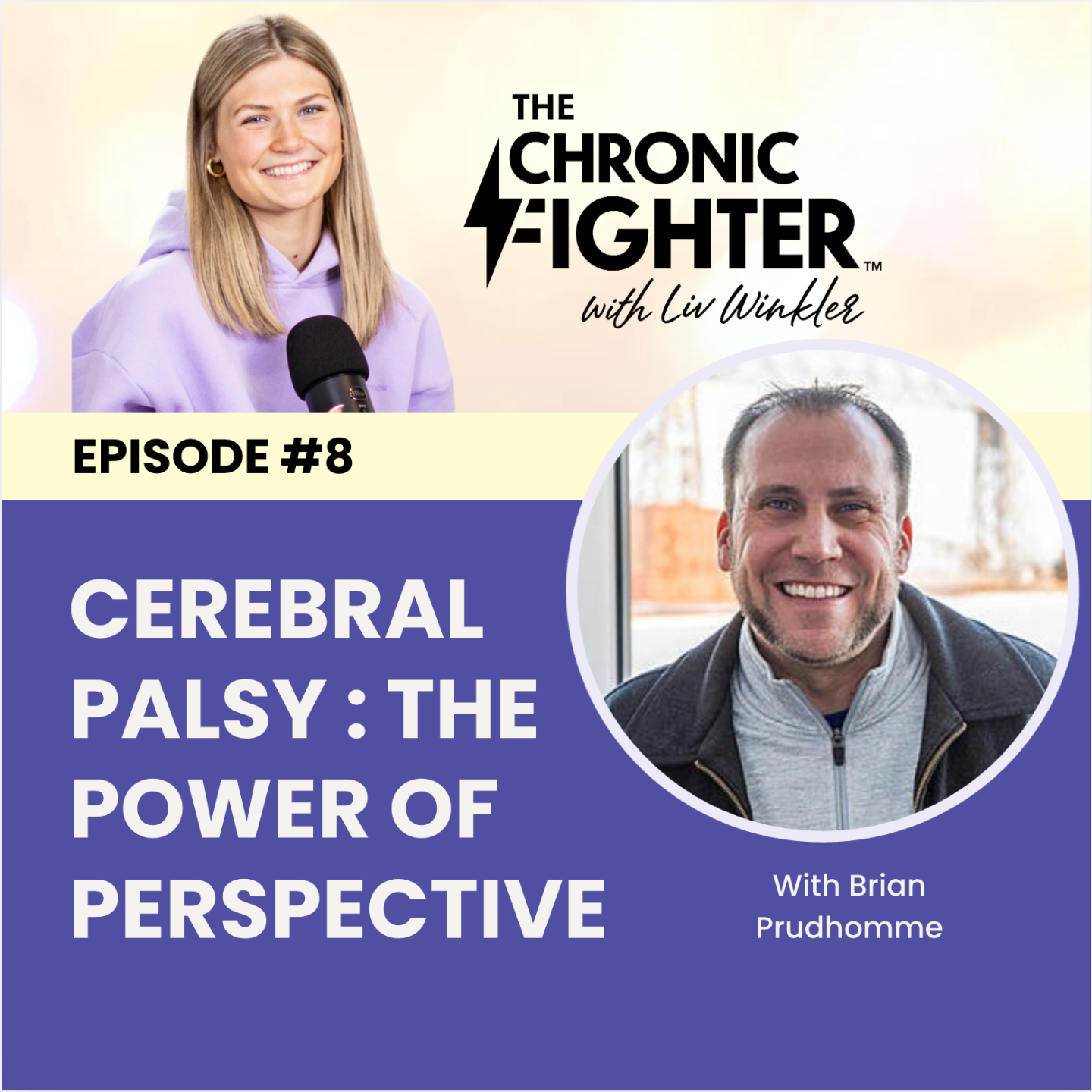
Episode 8: Cerebral Palsy: The Power of Perspective
Disability Doesn’t Define You
In this episode of The Chronic Fighter, I sit down with Brian Prudhomme, a sports announcer and radio host who has cerebral palsy. Brian has never known life without a disability, but he’s never let it define what he’s capable of.
Brian believes that people are so much more than their disability. If he could change or improve 10 things in his life, cerebral palsy wouldn’t be in that top 10.
Throughout our conversation, Brian shares how he has to get creative with everyday tasks, how his parents prioritized giving him a normal childhood, and the anxiety that can come with living with a disability. We also talk about how he’s found ways to pursue his passions that work for his body and focus on his strengths rather than his limitations. Brian also talks about his belief that disability is a state of mind.
Brian’s sense of humor, personal stories, and perspective on life make this a great listen!



What You'll Hear in This Episode
0:00 Coming Up
2:10 Meet Signe Libbon
3:06 Diagnosed With Rheumatoid Arthritis at Age 3
5:22 Growing Up With RA & Medical Complications
8:05 Managing Flares & Learning Your Limits
11:04 The Reality of Invisible Illness
14:34 Opening Up About Chronic Illness
18:21 The Daily Impact of RA & Medication
21:28 What People Don’t See Behind the Scenes
26:26 Grieving What Illness Limits & Finding Gratitude
37:07 Friendship, Support & Feeling Less Alone
43:52 Dating With Chronic Illness
53:14 PT & Managing RA
58:44 Faith & Hope with Chronic Illness
Biggest Takeaways
✔ See the person, not just their disability. Brian shares that while people often mean well, he doesn't want to be praised simply for doing everyday things. He just wants to be treated like anyone else.
✔ Don’t let the fear of a flare ruin your experience. It’s easy to imagine the worst-case scenario, but focusing on the present and handling challenges as they come can help you enjoy the experience instead of worrying about what might happen.
✔Accepting your limitations doesn't mean giving up on yourself. Brian makes a clear distinction between recognizing what you can't do and letting those limitations stop you from moving forward.
✔ You can still be part of an experience without participating in every part of it. Whether it's spending time with friends or attending an event, missing out on one activity due to a limitation doesn't mean you have to miss out on everything.
✔ Don’t dwell on your differences. Brian shares that things may take him longer or require a more creative approach, but he doesn’t beat himself up over that. Instead, he focuses on the fact that he was able to do it.
✔ Surround yourself with people who encourage you. Brian shares how much his family and friends have meant to him throughout his life, always believing in his abilities and encouraging him to stay involved in the things he loves.
Resources Mentioned
The Chronic Fighter: Health coaching, membership, and additional resources: https://thechronicfighter.com
Business & Coaching Socials
TikTok: @thechronicfighterco
Facebook: The Chronic Fighter
Instagram: @thechronicfighterco
Threads: @thechronicfighterco
Podcast Socials
TikTok: @thechronicfighterpod
Facebook: The Chronic Fighter Pod
Instagram: @thechronicfighterpod
If You Enjoyed This Episode
I’d love for you to subscribe, leave a review, and share this episode with someone who may need to hear it.
Living with a disability or chronic illness may mean doing things differently, but that doesn’t mean you have to let go of the things that matter to you. As Brian reminds us, accepting your limitations doesn’t mean giving up on yourself.
Thank you for listening, and I’ll see you in the next episode.
Your Journey Doesn’t End Here
Explore more episodes of The Chronic Fighter Podcast and continue discovering tools, stories, and support to help you build a life you love—while caring for your body along the way.
Main PodcastTranscript
Cerebral palsy for me has been part of life as long as I've known life. Accepting your disability means okay, bad analogy, but if it's a 12-step program, maybe the first three I can't even do. But there's nine left, so let's go to town on that. Focus on what you can do versus what you can't.
Liv 0:16Yes.
Brian 0:17You're only gonna be as limited as you decide you are. I was once told by a wheelchair basketball coach of mine, and it's never left my head, that a disability is a state of mind. So I'm never going to not remember that I have a disability. But in a weird way, it's my goal to make you not remember.
Liv 0:49Welcome to the Chronic Fighter Podcast, where we help teens and young adults with chronic illness take their lives back. I'm your host, Liv Winkler, a health and nutrition coach, founder of the Chronic Fighter Health Coaching Business, a lifelong chronic illness girl with a degree in psychology and concentration in health coaching. This podcast meets you exactly where you're at in your health journey and offers science-backed tools that changed my life and can change yours too. I would love to be the person for you that I wished I had growing up. Thank you for tuning in to the Chronic Fighter Podcast. Today's guest is Brian Prudhomme, someone I've looked up to for a long time. Brian was born with cerebral palsy and has navigated the challenges that come with living with a disability throughout his entire life. He's an incredible example of what it looks like to embrace your limits without letting them define what's possible for you. His love for athletics led him to a career in Minnesota Sports, where he spent the last 20 years in sports radio broadcasting and public address announcing. He actually announced some of my high school soccer games. In this episode, we talk about growing up with a disability, the difference between acceptance and giving up, and how embracing your limitations can sometimes lead you towards strengths and opportunities you never expected. Brian's perspective on accepting the life you have while continuing to move forward is what I think so many of us can learn from. I'm really excited for you to hear this conversation. Welcome to the Chronic Fighter Podcast, Brian. Having you here feels so full circle for me, and I've really looked up to you for a long time, so it's pretty exciting to be able to sit down and have this conversation.
Brian 2:25Well, thank you for saying that. Not only because I'm short, nobody looks up to me really, but I didn't realize that because announcing for you during your soccer career, I think some people don't realize how far away the announcer is from the game in proximity. So to find out that somebody looks up to me when I didn't get to talk to them as much as I would have liked, this is great to talk to you today.
Liv 2:44Yeah, I'm like, when I first reached out to you, I'm like, oh my gosh, I don't even know if he remembers me.
Brian 2:49Oh yeah. I told you you remember the good athletes. I don't know if you tell your audience how talented you were on a pitch. That's the correct term. But I don't know if you've ever told anybody how talented you are, but I do remember, and again, I'm very blessed to know your family for a lot of decades. So I'm pretty fortunate.
Liv 3:03Well, thank you. I know. It's pretty special that you went to school with my mom and uncle, and I know that they really enjoyed, you know, growing up with you, though. Pretty cool.
Brian 3:12Yeah, they're very entertaining people. So hopefully they find out in the next hour, give or take, that hopefully I can be entertaining too, but we'll find out.
Liv 3:20Oh, we already know you are.
Brian 3:21Yeah, she had the giggles before the show started, so yes.
Liv 3:24I did, yes. It takes me a second to start.
Brian 3:26That's okay. Been there done that.
Liv 3:28Well, to start off, I'd love for our listeners to get to know you. Can you share what your journey with your disability and chronic health challenges has looked like over the years? Whatever you're comfortable sharing.
Brian 3:38I don't think there's anything I'm not comfortable sharing, which could be either the best or worst thing to happen to your show. Um my journey really didn't have too many peaks and valleys in it because I was diagnosed, I think the diagnosis itself might have come at age one.
Liv 3:53Oh wow.
Brian 3:54But cerebral palsy for me has been part of life as long as I've known life. So as far as that journey goes, that's just been every day waking up going, okay, my lower body is not functioning the way most people's might, or the way you hope most people's might. So I've had strength difficulties, balance difficulties, and you know, tried to make the best of all of that.
Liv 4:16Yeah. That is interesting from such a young age, and I can relate to that too, because I have had chronic illness my entire life. That's all I've known. Yeah. Um, can you walk us through a bit of like what that journey has looked like, you know, learning? Well, I guess you were one, so like your parents learning about it and and what you did to kind of adapt your life?
Brian 4:35Yeah, so that's kind of been the blessing and the curse as well, because again, I don't know any different. So a lot of people have my admiration that might have been quote unquote able-bodied until some sort of tragic accident in their 20s or 30s or whatever, and you know, then they had to readjust and relearn everything. There hasn't been a lot of relearning. Everything for me has been new learning. Even, you know, coming to this podcast, coming down your flights of stairs, knowing how I can do that, knowing at what pace I can do that, um, getting up the steps to come into your doorway, knowing how I can do that. Um staying at a hotel this particular weekend. If it's not a walk-in shower, my life is a little more difficult. I have a walk-in shower at my home because some of the biggest difficulties I have is taking big steps up. Um, obviously, we're sitting down for this. I walk with two canes now. I walked with a walker as a younger child. I did walk without any assistance for a decent stretch of time, but to paint a picture for you, I stood a little bit like a catcher would in baseball. I wasn't straight up all the way, partly because my hamstrings couldn't do that, and then partly because your center of gravity is your balance, and mine wasn't great if I stood all the way up. So I'm not answering your question, but I am in the sense that everything's a constant adjustment because terrain will change, weather will change, situations will change. So I'm always adapting, whether it's you know, being the kid that lives six blocks from their elementary school but still needed a bus because six blocks for you might be ten minutes. Six blocks for me might be ten days. I'm joking, but you know, it's gonna be a lot longer.
Liv 6:12No, I know what you're saying, and that's well put. I mean, people with chronic illness in general understand what it's like to, you know, go day by day because you just don't know what each day will look like.
Brian 6:22But what choice do you have? That's the difference, which again, that to me becomes a total mindset idea. Like you could wake up every day and go, Well, this didn't go away. Now what am I gonna do. Well, it's not what am I gonna do. Because it didn't go away. So you knew enough about it yesterday, you can take what you knew yesterday and apply it to today.
Liv 6:39Yeah, learning each day. I love that.
Brian 6:40100%.
Liv 6:41That's really cool.
Brian 6:41Again, no choice in the matter.
Liv 6:43Yeah. Well, prior to this interview, you told me your family wanted your childhood to feel as normal as possible despite your cerebral palsy. How important do you think that was for your overall well-being?
Brian 6:54The most important thing that ever happened to me in my life, for sure. I mean, my dad passed away eleven years ago, and I still think of lessons he taught me every day. And it's hard to say that, you know, what they wanted because I don't want to speak for them and speak out of turn. But I feel like while they were compassionate to the situation, because my dad would take me to, you know, I was at a twins game today, I'm wearing the twins jersey now. My dad would take me to numerous games as a kid, but we sat sometimes up in the upper deck in the nosebleeds. Well, physically, in terms of mobilizing, I'd still be on my way there. So he would carry me, he would call it fireman style or call it sack of potatoes. He would have me hoisted over his shoulders doing stairs in the old Metrodome.
Liv 7:40Wow.
Brian 7:41Because, you know, he wanted me to get to the game, but he was compassionate enough to know like there's no way I can ask him to do this. That's kind of the polar opposite of your question, where that doesn't make me the quote unquote normal situation, but I got in trouble for the same things everybody gets in trouble for as a kid. I would say that I didn't have any homework because I wanted to hang out with my friends. I had tons of homework that I maybe didn't end up doing. I would make up excuses for why I came home late. I was having fun wherever I was at, so I came home late just like everybody else, and got in trouble just the same. There was never a well, you have cerebral palsy, so you're off the hook for this.
Liv 8:18Yeah.
Brian 8:19So there are goods and bads to normal, but the best part about it was they've never had me think of like, hi, I'm Brian, and I have cerebral palsy. That is not how I introduce myself to anybody. So all the credit in the world to them for that.
Liv 8:33That's really cool, and I think that that is so important for your upbringing to not feel so different from other people. I mean, I'm lucky because I had the same kind of situation. My parents always treated me, you know, normal compared to everyone else. Um if I had a bad flair, I would show up to a family gathering or holiday and I would just be treated as Liv. Like I wouldn't be, you know, asked all these questions, it wouldn't be a big deal. You know, they just welcome me in, just like every other family member. And um you know, my parents made a point to treat me the same as my brother. And um, you know, even in preparation for this interview, my mom had told me that when I was in preschool, my teacher called her up to say how important it is to to treat me and my brother, you know, the same and and not have any special treatment because I had these health issues. And I think that's just really good advice in general to parents out there of chronically ill children to treat them the same as the siblings, because otherwise, you know, if you don't have that normalcy, yeah, it's really isolating.
Brian 9:41You make it the focus of who a person is. Yes, it's part of you, certainly. Like I can't hide mine, it's very visible, it's fairly obvious. You might not know it's cerebral palsy, but most people will see me walking down the street and go, something's not a hundred percent right about that guy. And maybe I shouldn't even phrase it that way. It doesn't mean that there's something wrong with me, but there's certainly something different about the way that that person mobilizes. But in no way did they make that become why you should know me or what you should know about me. And that's always been huge. Your mom could tell you, or your uncle could tell you, like, hey, he got to leave class five minutes early all the time because there was five minutes to switch classes, he needed 10. And your your uncle would probably tell me, Hey, remember I got to carry your books because I wanted to leave class early too. It was an easy way to make extra friends when you're getting out of classes early. And that was stuff that I needed. So I remember that, but you can remember those like three to five things that were different because there were 400 other things that were just like everybody else that you were part of. And that's never underrated, in my opinion.
Liv 10:44And that's something we talk about is accommodations as well.
Brian 10:47For sure.
Liv 10:48Um, because you know, for a while growing up, I thought that if I had accommodations that would, you know, be so weird and different than everyone else. But it's like now I reflect on that thinking, why wouldn't I do it to make my life easier? And I think that, like you said, that perspective shift where it's like, yes, my my health is a part of my story, but it's not the only definition. It's not 100% of your story. Yes, exactly.
Brian 11:14I hope people would know you as hey, Liv the great podcaster, and people would know me as Brian, like you do, the guy that announces everything, or the guy that has a radio show, or as your mom would say, the guy that works way too often. None of that is about hey, that's Brian, the guy with two canes. Yes, that's true, but that is not, you know, it's not something that I'm disgraced by. I'm not ashamed of my disability at all. It's who I am. But I don't wear it like an identity or a t-shirt or even a badge of honor per se.
Liv 11:42Yeah, it's one part of the picture.
Brian 11:45Now, again, the way society goes is I've often joked about there are things that I got to do that able-bodied people might have said, hey, I could have used that. You know, at Duluth East, I had a key to the elevator. 98% of the students didn't, and they go, that'd be nice right now. Sure would. You know, went to the twins game today, had a handicap sticker, and lots of other people didn't. The guy who drove me said, awesome, no doubt.
Liv 12:06You know, it's the little things.
Brian 12:08Yeah, I mean it's you know, it's a comical example, but it's still perspective. I think that's huge.
Liv 12:13For sure. Yeah. That's a cool way of looking at it.
Brian 12:15100%.
Liv 12:16Wow, that's awesome. Well, following up with that question, how do you feel like your parents balance acknowledging your challenges while still making you feel capable?
Brian 12:25Whew, that's a really good question. Um, that's a deep diver because I think it's about, like you said, adaptations. Like we were talking about the sports that I played as a kid before we started the show. So I played slow pitch softball. Could I hit the ball? Yes. Could I run the bases? Not really. I started by trying to run the bases. And you want to talk about a guy that still gets thrown out at first, even if he was able to single to short left. It took me that long to get to first base, I was gonna get thrown out. But I actually appreciated the fact that nobody cared. You know, nobody said, like, well, let's fumble the ball around and let's boot it so he gets the feeling of getting a hit. No, I want to earn it. I can tell if you're dogging it for me. And then, you know, eventually they incorporated kind of, well, if we don't get him a runner, he's never gonna get a hit. So I got to the point where I was playing well into my adulthood with, I'll swing the bat, let's see where it goes. There would be an able-bodied teammate standing behind me at home plate, and they took off for me.
Liv 13:23Yeah, I get what you're saying. And like I think that's cool that you didn't want like special treatment. You just wanted to be treated like everyone else, and I relate to that. And like with soccer, you know, I didn't want to...
Brian 13:33But again, you were good. I'm gonna keep harping on that until you acknowledge it on this show.
Liv 13:37Well, thank you. But like I didn't want to be you know known as the girl with health problems. I wanted to be competing for a starting spot just like everyone else. I wanted to be contributing to the team just like everyone else. So there is that balance where it's like if you need help and support resources, you should be open to getting that. Yeah. But at the same time, you know, like still, you know, being a part of the team just like everyone else.
Brian 14:01I feel like my parents would acknowledge he's never gonna be the best player on a team. But there are gonna be things that he does really well, so let's not forget to mention that as well. Now I also played sports with other disabled people, and that was what I did really well because you realize how lucky you are compared to some severities of other disabilities. So there's a lot of different ways to look at everything.
Liv 14:21Yeah, and like what I like about what you said too is how can we focus on your strength?
Brian 14:26Yeah.
Liv 14:27Do you think that accepting your disability do you think that took time or did it come pretty naturally to you?
Brian 14:33Both. In the sense that it probably took time that was helped by my parents, just kind of telling me, like, okay, this is gonna be easy for you, this might not. These are gonna be things that we're gonna have you try because we think we have adapted ways to have you try it. This just might not be. And you become accepting of it. Otherwise, I think again, the wild card is I didn't have, you know, five years of bliss and then year six go, where did all my ability go? I just kind of had to grow into being a disabled person because there was never a time where I wasn't. That was the biggest part of it. It wasn't me accepting it, it was me presenting myself in a way where I put other people at ease to accept it as well. Does that make sense?
Liv 15:18Well, that's a really good point. I feel that same way where it's like I don't want to are you kind of saying like you don't want to be like, you know, a burden to other people, which it's like you never will be, but you know, you can ... we have those thoughts.
Brian 15:34Yeah. There are times where you have those thoughts, especially now. I know I talked to your mom who's been in real estate, that I'm saying, you know, we're looking for potential new houses around Duluth where I'm from and currently living. You don't want to be a burden to your spouse because you feel like you're limiting the housing market that we can look at. Like here's this wonderful palace of a house, which we haven't found yet, but hypothetically, here's this wonderful palace of a house, but it has no accessibility to it whatsoever. My wife would be in the lap of luxury in this home, but I couldn't be there at all. Thankfully we haven't come across that, but that's crossed my mind. That's hard.
Liv 16:12And I know I she would never want you to think that way.
Brian 16:14Oh, right, and I do too, but it doesn't prevent me from thinking that .
Liv 16:18Just because like they wouldn't think that way doesn't mean you won't. And that's something I've had to constantly work on. And I had my college best friends on, and we were kind of talking about these same things where I had all these thoughts about the kind of friend I was, and you know, like we go out to dinner and I have food allergies, so I dictate where we were at .
Brian 16:38I have that too.
Liv 16:38Okay.
Brian 16:39Not related to cerebral palsy at all, but age 33 somehow I became allergic to tomatoes. So don't take me out for pizza. It's gonna be brutal. Or it's gonna be white, one of the two.
Liv 16:50Anyways. Um but yeah, like I had those thoughts, but then talking to them, they're like, we never think this way. So it's just something that you know people with disability, chronic illness probably think about, but that is something that you know we focus on because we don't want to be that issue for other people. But meanwhile, back to like the identity, they don't see us as like, oh, you're the person that deals with this and this, they just see you as their friend.
Brian 17:17Right. And I think it's kind of the cliche of we're our own worst enemy or our own worst critic, because we probably don't give the people we're friends with enough credit because we say, like, well, I'm thinking this way, they must be. No, you're the only one. That's hard to grasp sometimes. But I know somebody who has never encountered me before, or because I don't walk the same as somebody normal, whatever that means, or able-bodied, that I'm gonna get a slightly elongated stare. Like, if that bothered me, I could never live life because I think it happens all the time. There are times that I'm cognizant of it happening, and I guarantee you there are times it's happening and I have no idea. So the part that I mentioned about making sure other people accept it, sometimes I think I overtried and still do. Like, you love my humor. You said that earlier. I appreciate that, but it's almost like a nervous tick for me. Oh no, they could judge me. Better make a joke quick.
Liv 18:09But I think that that's a good way of going about life because...
Brian 18:12It can be until you're around the same people that have heard the same routine over and over again. And my wife will go, here he goes again. My best man of my wedding will go, I've heard this one 17 times. And even your cameraman's going, he made two or three before we started.
Liv 18:26So Alright, well, in your opinion, what's the difference between accepting your disability and giving up on yourself?
Brian 18:33Well, say that again. Not to pin it back on you, but just say those words again, if you don't mind.
Liv 18:39What's the difference between accepting your disability and giving up on yourself?
Brian 18:44Polar opposites. To me, accepting your disability means okay, this is an obstacle, this is something that can get in my way as little or as much as I let it. Giving up on yourself means this is in my way, I'm done here. Believe it or not, I do take distance walks by choice at home. I'll try to walk a mile and a half to two miles a day in the summer if I can. Because if I don't, not because of cerebral palsy, but enhanced by cerebral palsy, we're all aging. I'm gonna get in worse shape if I don't do anything. I voluntarily went into physical therapy over the past few months. Had it as a kid because it was basically mandated as part of my PE and part of in the school district, and you know, having me be in good enough shape to be functional. But giving up on yourself is just saying, This is me, this is what it's going to be, and hopefully that's gonna be okay.
Liv 19:36Yeah, like not living your life.
Brian 19:41It's not going to be. Accepting your disability means okay. If it's, you know, bad analogy, but if it's a twelve-step program, maybe the first three I can't even do, but there's nine left. So let's go to town on that. Focus on what you can do versus what you can't.
Liv 19:57Yes, exactly. I like that last point.
Brian 19:59But that's not that hard, and to some people it's so difficult. So, yeah, that's how I look at it.
Liv 20:05Well, I think that was really well said. And that reminds me, you know, the other day I was just talking to my mom about like, you know, growing up, I and this doesn't even have to do with having chronic illness, this is just in general. But growing up, I would always be so hard on myself for the things I wasn't good at in school. Like I'm really bad at history and remembering. So I would focus on things I wasn't good at, but you know, everyone has their weaknesses and then everyone has their strengths. So we're talking about how can I use my strengths for you know this job and helping other people, and I feel like that translates to - you already are.
Brian 20:37Well, thank you. That means a lot.
Liv 20:39Um But like this translates to having a disability or chronic illness as well. It's like, yes, you can always focus on your limitations, but why wouldn't you focus on your strengths? And using those limitations, you know, it's your power. I always say like it's actually a superpower. Like, I don't think I would be where I am today without it.
Brian 20:59I like that. Well, and I can relate to that because I, again, I overcome too many things with humor. But I could say, because some people who don't know me well will ask, like, you know, oh man, do you ever wish that you didn't have cerebral palsy? Probably on the surface, of course. You know, who says sign me up for that? Nobody does. Right? But I will say something like, Well, if I woke up tomorrow and all of a sudden couldn't qualify for my handicapped parking anymore, I'd be bummed. Or, you know, cerebral palsy, again, cerebral or cerebral, we're not even sure about that. See, I told you I'd do it. It's hard to even pronounce, but trust me, I have it. But anyway, it's also one of those things where it's become such a part of who I am. Again, not my identity, but just part of what makes me me. So to have something that you've just kind of assumed go away is jarring. Good, bad, or indifferent. And I think the part about harping on what you're not good at again, it makes you human totally. But you also have to have realistic expectations. 'Cause I could do that too. I could sit there and say, man, you know, we're both from Duluth. I could sit there and say, I'll never do Grandma's Marathon. Well, come on. Were you really hoping that that was gonna be on your bucket list?
Liv 22:12Yeah.
Brian 22:12Then you need a new list, you know? But if I said, gosh, you know, I haven't gone for a walk in three weeks because I've sat home and binge watched everything, well then you should be mad at yourself for that. There's a difference between not being good at something and not being motivated about something. Totally different. Effort doesn't always equal performance, but lack of effort has no performance. And that's not even meant to be a line, that's just a way to look at things.
Liv 22:42Well, yeah, you can always set goals for yourself.
Brian 22:45Yes.
Liv 22:45And it might look different than other people around you, but there is always something you can work for. So I think that's really cool that you know, the perspective shift from something that's like so out of reach and maybe you wouldn't even want to do anyway, to something that's like, okay, I'm capable of this and I can get myself to do this, and that's something I can be proud of myself for.
Brian 23:03Well, I think that's a vast majority of kind of who I am or who I've become because my biggest passion is sports. People will say, Well, your biggest passion is broadcasting. No, my biggest passion is sports. As a result of that, my next biggest passion became broadcasting. Because reality set in real quick that I didn't have the typical, you know, seven, eight, nine-year-old dream where I'm gonna be in Major League Baseball, I'm gonna be in the NFL. Although I think I do have one paper I wrote in third grade that I said I was gonna be the first disabled linebacker in the NFL. Uh that didn't happen. But that would have been comical, to say the least. Maybe inspiring, maybe very difficult, maybe all of the above. But for the most part, I didn't have the huge dream of I love sports, I watch sports all the time, I'm gonna be one of them. No, but I also like to talk, as hopefully this episode has already shown. So I wondered, how can I combine my love of talking and my love of sports and make it happen? Well, I've become a broadcaster as a result. And believe it or not, I have cassette recordings, some of your audience might even know what those are, some might not, but I have cassette recordings of me being seven years old and playing sports video games, turning the volume down, and doing the play-by-play of it because this was my voice at age seven. So that was me wanting to do hockey play by play, baseball play by play, basketball play by play, and then as I got older and that became reality and you could go to school for it and all of those things, I did that. So I've become a passionate broadcaster, but it's still all about a passion for sports, and that's just because I'm just like my dad. My dad loved k new sports backwards and forwards. The apple didn't fall far from the tree.
Liv 24:49That's really cool. I love hearing how you found a way to still do something you're so passionate about.
Brian 24:54Oh, yeah.
Liv 24:54And that's one of the biggest reasons you're such a good example of what our mission is here.
Brian 24:59Right. Even when you were playing sports at East, I couldn't do that either for obvious reasons, but I was a student manager, so I was involved still.
Liv 25:17If you're listening to this podcast, chances are you have felt overwhelmed trying to figure out chronic illness. I know I did. That's exactly why I created The Chronic Fighter, because no one should have to figure this out alone. At thechronicfighter.com, you'll find one-on-one coaching and a community designed to help teens, young adults, and parents navigate the challenges of chronic illness. My parents and I spent years trying to make sense of my health on our own. Researching, connecting the dots, implementing lifestyle changes, advocating, and searching for answers. Experts estimate that 80 to 90% of health care happens outside of the doctor's office. And that was certainly true in my experience. Growing up, I would have given anything to have someone who truly understood what I was going through. Someone to show me that I could work with my body and still build a meaningful life. Through one-on-one coaching, I help bridge the gap between the doctor and patient because managing chronic illness involves so much more than what happens during appointments. Together, we focus on symptom management, nervous system regulation, sustainable habits, and practical strategies that help you feel more in control of your health and your life. If coaching isn't the right fit right now, or you'd like support alongside it, the Chronic Fighter membership offers flexible access to tools, education, and a community of people who get it without a rigid schedule or pressure to keep up. No matter where you are in your health journey, I'd be honored to be a part of it. Visit the Chronicfighter.com to learn more. Well, what you're talking about actually makes me think of a TED talk called Embrace the Shake. I don't know if you're familiar with that.
Brian 27:00I wasn't until I talked to you and then I investigated a little bit. Yeah. It's pretty well said.
Liv 27:06Isn't it?
Brian 27:06Yeah.
Liv 27:07I discovered that in college and I it really changed my perspective on life, and I thought it was a really cool way to think about chronic illness. So for those of you that aren't familiar, um it's a guy named Phil Hansen. He's an artist who developed permanent nerve damage, causing his hand to always shake. Instead of stopping art, he decided to embrace the shake and took a different approach with it. It's not one he thought he would take, but it still allowed him to do something he loved, which is exactly what you're talking about, is still doing something that you loved. Um he created art by using his feet, um, doing swiggly lines, um using a blowtorch, even.
Brian 27:47Which is amazing.
Liv 27:48I know. I'm like, I can't even imagine doing any of this.
Brian 27:51You have a blowtorch, it's the light that we're using right now.
Liv 27:53Yeah. Sure feels like it. Anyways, he said embracing a limitation could actually drive creativity. So I think that this is a really cool message to put out there to other people that feel so limited. How can you actually be creative with those limitations?
Brian 28:10I think I would go back further than that because you mentioned people feeling so limited. I don't know if you can speak directly to those people and have it hit home, but my first message would be don't. Because you're focusing on your limitations, you're only going to be as limited as you decide you are. One of the things I told you before we got together today was I was once told by a wheelchair basketball coach of mine, and it's never left my head, that a disability is a state of mind. Now, on the surface, or overall, that's false. I mean, because I could wake up tomorrow and go, today I decide I'm not disabled. Well, guess what? As soon as you go to put one foot in front of the other, you still are. But you can wake up each day and decide, oh man, how am I going to attack this day with this disability and this scenario and this task and all of these obstacles and all of these again limitations in front of me? I just don't see how I'm going to get it done. Then the disability won that day. If you wake up and say, Alright, well, I gotta have this, but I can easily do this, I can get around it by doing this. I mean, how many episodes of this show have you done? And I'm not, as a broadcaster, I'm trying not to flip the script and interview you because that temptation is there. But how many episodes of this show now have you done?
Liv 29:26I believe this is the eighth episode.
Brian 29:29Okay. So in eight episodes or in eight encounters with your interview subjects, how many different things, whether it's an audio problem or a lighting problem or a multiple takes problem or whatever, that you had to work around something to get the episode to look how you wanted it to.
Liv 29:44Oh, there's been plenty.
Brian 29:46Right? And honestly, a day in the life of being chronically ill or disabled or whichever label you want to put on it, that's all that is. It's okay, well, you know, this place that I'm going to isn't gonna have a ramp, but they're gonna have stairs that are small enough that I bet I can do. Or if they're not, thankfully I've got an upper body that has gotten me through a lot of things. So again, it might not have to look real pretty, but I'm gonna boost myself up and get to wherever I need to get. I told your mom while I was coming down these stairs to be on this show. She said, Well, we are worried about these. Is this gonna be okay? I said, Yes, but it's not gonna be fast and it's not gonna be pretty, but we're gonna accomplish the end goal. What's wrong with that towards lots of things? So that's how I look at that.
Liv 30:33I love that so much. And I feel like if you go into everyday, like, I don't want anything to happen to me, I want it to go perfectly smooth.
Brian 30:41We all do, nobody gets that.
Liv 30:43Yeah, but it's like then when something comes up, it's like you're gonna have a reaction every time? Like that's not a good way to live either.
Brian 30:49Whenever anybody does something perfect, I'll let you know. I've never, you know, other than I'm a big baseball fan, obviously, and there is such thing as a perfect game. But other than that, having something go absolutely perfect, no. It's yeah, it's nice to have goals, but that's one that's hard to reach. But in terms of you know, limitations leading to creativity, I think there are lots of ways, but again, I think it's just simply working around things. You don't necessarily realize, hey, that was creative because I did that. You know, I think we think of creative, like you said, with the TED talk as something very artsy or very grandiose. Creativity can be super minor. You know, like I talked about with needing walk-in showers for the most part. Everywhere I go is not gonna have them. I'm going to find a way to get in the shower, take a shower, and get on with my day. Certainly not gonna broadcast that for obvious reasons, but there's an element of creativity that I just pulled off. It's just not as public or as wowing as you may want something to be. But I think when you're dealing with chronic illness or disability, you are being creative in everything that you do because able-bodied people, without you know, throwing them under a bus, so to speak, can take some things for granted that we can't. So we're creative in just getting from point A to point B sometimes. Does that make sense?
Liv 32:04No, yeah, it totally does. And I think that there's a lot of little things that go on every single day that people don't realize like people with chronic illness have to do. And um I feel like I kind of want to talk more about some of the specifics because growing up, I'm sure you had to learn how to adapt with like traveling.
Brian 32:23Still am. Yeah.
Liv 32:24Do you have some of those skills and tools and different, you know, adjustments from growing up though, that you can like apply now, I guess?
Brian 32:32I think so, and I think some of those adjustments change as your body changes as you age.
Liv 32:37Ah, sure.
Brian 32:37You know, even getting a ride here today or getting a ride from Duluth down to the cities earlier today. There are certain adjustments and creativity, if we want to call it that, that I have to do just to get into somebody's vehicle, get out of somebody's vehicle, get into a stadium as I went to a twins game earlier, get out of a stadium. Now, again, ADA rules and whatnot, and accessibility and all those things, society has really tried to help as best they can. Now, can they be better? Sure. But that's a different show at a different time.
Liv 33:08Yeah.
Brian 33:09But we're always making adjustments to do certain things. Uh the biggest adjustment I think that I've had to make that maybe I'm not proud of is the fact that I told you I don't drive. And some people go, Well, what in the world happened there? Well, some of that had to do with cerebral palsy, some of that had to do with between my own ears. Anxiety's a thing, right? Back when I was learning to drive, because I did pursue it. I did behind the wheel, I had a permit, I took like a mock driver's test, not one that counted, but it was one of the worst experiences of my entire life. That was just something that even though I know technology and society and all these improvements, you know, modern medicine, whatever you want to call it, have tried to make things easier for disabled people to drive, what have you. I will never. I just won't. And there have been certain things that have happened in the world today with gas prices and car insurance and you know, repairs and things that I could argue financially, maybe I'm coming out ahead by not driving. That's true. But there's a price of freedom as well. It's dawned on me that like if something moderately severe, obviously, if something's extremely severe, you're gonna dial 911 and get an ambulance, whatever. But something moderately severe, it's just her and I living at home. She needs to get somewhere, but not on her own doing. I can't help her. That scares me to a level I can't even express.
Liv 34:31Do you have a plan in place if that happens?
Brian 34:34No, and honestly, talking it out right now, I've been like, okay, I have a to-do list. Actually, I should. Right. But so that's one of the things, and again, I don't know that I answered your question directly. I've been really good at not doing that. But in terms of limitations that I've had to embrace without embrace being the right word, if there was one limitation that I know I could have done something about and didn't, and to some level I'm still embarrassed by it, but at the same time it's been long enough that like really are you gonna use the word embarrassed? But like in high school, if you're trying to date somebody and it's like, hey, you want to go out? Okay, cool. What time are you picking me up? That was a tough sell. I was a tough sell for a lot of reasons, but I'm not getting into that.
Liv 35:14So well, I totally understand where you're coming from. I still feel that way with certain things, you know, just being, you know, different than other people. Like, for example, I mean, this is a different scale, but if I go out go with my friends for a weekend, I don't stay up as late as them, or sometimes I don't stay with them because that's really hard on my body not getting good sleep. And these are things that it's easy to compare to other people and be like, well, why can't we be like them? But how have you been able to give yourself some grace through that? Because I understand how that can be hard, you know, feeling like you don't have that independence, but realizing like you still live a full life, even not being able to drive, and you know what, you know, like if you have a lot of anxiety around driving, like that's okay not to. Like, you know,
Brian 36:02Even coordinating this with you and your family. I was like, well, by the way, you know, if you want me to come down and do it. Right, and you know, your family's tremendous, and not everybody would feel that way. But it was, hey, you know, I know you might be assuming that I can just up and leave and we can make this happen, it's not really that easy. I don't know if I ever got to a point where I just overcame that as much as it was, hey, this is me, and this is the one thing that's not gonna change, and some people are gonna accept it and some people aren't. And that's just kind of how it goes.
Liv 36:34And I feel like that's what you have to accept, is that not everyone will understand this, and that's okay.
Brian 36:39Right.
Liv 36:39They're not in my shoes, so you know, if they don't choose to accept the situation, then you know, maybe they're not meant to be in your life. And I've kind of had to work on that too.
Brian 36:48But sometimes I get to the point where I'm like, I don't want to be that burden for someone else where I don't even want to ask for a ride. So I'm just going to order up an Uber or Lyft and I'm gonna meet these people there, and I'm just gonna go. Well, that might be fifty extra dollars if you do it round trip, but you made that choice. Well so you just decide to make that choice.
Liv 37:06Yeah, what I heard from that is you still went. So it might look different, but you still went.
Brian 37:11And I think that's me in a nutshell. And again, we could we save everybody a lot of time of listening to any of my answers, and I could say everything that is me, and I've probably never told either of them this, and it's too late for my dad, because as I said, he's been gone for 11 years, but I could save a lot of time on this whole show and just say, I hope my mom sees this, I hope my sister sees this, I hope all of my immediate and extended family sees this, and I could just say thank you, because without you guys, just pushing me sounds violent, pushing me sounds dramatic, but encouraging me and focusing on what I could do, and focusing on you still want to be part of this, so here's what you have to do is the biggest thing. I have a personality that wants to be part of things and that helps, but I got it from them. So I hope that makes sense.
Liv 37:57No, I totally understand.
Brian 37:59So I could make this podcast into a giant thank you note to my family.
Liv 38:03Well, shout out them. That's awesome. I feel the exact same way with my family because I'm like ...
Brian 38:08And knowing yours, you should.
Liv 38:10Yeah, I'm like I would not be where I am today without them. They're I mean, they saw something in me when I didn't always, and like they always encouraged me and supported me through everything. So having that support is huge, and whether that's like your family and parents, your um friends, you know, connecting with different organizations, church, whatever that looks like, having support is huge. And um, especially on the hard days too, because it's easy to get you know frustrated and down and discouraged. And I actually kind of want to ask more about the mental side because I know this that your disability was um hard on you physically, but as you've kind of mentioned that there's a mental aspect of course as well. Yeah. How did you work on that throughout the years?
Brian 38:57Again, I think it might not have been as much work as kind of the cliche of this two shall pass kind of thing. Because if I think about the times that my disability mentally got in my way, a lot of it was a while ago. It would be things like, you know, in elementary school, we had the field trip to the roller rink. Well, I wasn't gonna be roller skating. We had I think we were supposed to, I don't know that our class ever went, but we were supposed to have a field trip - you're from Duluth, so you'd understand this - to Spirit Mountain. I'm not going skiing. You know, there were a lot of different things that I just wasn't gonna be able to do. You know, maybe I had a group of friends that they bonded because they wanted to go running. Well, okay. Let me know how it went. You know, I mean, there were just things that I wasn't going to do. But again, it was finding ways to be inclusive of myself, not even necessarily asking other people like, hey, don't forget about me. It was like, well, just immerse yourself. So the roller rink story ends kind of cool because when we were younger, it was, you know, you're not allowed to play video games, you're only allowed to skate in the roller rink. Well, since I couldn't roller skate, I was given a roll of quarters and I got to play video games all day. Guarantee you my friends were jealous of my situation versus theirs. Right. And then, you know, if friends wanted to go running or something and I couldn't, it was like, okay, well, you guys go do that. I'm not gonna stop you from it, but are we gonna go to a movie later? Do you wanna play tennis later? Do you want to play video games later? And there's 24 hours in a day. If I wasn't gonna be able to be part of a fraction of it, let's focus on the part that I am part of per se. And I guess currently the disability doesn't take as much of a mental toll, except for doing play-by-play now as a radio broadcaster. A lot of people just focus on like the vocal part of it or the sports knowledge part of it, or having fast enough reflexes like brain to mouth to go, okay, you just saw this, you need to describe it now. Those are all challenges. There's a lot more to a radio broadcast than that piece. There's a lot of just like on this podcast, there's a lot of equipment involved, there's a lot of setup, there's a lot of heavy artillery, as I call it, to make a broadcast happen. I can't do any of that. And I don't even like the word can't, but sometimes there's a reality to like this is not something you should try. So I do feel badly that I might be the guy you want behind the mic doing the broadcast, but I'm not gonna be able to do this solo. And if that's your hope, you gotta call somebody else. Because somebody else has got to set up all this all these giant apparatuses that are involved. But as much as I've shouted out my family, I've been blessed with great friends and great co-workers that have said, you know, don't worry about it. We'll do that part. You know, you do the parts that are your strength. You want to use cliches, teamwork makes the dream work, and we do that. And again, you'd have to ask them if it's truly draining on them or truly a burden or something that they know is part of the equation, maybe don't love, but do it anyway. But it seems like we've got a good give and take figured out and you just gotta be. Have I done a lot to make my life as good as I can make it? Yes. But have I been very fortunate to have good people that have allowed me to do those things? 100%.
Liv 42:18That's amazing.
Brian 42:19Yeah.
Liv 42:19But you're a great friend and son and um brother to all of them too.
Brian 42:28And I hope so. If not, I owe them a lot.
Liv 42:31And you know, hearing you might not be able to do the setup piece. Well, there's people out there, disability or not, their strength is not talking on the radio. And that's something you bring to the table. So everyone has their strengths. Again, bringing this up again, everyone has their strengths that they can offer, and then that's cool that you could work as a team to combine those strengths.
Brian 42:50Right. So like people will talk to me about, you know, how come with your show you line up so much of the guests, or you line up so much of the sponsors, or you do this, this, and this, and I said, Well, because that's my part of the equation. We could talk about the litany of things I don't do because that's not my strength, or that's not even possible. So it's a split responsibility, and you just make sure you split it the right way. You know, you asked me to do a podcast with you. I'm honored. Well, you asked me to run a 5K with you, I'd be like, We'll walk it. I've done that.
Liv 43:22Really?
Brian 43:23But if you wanted me to run a 5k with you, I'd be like, Liv, I love you, but we're not doing this.
Liv 43:28Oh my gosh. Um Well, that's pretty cool. That's a good way of looking at it. And you were talking about when you were talking about roller skating, how you were playing the video games, it kind of made me think, again, a smaller scale, but if in college my friends would always go on like sweet treat runs late at night, and it's like we go somewhere that I could not eat, but I'd go with them in the car and we'd be singing karaoke, and I'd still be a part of it. And I just had to get over that I couldn't eat the same thing. Maybe I'd go back home and have something, but it's like, okay, I'm still a part of that. Or like you join in later. It's like that's better than not doing it at all, not being with them at all.
Brian 44:02Well, and it's funny that you say that because everybody has their own strengths, and everybody also has things that if they could, they would probably like to change, or things that they just have to make adjustments on. My very best friend and my co-host on the radio, I hope he's okay with me sharing this, I would think so, because he's pretty open about it. He's celiac positive. So his diet is incredibly restricted. So, you know, we went to a twins game this afternoon, and I tell him, You're driving, I'm the one getting the hot dog and the nachos, and we'll figure out how you're gonna eat later, but I'll buy the tickets for you driving, and I'll pay for parking for you driving. It is a split decision. We've got it worked out perfectly. So I understand that. Now it's funny that we've brought up digestive things, because I've got my own with those two.
Liv 44:56Really?
Brian 44:56Unrelated to cerebral palsy, but I will tell you those two in combination is kind of the only time that I felt like, really? This is a lot to deal with. Because if you're in a situation where you need a bathroom and you need a bathroom pronto, but you've got mobility that doesn't allow you to get there quickly, I'm like, oh now what? Because you know this.
Liv 45:16That's so real, though.
Brian 45:17Right. That's just a basic reality, to be honest. Sorry, I had to clear my throat there real quick. But if I think about when I announced for you as a soccer player, think back to that field at Duluth East.
Liv 45:29Yeah.
Brian 45:30Think of where I am, think of where the bathrooms are, think of how long I know you know it takes me to get down those steps. I have taken, I will be incredibly open about this. I have taken medications that I don't even probably need to shut my bladder off for however many hours a game is going because it's like, well, forget this, it's not an option. Well, and I didn't come here planning to be that open about that. But I think my point for this is the focus of this episode and this show and my profile, if you will, the the spotlight on me and a warm one at that um is the cerebral palsy. I have told many people in my life that if they ask me to list five to ten things that I wish I could change or improve in my life, cerebral palsy doesn't make the list.
Liv 46:21Wow.
Brian 46:21That's not something I think of and go, well, let's get rid of that. I probably should, but I think of like I need to lose weight. I've got skin issues that I'm not happy with. I've got the reason I have a hat on is I've got a bald spot now at 47 that you can see from Google Earth. And you know, things of that nature. So people probably look at me and go, I bet that guy wishes he walked better. Sure, but it's not in the top ten. You know?
Liv 46:48Yeah, so it's just kind of just hearing that makes me think of how you just have adapted your life and accepted it, so it's not like this huge deal every day, you know, it's just like your reality, and that's okay.
Brian 47:02I don't even mean this as a detriment to you, and I hope it doesn't come out that way. But the most that I've had to think about my disability from a broad perspective and a detailed perspective is preparing for this show to give you good answers, well thought out answers, and kind of harken back down memory lane of my own life, of you know, double-digit surgeries before the age of 15 at Mayo Clinic, you know, physical therapy at every turn, um, you know, learning to walk with canes with a walker without what have you, thinking of all those things. Now, some of it is age, and it's like, well, they don't do as much for you in your upper 40s as they did when you were growing up. But I think it's more of I don't make that my focal point. I will for you. I'm not afraid to talk about it, I'm not shy about it. But when we talked about waking up in the morning and going, gosh, I have cerebral palsy again, what a day this is gonna be, doesn't dawn on me.
Liv 48:00That's really great to hear. That's really encouraging that it's not like if you were constantly thinking about that every single day, that's just not a good way to live.
Brian 48:09And I think it's one of those things that you don't even know if you're thinking about it, if that makes sense. Because if you really think back, and we could hit the rewind button earlier in the show, I kind of contradicted myself because I said, Well, I'm thinking about my disability all the time. I gotta go back up these stairs when we're done to get out. I'm gonna be thinking about okay, how am I gonna do that?
Liv 48:27Yeah.
Brian 48:27So I'm thinking about it, but I'm not thinking about, gosh, I gotta do a flight of stairs with cerebral palsy. No, I gotta stay upright just like you do, just like everybody else does.
Liv 48:36You're not being like drained from thinking about these things. You're not using all your energy to dwell. That's the word, dwell on your circumstances.
Brian 48:44I don't have the time for that.
Liv 48:45No, you don't. And for like, I don't know about you, but for me, like, I have very limited energy throughout my day, so it's like I need to be careful about how I'm using it. Yeah, you know, like I'm not going to spend the whole day worrying about how my body will do later going out with friends. I'm gonna do what I have to do in the day, and then I'm gonna make the most of it and go have fun with that. Yeah, that's a waste of time and energy to you know question how things are gonna go and I'll deal with it.
Brian 49:11You're still a human being. You're probably thinking about, like for this show, you're thinking, okay, how am I gonna do the best version of this podcast I can? And some of that might be, I hope I'm feeling good. That's obvious. But you're not going to drain yourself thinking, gosh, I hope I don't have a flare because I have a podcast today. I'm a big believer in Murphy's Law. If you do think that, that's gonna happen to you. My wife will tell me, she'll be glad I brought this up if she sees this. She'll say, You psych yourself out. You go somewhere going, Gosh, I hope I don't have a digestive problem today, or gosh, I hope everybody else in my group has fun. I worried so much, I ruined it for me. And none of that though has to do with cerebral palsy. I could sit there and say, I hope I don't fall down in a group of thousands today, because that could be embarrassing. Sure. But on my rank of what am I thinking about, what am I worried about, to go back to my original point, it's not on the list. Yeah.
Liv 50:06It's just there's enough to think about , yes.
Brian 50:09Like in a way, it's been enlightening and almost what's the word gratifying to bring my disability back into light, not just for you, not just for this show, but sometimes for me. But then also at the same time, I'm like, gosh, I've been talking about this for a long time, and I don't normally sit down and do that unless somebody just met me. Because somebody might say, you know, and people will be sometimes rude. I think I was telling you and your cameraman before the show that somebody asked me one day, what's wrong with your legs? And I wanted to go full-fledged joke on them and go, Why'd they leave? You know, I mean, if you're gonna play stupid games, win stupid prizes. If you're gonna ask a stupid question, I'm gonna give you a stupid answer.
Liv 50:48Well, I love it. But I love what you said.
Brian 50:50But other people are going to say, you know, they're gonna be real quiet and private about it, hey, can I ask? You know, what's the deal there? And then I'll, you know, map it out. Hey, I was born with cerebral palsy, used to have a walker, used to have canes, you know, whatever. But I don't find myself giving that explanation as often anymore.
Liv 51:10Okay.
Brian 51:11But I think it's because not that we all hang out with people our own age, but you start adulting more often. And adults either have been subjected to it enough that they're not baffled by it, or they just don't care. And that isn't necessarily a negative connotation. Not caring doesn't mean you're dismissive. Not caring means you want to know me here, not here.
Liv 51:34Yeah, I think that's definitely true. Unfortunately, yeah, people don't always know the right things to say and can be rude. And I've definitely been there with experiences too, and that's probably really hard with you know being visibly able to see.
Brian 51:50And that's the biggest difference. Like what you're battling, nobody would know unless you chose to share it. What I'm battling, even though I don't always love that word. Yeah, I can't hide it, you know.
Liv 52:02So that comes with its own challenges, and it's nice to hear that you don't really, you know, those challenges don't really affect you like maybe it did when you were younger.
Brian 52:12I'm in complete control. I just gotta get from point A to point B. I think I look wonderful. And then if I saw a video of it, I'd go, oh. You know, it's kind of like the TikToks of when you you see somebody who says, you know, how I think I sound singing my Mariah Carey, and it's perfect. And then what my neighbors hear, ehhhh...
Liv 52:29Yeah, that's so me! Ha! Um well I think that I would like to say that majority of people are either gonna just want to know you for you , and if anything, and those are the kind of people you want in your life anyways. And that's something that's really helped me. It's like if they don't look at me that way, it's like, well, would I really want them in my life? If anything, I think most people are just inspired by you and impressed by just how your resilience and your strength and all you've accomplished. Like I just admire you so much, and I always have. And that's the biggest reason I wanted you on this podcast, because I'm like, you just again are just such a good example of our mission. And um I think that most people would look at it that way.
Brian 53:14Now I hope my mother-in-law doesn't see this because you use the word inspiring and that's become a fun joke between us. Because a lot of people do say, Brian, you're inspiring, or certainly when I used to walk 5Ks, boy, are you inspiring, or you're an inspiration, or this, that, or the other thing. Well, it takes me an hour plus. I'm gonna get last, but I'm gonna finish. And that's one of those.
Liv 53:34Well, I don't do that at all.
Brian 53:35Well, that's knowing your realistic expectations, and that's part of it. You didn't beat anybody in the race, maybe, but you beat everybody that stayed on their couch instead. You don't always think about what you're doing for someone else. I had no clue until a month ago that I inspired you at all. I didn't know. I didn't try. So you're welcome, but I didn't know.
Liv 53:52Well, I should have told you sooner. Um But yeah, it's just you living your life to the fullest, you know, no matter what your challenges are. I mean, that in itself is inspiring, and that is kind of interesting that you brought that up that you didn't even realize you were inspiring.
Brian 54:09I never never have.
Liv 54:10But if you think about it, like, you know, that's a hard life to live if you, I like that you said earlier, you let the disability win. But you know, by going after your goals still, like, I mean, again, that's just inspiring and a good way to look at life is just what you're able to do. So I think that you're you inspire people every day without realizing it.
Brian 54:32And I think the without realizing part is first of all what makes it cool, but second of all, it better be that way. Because the thing that would be concerning to me, first of all, if I set out with a goal to inspire others, unless I was on some sort of mission that it's absolutely documented, like this is what I'm trying to do. If I as a person was out trying to inspire others, first of all, I need new goals. Um, but second of all, I would be a little bit wary of am I truly inspiring people, meaning I'm making them want to better themselves or making them want to make changes in their own life, or am I inspiring people in a way that some others could view as a pity party? Like, are you inspired by me because you think my life should be a lot harder than it is? Because then I blame that person for saying, Well, you don't really know me. For example, I was at a festival at Bayfront Park a couple of weeks ago. I didn't know these people. I was standing drinking a beer with some friends of mine, and these guys came over to me and said, Hey man, I think it's great that you're here. Okay, why?
Liv 55:38Well You too.
Brian 55:40Well, and a couple beers in, I probably said something to that effect. That's a different show, different story. But it was kind of like, okay, cool, why? And they're like, Well, I can tell it's not real easy, but you're here, you're doing it. And I was like, You're doing what? You know, so that made me think, okay, well, maybe it does look hard when I'm getting around. But then, did I truly inspire those people at all? Or did they feel like they needed to come tell me, like, hey, we see you, and it's great that you're still involved with regular people. The gesture is nice, the delivery's terrible. So, how you inspire people, I think you want to, I'm very cautious of that because even when you said I inspired you, which I think is awesome because you and your family mean the world to me, but there was part of me that thought, I wonder if I'm gonna be the anti-inspiration on a show like yours, because you are in a great way drawing attention to chronic illnesses and disabilities and things of that nature. And while I don't shy away from mine, I don't put a spotlight on it either. So I wondered if, and I don't think it's gone this way at all, but I wondered if, as you and I were talking, if you would be like, Well, he's pretty dismissive of his disability. I'm not, but at the same time, the more people know me and don't bring that up, that's a win for me. So kind of. Does that make sense?
Liv 57:01Yeah, I get what you're trying to say. Yeah.
Brian 57:02Um It didn't come out perfectly, but I hope it made sense.
Liv 57:05No, it does, and I appreciate you being willing to talk about it, especially when it's not something you talk about.
Brian 57:10But there's no level of discomfort talking about it, because that's me, that's my life, you know?
Liv 57:15Yeah, and I think that the reason that actually it's ironic that you say that because one of the reasons I wanted to talk about it is just to say, like, hey, you have this, but like it doesn't define you and look at all you're doing. Because again, like what I was trying to say earlier is that you have a choice. Everyone with a chronic illness, disability has a choice of if they want to keep going and keep pursuing their goals, or if they want to let it win and stay home and you know, stay in bed, and it doesn't seem like you have ever thought about that route.
Brian 57:50I feel like in a roundabout way, I'm gonna summarize it as this, and this is gonna sound like some quote that you read in a book or chicken soup for the soul or something, but it's just the way that I look at it.
Liv 57:58Well, that's good.
Brian 57:59I'm never not going to remember that I have a disability. Because, like I said, with every move, you know, you talk about listening to your body, I don't have a choice. My body's gonna scream at me if I do something incorrectly or it's gonna be on the ground, and then it's yelling at you pretty good then. So I'm never going to not remember that I have a disability. But in a weird way, it's my goal to make you not remember. Because, you know, you're gonna go, oh yeah, Brian, I know him. He talks a lot, he thinks he knows more than he does about sports, and he does a lot in radio and he smiles way too much and cracks weird jokes. Okay, you can list all those things. I'm good with that. You didn't say at any point, that's the guy with the disability. Now, if you're in a group and somebody else doesn't remember who I am, and you say, you know, the guy with the two canes, I'm good with that. That's fine. You know, somebody could say the pretty girl wearing the white shirt, that could be you. But, you know, it's kind of in a way me trying not to make people remember me just for that. Does that make sense?
Liv 58:59And I think you do a great job of that.
Brian 59:00Because when you talk as much as I do, you have no choice.
Liv 59:03I don't think you are known for that. That's not what me or my family has thought of you as at all.
Brian 59:08Like And that's why those are great friends though. You're blessed with good people.
Liv 59:12Yeah. Well, I think that you are so well-rounded and you make a point to be, you know, kind to others, and um you're just you're very good at what you do, and you're just overall a really good person. I think that's a good thing.
Brian 59:26No, I really hope my family sees this. They need to hear these things.
Liv 59:30Well, I don't think you have to worry about people just seeing you for that because you're so much more than that.
Brian 59:36I think at this point in my life, and thank you for all of that, by the way. I wasn't uh fishing for that kind of compliment sandwich.
Liv 59:41Well, I mean it.
Brian 59:42I appreciate that. And I think at this point in my life, I hope you're right. But if you're trying to reach a younger audience or people that are just encountering their disability or their chronic illness, or trying to decide, in a sense, who they're going to be as a result of it, I think it's important to know that those might be some things that you're gonna have to deal with. Where you know, I don't want to age myself terribly, but I'm probably past that point now. Like I've explained it enough. We're good. You know?
Brian 1:00:12Oh my gosh. I feel like you've kind of touched on this, but I just want to kind of end with two more things. Sure. Um for anyone that does feel stuck because of their health, what would you want them to hear? If you could put it into just, you know, a few things. What are some of the most important things you'd want them to hear?
Brian 1:00:32This is gonna be my worst part of the show because this is going to be do as I say, not as I do. Because well, because I am horrific at going to the doctor or seeking medical help. Maybe not related to my disability, because like I said, the minute things started to go awry, I was like, hey, I'm gonna call a therapist, I've got a chiropractor that does great things for me, like I'm gonna take the measures that I need to take to get this taken care of. But there are basic medical things like getting a physical or depending upon your age, getting a colonoscopy and doing certain things that I'm admitting to whoever sees this show, like I'm not good at that. So I would say put your health first, just make sure you prioritize it for one, and I've got to get better at it. But people who are just, you know, trying to come into their own with that, that's the first thing that I would say is make sure that your health is a priority. And once you master that, I'm not sure what else you really need to focus on. Because as long as you do that, you're gonna be exploring the right avenues to put yourself in the best situation possible. I think that's a shorter answer than I wanted to give, but sometimes I think it's that simple. And I think as it relates to my disability, I'm doing a good job, but overall, just as you age, you have to be cognizant of a lot of things, and I got a long way to go to get better at that.
Liv 1:01:51I think that's a really good point, though, because that kind of goes back to working with your body and making those adjustments, and that's something that can take time. I mean, it's taken me a lot of my life to learn, you know, certain things to make my life easier, but I think that being in tune with your body and what works for you, which could look completely different from me, yeah. But learning those things, wanting to better yourself every day, I think that that's huge. And just taking care of yourself overall with lifestyle choices is the other thing.
Brian 1:02:18And something you said earlier that I hadn't thought of - it was give your body some grace once in a while. But when it got to the point where like putting your shoes and socks on on a given day had you tired. Not tired to the point where you gotta end your day, but you're like, that was work and that shouldn't be. And basic things to be a human, whether you have a disability or not, are becoming a challenge. Then realize that and go, okay, I gotta do something.
Liv 1:02:41Don't ignore the signals. Don't push them off. Yeah.
Brian 1:02:44But if it's something that you have as a goal that you can't yet do, don't write yourself off. Just understand what the steps are to get to that goal.
Liv 1:02:52Yeah, that's very true. And then that's where the being proud of yourself for the little wins. Yeah.
Brian 1:02:58And I need to get better at that too. I feel like this show helped me in that regard.
Liv 1:03:00Oh. Well, I like hearing that.
Brian 1:03:02Yes.
Liv 1:03:03Well, finally, I want to end by asking you what you're most proud of. However, you want to answer that.
Brian 1:03:09Oh well, since I gave a shout-out to most of my family and I left two of the most important people in my life out. I'm most proud of, I hope, being a hell of an uncle. Because my two nieces are the coolest people on planet earth. And I didn't bring up my brother-in-law, so I better, because he's gonna be like, sure, you brought up everyone else. What about me? Uh Jim Leste, you're awesome. Yes. Um I'm proud of the fact that I just almost ruined your microphone. I heard that pretty good.
Liv 1:03:37Um happens all the time.
Brian 1:03:39I think I'm proud of the fact of what you said earlier when you said, I don't think people know you for your disability. And I think at face value, you certainly could and maybe even should. So the hardest work that I've put in, whether I realize it was work or not, was being known for something else. Because the attention is on something I can control. Very different. So I think I'm most proud of being Brian Prudhomme, announcer, Brian Prudhomme, good friend, good husband, good uncle, great uncle, I said, fabulous uncle, all those things. Um I don't know who's over there that I keep looking at. Um, nobody. But I'm proud of being me versus disabled me, because it's different, if that makes sense.
Liv 1:04:21I think that's really cool how you put that.
Brian 1:04:23I'm proud of being able to be interviewed versus being the interviewer. This is very different for me.
Liv 1:04:28Well, I'm glad that you're kind of showing me the ropes because I don't, this is the beginning.
Brian 1:04:32I didn't do anything. You were great.
Liv 1:04:33Oh no, you did. Trust me.
Brian 1:04:36All I did was sweat on this couch.
Liv 1:04:37It is hot in here. I think your job is so cool too. I just love what you do. And I was listening to the...
Brian 1:04:43The most baffling part of that, by the way, I don't know if you know this. I think I told you in a phone call, none of that is my day job. Yeah. Some people tell me it's a well-paid hobby, but it's yeah.
Liv 1:04:53I don't know how you do it all. That's another thing that's crazy, is just like look you don't have limits like when it comes to look at all you do for work. Like, you're a busy guy.
Brian 1:05:01Well, if you want to be a better husband, which I do, I need to cut back on some of that. But that's a different show, different time again.
Liv 1:05:08Well, I mean, uh knowing how busy you are makes it even more special that you came and wanted to be here today. I'm absolutely, you say you're honored to be here, I'm so honored to have you. And I think that this was a really powerful conversation, and you're just an incredible person. So thank you for being here. I really enjoyed it.
Brian 1:05:28Well, thank you. I did too, and I was a little bit worried about you know what you hope to get out of the show and what I give to people because I am what I am, and some people when they see shows like this or stories that involve illness or disability, they want a tearjerker, they want something that you know really tugs at the heartstrings. I'm not that guy. I am genuine, but I am also genuinely layered in sarcasm. Does that make sense?
Liv 1:05:55Yeah.
Brian 1:05:55Like I am genuine, I'm not gonna lie to you about who I am, but almost everything I say is gonna have hopefully something witty on it, or something again to put you at ease. So if somebody was looking for, you know, oh man, I used to fall down in the hallways at school, did that happen? Yes. Did it happen a lot? No. You know, was I bullied in school? Absolutely not. You know, was I socially accepted? Yes. Credit to tons of people. So I wasn't sure what the show hoped to get from me, but I was never gonna be anything but me. And I was just like, oh well, we'll see. You're gonna hear some answers that you're gonna go, I can't believe he said that, but here we are.
Liv 1:06:30You're saying you were worried that I wanted that. I wanted you to come exactly how you are, and I wanted to hear these like amazing accomplishments and stories, and like, yes, we're not gonna pretend like everything's great all the time, but we're also gonna show like how capable of a person you are. Yeah. You know?
Brian 1:06:50Well, I think the biggest thing that I took out of this is again, my goal has never been to be an inspiration to someone. I've never said something or did something, and I said, Well, that's gonna get everybody. And to know that from afar you looked at me the way you did, that's the closest thing to like a tear jerker I would have got out of this because that's extremely flattering. That's some of the nicest things that somebody who I don't know super well has said about me. And I appreciate you for this. This was fun.
Liv 1:07:16Well, yeah, I had so much fun, and that's a reason that I'm doing this, is because I want people to feel less alone and um have that relatability because we don't have the same kind of chronic illness, but I felt less alone being able to know like your circumstances a little tiny bit, right? And everything you were doing, it's like okay, like I'm not so different.
Brian 1:07:40So I feel like I'll always be in your corner.
Liv 1:07:42Um I think that that's why representation and these stories matter so much.
Brian 1:07:47Yeah, yeah. What you're doing is awesome.
Liv 1:07:49Thank you so much. Thank you again so much for being here.
Brian 1:07:51No, it was a blast. My pleasure.
Liv 1:07:59Thank you for listening to the Chronic Fighter Podcast. I am so grateful you're here. Whether you're navigating chronic illness yourself or learning how to support someone who is. I hope today's conversation resonated with you. Don't forget to follow us on social media at the Chronic Fighter Co. and the Chronic Fighter Pod, and check out our website at the Chronicfighter.com. Remember to celebrate the little wins and have something that gets you excited to get out of bed every day. I'll see you next time. v>
Start Here When It
All Feels Like Too Much
Think of this as a roadmap for flare days, for the moments your body needs a little extra support.