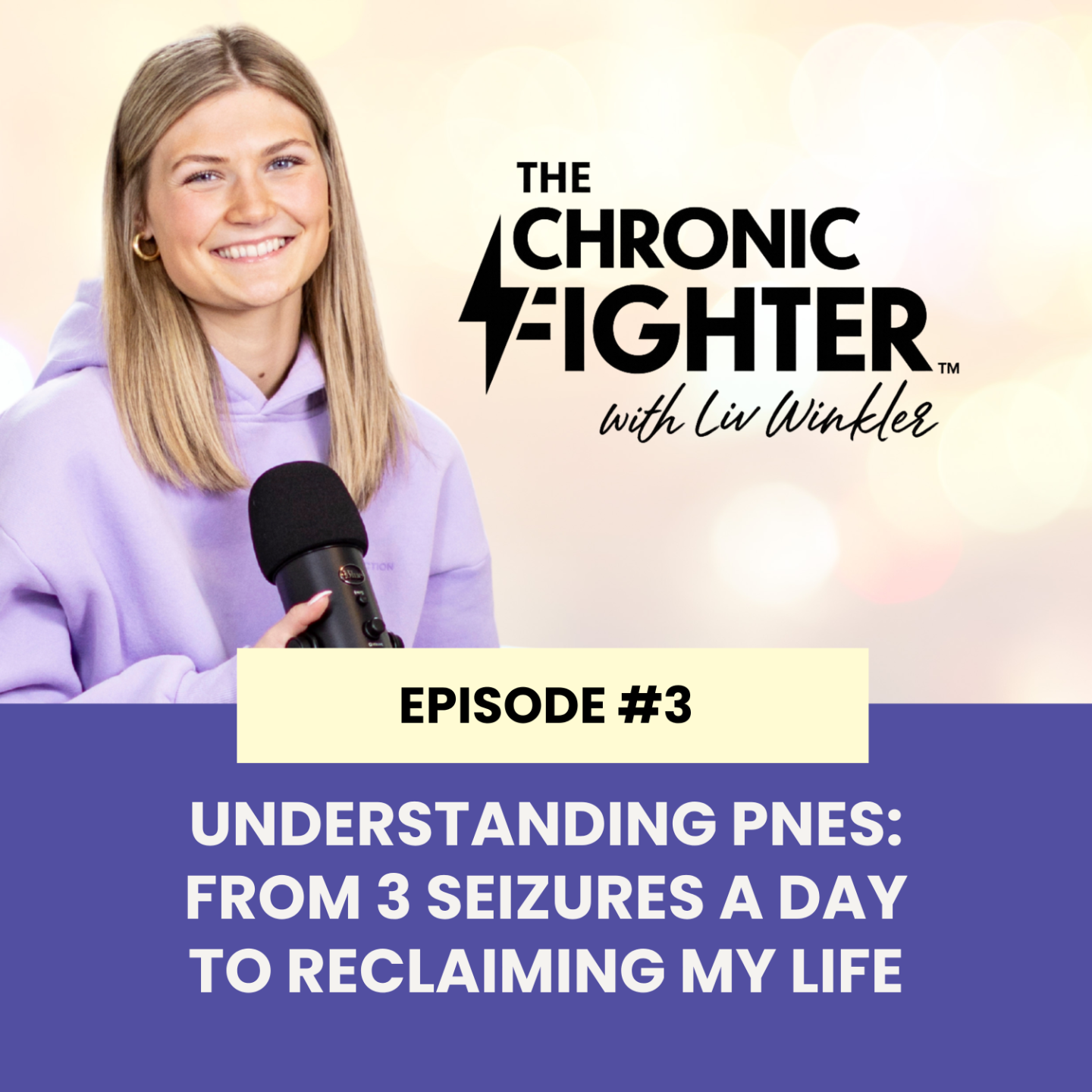
The Chronic Fighter with Liv Winkler
Episode 3: Understanding PNES: From 3 Seizures a Day to Reclaiming My Life
PNES can be confusing, overwhelming, and scary, especially when you're experiencing symptoms for the first time.
In this episode of The Chronic Fighter, I'm sharing my personal experience with psychogenic non-epileptic seizures (PNES), from experiencing three or more seizures a day to rarely experiencing episodes today.
I'll break down what PNES is, how it differs from epilepsy, what was happening in my body during episodes, and the tools and support that played a major role in both my short and long-term recovery. I'll also share what I've learned about navigating unpredictable symptoms without letting them take over my life.
While this episode focuses on my experience with PNES, you don't have to have PNES to take something away from this conversation. Many of the concepts I share around nervous system regulation can apply beyond PNES to experiences like dysautonomia (POTS), anxiety, panic attacks, chronic stress, overstimulation, or feeling constantly on edge.
This episode is everything I wish I had known when I first developed PNES. I hope it helps you better understand what's happening in your body, gives you practical tools to move forward, and reminds you that you are not alone in this.
PNES is real, your symptoms are valid, and there is hope for moving forward.



What You'll Hear in This Episode
01:26 – What PNES is, the different terms used to describe
it, and how it relates to FND
03:41 – My first PNES episode and what it was like
experiencing multiple long-lasting seizures
05:53 – Getting evaluated, EEG testing, and understanding
the difference between PNES and epilepsy
07:00 – Why PNES is real, valid, and not simply "all in
your head"
07:44 – Recognizing my symptoms, auras, and early warning
signs
08:45 – Understanding how both physical and mental
stressors can trigger PNES
09:37 – Why excitement and positive changes can also
overwhelm the nervous system
10:40 – What happens in the body during a PNES episode and
the role of survival mode
11:53 – Why physical regulation can be more helpful than
simply trying to "think positive"
12:37 – Cold exposure, vagus nerve stimulation,
distraction, and other tools I use
15:55 – Breathing exercises, staying calm, and changing how
we respond to episodes
17:05 – Long-term recovery and finding a provider who
understands PNES
18:52 – Resources for finding PNES specialists
19:21 – Addressing underlying health issues, lifestyle
habits, and overall stress
21:36 – The "stress bucket" analogy and why symptoms aren't
always caused by one trigger
22:28 – Learning to live my life without letting PNES
dictate what I can do
24:09 – My experience having PNES in public, while
traveling, and at the airport
25:31 – Practical safety tips and creating a behavioral
response plan
26:22 – Final thoughts and encouragement
Biggest Takeaways
✔ Your symptoms are real. PNES is a Functional Neurological Disorder. Unlike epilepsy, it isn't caused by abnormal electrical activity in the brain, but there is a problem with how the brain and nervous system are functioning.
✔ Think of your nervous system like a "stress bucket." Physical and/or emotional stressors can build up over time, and often it’s multiple things adding up until your nervous system reaches its limit and an episode occurs.
✔ How you respond to symptoms matters. Staying as calm as possible and having people around you do the same can help avoid adding more stress to an already overwhelmed nervous system.
✔ Regulation tools can help both in the moment and over time. Tools like cold exposure, breathing, and vagus nerve stimulation can help when symptoms arise and support regulation between episodes.
✔ Finding the right support matters. A provider who understands PNES can help you make sense of your symptoms and create an individualized plan for recovery.
✔ PNES doesn't have to dictate your life. Learning how to safely navigate symptoms while continuing to get out of the house and do the things you love can be a huge part of taking back control.
Resources Mentioned
The Chronic Fighter: Health coaching, membership, and additional resources: https://thechronicfighter.com
Non-Epileptic Seizures – Find PNES providers by state: https://nonepilepticseizures.com
FND Hope – Support and resources for Functional Neurological Disorder (FND): https://fndhope.org
National Association of Epilepsy Centers (NAEC) – Find specialized epilepsy centers for further evaluation and care: https://naec-epilepsy.org/
Business & Coaching Socials
TikTok: @thechronicfighterco
Facebook: The Chronic Fighter
Instagram: @thechronicfighterco
Threads: @thechronicfighterco
Podcast Socials
TikTok: @thechronicfighterpod
Facebook: The Chronic Fighter Pod
Instagram: @thechronicfighterpod
If You Enjoyed This Episode
I'd love for you to subscribe, leave a review, and share this episode with someone who needs to hear it.
Whether you're living with chronic illness yourself or walking alongside someone who is, I hope this episode reminds you that you don't have to navigate this journey alone.
Thank you for listening, and I'll see you in the next episode.
Your Journey Doesn’t End Here
Explore more episodes of The Chronic Fighter Podcast and continue discovering tools, stories, and support to help you build a life you love—while caring for your body along the way.
Main PodcastTranscript
My parents remember there were times that summer where I was practically in a seizure all day. Multiple seizures, all lasting a long time. I feel disconnected from my body. My head feels like it's spinning. My thinking becomes foggy. My vision gets blurry and I may start to shake. One thing that's been so frustrating for me while navigating PNES is being constantly told to just think more positive and I will feel better. What actually tends to help is calming your body down physically. A helpful way to think about triggers is like a stress bucket. Over time, different things fill that bucket. Chronic stress, illness, trauma, anxiety, pushing through symptoms, not getting enough rest, and eventually it overflows. I went from having three seizures a day to starting my own podcast and business.
Welcome to the Chronic Fighter podcast, where we help teens and young adults with chronic illness take their lives back. I'm your host, Liv Winkler, a health and nutrition coach, founder of the Chronic Fighter health coaching business, lifelong chronic illness girl with a degree in psychology, and concentration in health coaching. This podcast meets you exactly where you're at in your health journey, and offers sciencebacked tools that changed my life and can change yours, too. I would love to be the person for you that I wished I had growing up.
>01:26 Hi, welcome to the Chronic Fighter podcast. I'm your host, Liv Winkler, and today's episode is one I've been especially excited to share with you. It covers the topic I get asked about most is something I've personally experienced and a condition I feel needs more awareness, resources, and support available. We're talking about PNES or psychoggenic non-epileptic seizures. There are many terms used to describe PNES. You might hear it referred to as functional seizures, dissociative seizures, functional dissociative seizures, or conversion disorder with seizures. PNES is also considered a type of functional neurological disorder, often called FND. For simplicity, I'll use the term PNES throughout this episode. Mouthful. Even if you don't experience P&S specifically, a lot of what we are about to talk about can still apply if you deal with other things related to nervous system dysregulation like panic attacks, feeling constantly on edge, heart palpitations, dizziness, or fatigue.
Before we get into this episode, I want to start with a quick disclaimer. I am not a medical professional. Everything I'm sharing is based on my own personal experience and work as a health coach. Please seek professional help from experts in this field. My goal for this episode is that you can make sense of what's going on and hopefully learn ways to move forward because I remember what it felt like in the beginning. When my symptoms first started, my life felt completely on hold. I felt alone, confused, and scared. It honestly felt like I would never get back to a normal routine. But today, I'm happy to say I rarely experience episodes and I feel more in control of my health and my life. And that shift didn't come from one big fix. It came from learning new tools, understanding my symptoms, and figuring out how to better support my body. And that's what I want to help you start doing, too.
03:41 I don't remember my first P&S episode, but my mom does. It was a summer in between freshman and sophomore year of college, so I was back at home with my parents. I was sitting in the living room watching a show when I told my mom I felt off. She went to make me a smoothie, thinking I may just need some fuel. She handed it to me and went back into the kitchen to clean up. My mom walked back into the room and found me passed out. My entire smoothie spilled all over my shirt in the couch, my body shaking like a leaf and my eyes rolling back. I was unresponsive and completely unaware of my environment and what was happening to me. It's hard for me to even think about this because at the time my mom had no idea what was happening to me. So I can only imagine how scary this was for her to witness.
That first non-epileptic seizure lasted around 25 minutes. 25 to 45 minutes is a typical length for me, but it depends on the person. As I came out of the episode, everything was blurry and I was unable to communicate at first. I would describe that feeling after the seizure is similar to having a very bad migraine where it feels like you're just kind of out of it and not fully present. My mom ended up calling her friend, who's a doctor, to come evaluate me during the seizure, and her friend did a quick assessment and told us it appeared to be PNES. That was the start of us learning about this illness. We had never heard of it before. That moment marked one of the hardest seasons of my life. My parents remember there were times that summer where I was practically in a seizure all day, multiple seizures, all lasting a long time.
My heart goes out to any of you who are experiencing PNES for the first time. If you're in a place like that right now, I just want to say I get how overwhelming, miserable, and scary it is. But I want you to know that is not where you stay. Because one of the biggest things that changed everything for me was understanding what was actually happening in my body. And with that knowledge and the right support, my seizures became way less frequent and long-lasting. I'm in such a better place right now.
05:53 If you're experiencing seizure- like symptoms, the first step is always medical evaluation. PNES can look and feel very similar to epileptic seizures. So, it's really important to rule out epilepsy or other neurological conditions. This is typically done by seeing a neurologist and completing testing such as an EEG, which measures the electrical activity in the brain using electrodes placed on the scalp. There are different types of EEGs depending on how long they record and whether video is included. Video EEG monitoring which records both brain activity and video at the same time is considered the gold standard for distinguishing between epilepsy and PNES. I went through this process myself. I worked with neurologists and underwent EEG testing at Mayo Clinic in Rochester, Minnesota. and it provided a lot of clarity for me as to what was happening to my body.
With epilepsy, seizures are caused by abnormal electrical activity in the brain. PNES is not caused by abnormal electrical activity in the brain. Therefore, it is considered non-epileptic. 07:00 And I want to pause here to say that just because PNES is non-epileptic does not mean it isn't real. I've had so many people reach out to me saying they weren't believed, that they were told their symptoms were just anxiety or all in their head. But PNES is a very real neurological disorder. It's classified as functional neurological disorder or FND like I had mentioned earlier. In FND, brain scans and other tests often show no structural damage causing the symptoms, but there is a problem with how the brain and nervous system are functioning. Non-epileptic seizures are generally non-life-threatening, but safety is still essential. You should always get to a safe place, especially if symptoms come on suddenly.
07:44 For the first year of having PNES, my symptoms were mostly showing up in the form of seizure, but today I rarely have full seizures. I experience what I describe as a weird feeling or a dizzy spell, sometimes referred to as an aura. This often occurs when I'm feeling overstimulated. I feel disconnected from my body. My head feels like it's spinning. My thinking becomes foggy. My vision gets blurry and I may start to shake. This actually happened the other day while my mom was talking to me. I was looking right at her, but I couldn't fully stay present in the conversation. I struggled to respond and eventually needed to step away to take a break. Later, I realized my body had simply been on overload that day, which hadn't happened for a while. These are some of my common symptoms, but pianas can look completely different for everyone. For example, people may experience loss of awareness, muscle stiffness, weakness, eye fluttering, brain fog, racing heart, shortness of breath, difficulty speaking, or unsteadiness.
08:45 Another confusing thing about the disorder PNES is that it has the word psychoggenic in the title. So, a huge misconception is that PNES is all mindset and mental. PNES symptoms can be triggered by mental stress like dealing with grief, learning a new job, or worrying about a test. But PNES can also be caused by physical stress like a physical illness. PNES can be due to just mental, just physical, or a combination of both stressors. I had the worst PNES symptoms when I had undiagnosed Crohn's disease. Chronic illnesses like Crohn's often go hand in hand with P&S. When your body doesn't know how to handle stress it is experiencing, it reacts in a physical way like P&S seizures. My P&S is also worse on my cycle when I have a cold or if I accidentally eat gluten as a celiac.
09:37 Something that surprises a lot of people is that P&S can unfortunately also be triggered by excitement like a birthday party, a big event, or being around a lot of stimulation. It can activate your nervous system in a similar way to stress. A personal example of this for me was when I flew across the country to surprise my childhood best friend at her soccer game. I had so much builtup excitement that my body went into overdrive. My system responded to that surge of activation and adrenaline the same way it would a stressful situation and I ended up having a PNES episode the next day. And this doesn't just apply to excitement. Even positive changes in your life, like starting a new medication or supplement, introducing a different diet, or changing your routine, can still be a lot for a sensitive system to adjust to. I've learned to take things really slowly, slower than most people need to. That's just what works best for my body, and my providers are aware of my P& so they can factor that in when we make changes.
10:40 So, what is happening when you experience a PNES episode? while your nervous system becomes overwhelmed and disregulated and your body shifts into survival mode. There was a Tik Tok trend going around where people would say things like, "My nervous system doesn't know the difference between running from a bear and going to a doctor's appointment." And honestly, that's a really accurate way of thinking about it. That's essentially what's happening with P&S. Your body is reacting as if you're in danger, even when there isn't a real threat present. So, even though it feels like your body is working against you, it's actually trying to protect you. It's just misfiring.
This is when your fight orflight response kicks in. You're flooded with stress hormones like adrenaline and cortisol. Your heart rate increases and your body temperature rises. Your body even redirects blood flow to the areas it needs for survival like your muscles, heart, lungs, while pulling resources away from things like digestion. That's why being stuck in a prolonged fight orflight state can affect so many different areas of your health. People may experience digestion issues, fatigue, dizziness, muscle tension, sleep problems, and other symptoms because their body is constantly prioritizing protection over restoration.
11:53 One thing that's been so frustrating for me while navigating PNES is being constantly told to just think more positive and I will feel better. And while mindset absolutely matters for overall health, that's usually not what stops a P&S episode. What actually tends to help is calming your body down physically, especially once symptoms have already started. Trying to talk yourself out of it mentally can actually make it harder to come out of that state. The goal is to bring your body out of the fight orflight state and into a regulated safe state, what we call the parasympathetic state or rest and digest.
Let's talk about immediate tools you can use during the start of a P&S episode and then we'll get into tools for everyday use. You'll see some overlap between the two. For me,12:37 one of the most effective tools has been cold exposure. If I feel symptoms coming on, I'll use ice like on my wrists or an ice cap, and it can lower my heart rate really quickly. Cooling your body is a strong signal of safety to your nervous system.
If you're listening to this podcast, chances are you have felt overwhelmed trying to figure out chronic illness. I know I did. That's exactly why I created The Chronic Fighter, because no one should have to figure this out alone. At the chronicfighter.com, you'll find one-on-one coaching and a community designed to help teens, young adults, and parents navigate the challenges of chronic illness. My parents and I spent years trying to make sense of my health on our own, researching, connecting the dots, implementing lifestyle changes, advocating, and searching for answers. Experts estimate that 80 to 90% of health care happens outside of the doctor's office. And that was certainly true in my experience. Growing up, I would have given anything to have someone who truly understood what I was going through. Someone to show me that I could work with my body and still build a meaningful life. Through one-on-one coaching, I help bridge the gap between the doctor and patient. Because managing chronic illness involves so much more than what happens during appointments. Together, we focus on symptom management, nervous system regulation, sustainable habits, and practical strategies that help you feel more in control of your health and your life. If coaching isn't the right fit right now, or you'd like support alongside it, the Chronic Fighter membership offers flexible access to tools, education, and a community of people who get it without a rigid schedule or pressure to keep up. No matter where you are in your health journey, I'd be honored to be a part of it. Visit the chronic fighter.com to learn more.
There are also other tools you can experiment with. Distraction can help, like simple games, word searches, or watching something familiar. Maybe a comfort show you've seen many times so you don't have to think much about what's going on. Talking to someone you feel safe with, listening to music, a weighted blanket, or even using strong sensory input like sour candy can help shift your state. Non-invasive vag nerve stimulators like sensate or trvega can be very powerful tools, too. The vagus nerve runs from our brain stem to many of our major organs, including the heart, lungs, stomach, and intestines. Activating the vagus nerve can help support nervous system regulation, allowing the body to shift more easily into a rest and digest state rather than staying stuck in survival mode. You can try using this tool at the start of symptoms, but many people also find it helpful to use them consistently, often one to three times a day, depending on the device and their individual response to maintain a calmer and more regulated nervous system. Think of it like an exercise for your nervous system. The benefits often come not just from using it during a flare, but from practicing regulation on a regular basis.
15:55 Breathing techniques can be helpful, too, but usually only if you catch symptoms early, and that takes practice over time. But being proactive and incorporating breathing exercises into daily routine can help your body regulate and prevent future seizures. Another huge piece of this is how you and the people around you respond when symptoms happen. The more fear and panic involved, the more it reinforces to your body that something is wrong. So, the goal is to stay as calm as possible. If you can get yourself to a safe place, but don't make it a big dramatic situation. Even mentally, try to downplay it. Instead of fear, think of it as something annoying but manageable. Remind yourself, "I am safe. This will pass." And if you're with other people, it really helps if they stay calm and reassure you're safe and okay, too.
Everything we've talked about so far, ice, vag nerve stimulation, distraction, breathing exercises, and other regulation tools, can be incredibly helpful when symptoms are happening or starting to come on, but as I mentioned, can also be implemented in between episodes to feel more grounded and manage overall stress.
17:05 Recovery is about more than getting through an episode in the moment. It's about helping your nervous system become less overwhelmed over time so episodes happen less frequently and have less control over your life. Until developing P&Es, I didn't realize how much stress my body had been carrying. I developed PNES when I was 19 years old after a lifetime of navigating chronic illness. I believe that my PNS stems from years of physical and mental trauma related to undiagnosed disorders, health anxiety, feeling so different from others, and most of all, a lot of physical pain.
One of the biggest turning points in my recovery was finding a PNES provider in my area. She helped me understand what was happening in my body, develop strategies for managing symptoms, and create a plan for moving forward. When we first started working together, we focused on immediate tools and strategies to reduce the frequency and intensity of my symptoms. Over time, we shifted toward the longer term work to process difficult health experiences, reduce health anxiety, learn how to feel safe in my body, and better care for my body. So, it didn't get to the point of PNES symptoms. Much of what I know about PNES today came from working with her, and she played a huge role in getting to a much better place with my health.
One of the first steps in recovery is having the diagnosis explained in a way that the patient can truly understand. Unfortunately, when providers are unfamiliar with PNES or don't know how to implement an appropriate treatment plan, people may struggle to improve and can sometimes experience worsening symptoms. That's why it's so important to work with a therapist, neurologist, or other health care professional who is familiar with PNES, or better yet, an expert in PNES who knows how to help parents navigate it effectively. 18:52 I will link a few resources in the show notes that you can check out to try and find one in your area. I use non-epileptic seizures.com. They list the PNES providers by state. Just know it's not a complete list, but it's a really helpful place to start. I've also heard of another site called FND Hope. I'm not as familiar with that one, but it's more broad and covers functional neurological disorders as a whole, not just PNAS, but that could be another place to look.
19:21 Another major piece of my recovery was understanding the role stressors were playing in my symptoms. Prior to therapy, I didn't realize physical stressors could be just as significant and in my case, even more significant than emotional stressors. It made a big difference for me to understand that my physical health was impacting my PNES episodes and to rule out any serious underlying medical issues. In the beginning of experiencing episodes, I remember always wondering in the back of my mind, am I going to be okay? This feels scary. Is everything working right? What if something is dangerous? What if this time I'm not okay? I mean, it mimics an epileptic seizure. So, it's difficult at first not to have these thoughts. But once I got evaluated by doctors to make sure I wasn't missing anything else, it became a lot less scary. I knew I was safe. My body was simply misfiring and making mistake and I would always get through the episodes. If there's a possibility of other unadressed physical issues, it might be harder for you to feel in control with the unknowns.
Like I mentioned earlier, my symptoms were at their worst when I had undiagnosed Crohn's disease. My body was under constant stress and had significant inflammation. I wasn't eating enough. I was in pain and I was exhausted. But once my physical health improved, my PNES symptoms improved drastically, too. Now, I rarely experience episodes. PNES is often a sign that your nervous system is carrying more stress than it knows how to handle. My symptoms also get worse when I haven't eaten enough, when I'm low on sleep, when I'm sick, or when I'm out of a normal routine. Lifestyle habits matter more than you might think. Things like eating regularly, staying hydrated, getting enough sleep, gentle movement, and pacing your energy all play a huge role in supporting your nervous system. It can also be important to incorporate mindfulness practices such as meditation, listening to music, journaling, and breathing exercises. Over time, these practices can reduce the likelihood that stress manifests as physical symptoms. These aren't necessarily tools you'll use when you feel a seizure coming on, but they can help lower your overall stress load and make episodes less likely in the future.
21:36 A helpful way to think about triggers is like a stress bucket. Over time, different things fill that bucket. Chronic stress, illness, trauma, anxiety, pushing through symptoms, not getting enough rest, and eventually it overflows. And when that happens, your body may trigger a shutdown response, which can look like a seizure. This is your body saying, "I'm overwhelmed. I need to protect you." The bucket analogy really helped me understand the bigger picture. Before learning about this, I was always trying to figure out what caused each seizure after it happened. And a lot of the time, it didn't make sense. I couldn't point to just one clear trigger. But now it makes sense. When I think about my bucket, I can see things were building up over time. It often wasn't just one thing. It was everything adding up until my body finally hit its limit. There's usually one last thing that puts me over the edge, but it isn't the only cause.
22:28 As far as P&S affecting your everyday life, you have the ability to take back control. It may not feel like it, but I promise you, with the right knowledge and tools, you can. As intimidating as it is, one thing that really helped me with my P&S symptoms was not letting the fear of having episodes in public keep me from getting out of my house. You have to train your body to know that if it happens, it isn't the end of the world. And PNES won't dictate your life. Have a plan for if it happens. If you need to deal with it, do it. But then continue on with whatever you're doing. Maybe you have a plan to go to the bathroom or your car. Warn your friends before going out. The retraining takes time, but as soon as you give into your body and let it dictate everything you do, you get stuck in an endless cycle. Of course, don't drive or do anything that puts you in a dangerous position if you don't feel like you're in the right state, but don't be afraid to still live your life.
Obviously, it's not fun to deal with symptoms, especially in public. But in my experience, staying home signal to my nervous system that home was the only safe place. Going out and about helped teach my nervous system that I could be safe in other environments, too. For me, still engaging in life and doing the things I love was an important part of my recovery. Over time, you begin to learn your body's cues, recognize your triggers, and figure out what helps you get out of that P&S state. The more you can pay attention to things, maybe by journaling, work with professionals, and educate yourself, the easier it gets.
Trust me, there was a time when I was experiencing three or more seizures a day, multiple happening in public. And as much as I wanted to stay in bed because that was easier for me, I continue going out of the house because I didn't want the illness to win. 24:09 For example, during that time of frequently having seizures, I still decided to go on our big family vacation to Hawaii that we were all so looking forward to. I ended up feeling a seizure come on in the airport while we were eating before our flight out. I snuck away and locked myself in the bathroom stall and texted my mom to let her know what was happening. I'm always good about getting somewhere private and safe when I feel a dizziness spell coming on. My mom found me minutes later and she was calm in a sense because she knew I'd be okay, but still a little concerned because obviously it's an uncomfortable situation and we had a flight to catch. She ran through a backup plan on what to do if she and I had to catch another flight. But luckily, I was able to get out on time and somehow made it on the plane. That day was an example that it's better to miss a flight and delay our vacation than to not go at all. Did it suck? Of course. But I'm so glad I made it to Hawaii because that was one of my favorite memories.
There have also been moments when I've been with friends and had that weird feeling come on and I had to excuse myself and go to the bathroom for 20 minutes to either get myself out of the spell or go through the seizure and get back out there. My friends have been there for me asking what they can do, but it's usually something I handle on my own. and they know that it's something I experienced, so they don't panic and they're good about including me again when I join the group afterwards without making it a big deal.
25:31 To help with going out in public with PNES, these are some practical things I recommend doing. Add PNES information to your phone's medical ID. Be open to telling your close friends, family, teachers, and co-workers about your seizures so they know how to respond if an episode occurs. Teach them how to stay calm and support you during an episode. When I first developed PNES, my therapist helped me create a behavioral response plan that I shared with my family, so they knew exactly how to help me if my seizures occurred. You probably can also have your provider create a seizure response plan for school, work, sports, or other environments where an episode can happen. This can prevent unnecessary panic and make situations feel much safer. I saw a huge shift in my parents once they understood my condition and knew how to support me during an episode.
26:22 I'm hoping as this episode comes to a close that you feel less alone and have some new insight and tools to try out. Just know P&S is real. Your symptoms are valid. And you don't have to stay stuck. You can understand your body. You can feel in control again. And you can live your life without constantly fearing the next episode. I'm here for you and my DMs are always open. You can find my health coaching contact information on my Instagram, the chronicfighter co. As well as my website, the chronicfighter.com. I'm so grateful you're here and I'm so proud of you. I'll talk to you next episode.
Thank you for listening to the Chronic Fighter podcast. I am so grateful you're here. Whether you're navigating chronic illness yourself or learning how to support someone who is, I hope today's conversation resonated with you. Don't forget to follow us on social media at the Chronic Fighter Co. and the Chronic Fighter Pod and check out our website the chronicfighter.com. Remember to celebrate the little wins and have something that gets you excited to get out of bed every day. I'll see you next time.