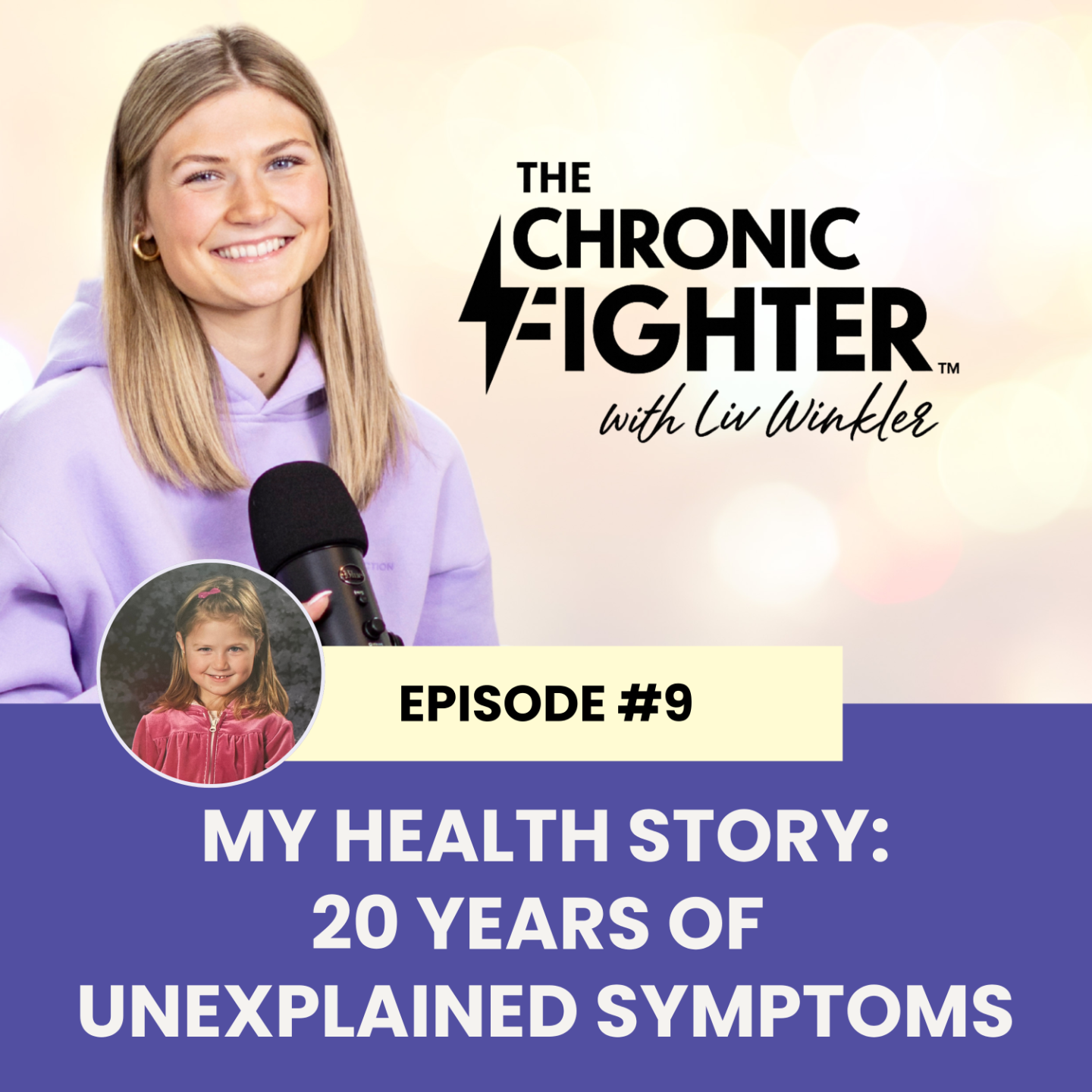
The Chronic Fighter with Liv Winkler
Episode 9: My Health Story: 20 Years of Unexplained Symptoms
“You’re a Complicated Case”
For most of my life, I knew something was wrong with my body, but finding answers was anything but simple.
We figured out I had celiac disease at five years old, but that was only the beginning. For the next two decades, I dealt with unexplained symptoms, countless medical appointments, tests that came back normal, and periods when I was too sick to participate in everyday life.
In this solo episode of The Chronic Fighter Podcast, I'm sharing my health story in more depth than I ever have before. From missing weeks of school as a child to playing college soccer with POTS, experiencing multiple PNES seizures a day, and eventually becoming bedridden after graduating from college, I walk through the experiences that shaped my life.
I also share how I was eventually diagnosed with Crohn's disease and a hypermobility disorder, what it took to begin rebuilding my life, and how those experiences led me to create The Chronic Fighter.
I spent so many years asking, "Why me?" I may never have a complete answer to that question. But I can decide what I do with everything I've been through.



Chapters
00:00 Coming Up
02:20 My Health Story & Two-Decade Search for Answers
03:14 Growing Up Sick & Missing School
05:28 Becoming Bedridden at 12 Years Old
06:49 Worsening Symptoms, Severe Anemia, & Unanswered Questions
08:58 Fainting Episodes & Being Diagnosed With POTS
10:47 Playing College Soccer With Chronic Illness
12:00 Developing PNES & Experiencing Multiple Seizures a Day
16:36 Bedridden Again & Discovering Hypermobility
18:30 Finally Being Diagnosed With Crohn's Disease
19:27 Brain Fog & Unable to Handle Any Kind of Stimulation
22:24 Slowly Rebuilding My Life
Episode Highlights
✔ Normal test results don’t always mean nothing is wrong. When you’re experiencing debilitating symptoms, repeatedly being told everything looks normal can be incredibly discouraging.
✔ Chronic illness can affect every part of growing up. Missing school, managing symptoms, keeping up with friends, and trying to participate in sports or other activities can be difficult when your health is unpredictable.
✔ Multiple conditions can overlap and make finding answers more complicated. Understanding how my different diagnoses affected one another helped us begin connecting pieces of my health story.
✔ Getting a diagnosis doesn’t always mean getting effective treatment. Having a name for a condition is important, but finding providers who understand it and can help you manage it is another challenge.
✔ Recovery doesn’t always happen all at once. After being bedridden, I had to gradually rebuild my ability to tolerate everyday activities, socializing, and being out in the world.
✔ Accepting chronic illness doesn’t mean giving up. I’ve learned that I can respect my limitations, adapt my lifestyle, and continue working toward my goals without waiting for my health to be perfect.
Resources Mentioned
The Chronic Fighter: Health coaching, membership, and additional resources: https://thechronicfighter.com
Business & Coaching Socials
TikTok: @thechronicfighterco
Facebook: The Chronic Fighter
Instagram: @thechronicfighterco
Threads: @thechronicfighterco
Podcast Socials
TikTok: @thechronicfighterpod
Facebook: The Chronic Fighter Pod
Instagram: @thechronicfighterpod
If You Enjoyed This Episode
I’d love for you to follow the podcast, leave a review, and share this episode with someone who may need to hear it.
If you can relate to any part of my story, I hope this episode makes you feel a little less alone in what you’re going through.
Thank you for listening, and I'll see you in the next episode.
Your Journey Doesn’t End Here
Explore more episodes of The Chronic Fighter Podcast and continue discovering tools, stories, and support to help you build a life you love—while caring for your body along the way.
Main PodcastTranscript
Obviously, you don't want a doctor to tell you that you have some horrible disease, but when you know something is wrong with you, hearing everything looks normal over and over again doesn't feel like good news anymore. It starts to feel devastating. I went from having three seizures a day to starting my own podcast and business. Welcome to the Chronic Fighter Podcast, where we help teens and young adults with chronic illness take their lives back. I'm your host, Liv Winkler, a health and nutrition coach, founder of the Chronic Fighter Health Coaching Business, Lifelong Chronic Illness Girl with a degree in psychology and concentration in health coaching. This podcast meets you exactly where you're at in your health journey and offers science-backed tools that changed my life and can change yours too. I would love to be the person for you that I wished I had growing up. I have had health issues for as long as I can remember. When I look back on my life, I'm flooded with gratitude for all of the memories, experiences, and people who have brought me so much joy. But no experience was completely symptom-free or completely worry free. Because at every single stage of life, through every memory, I have always had to be intentional about my lifestyle choices in order to live at my best. Some of my earliest memories are being terrified to eat. And I don't mean being a picky five-year-old who didn't want to eat her vegetables. I mean actually being scared to put food in my mouth because I knew there's a chance I'd end up curled up on the floor screaming in pain. At any age, worrying about every little thing you eat is stressful, and I was only in kindergarten. My parents were desperately trying to figure out what was wrong with me. They removed basically every known allergen from my diet, and while my diet became less restrictive over time, I remained gluten and dairy free from that point forward, and I eventually learned I have celiac disease. I went through tests that no kid should even know exist, including having my first colonoscopy when I was again only five. I ended up in the ER more times than I can even remember, and over and over again we'd leave without an answer. This was just the beginning of my two decade search for answers to my mystery symptoms. Hi, welcome back to the Chronic Fighter Podcast. I'm your host, Liv Winkler. I'm several episodes into this podcast now, and I realized I've talked about pieces of my story along the way, my parents' perspective of raising me, my disorder PNES, my seasons of being bedridden, sports with chronic illness, and friendships and dating with my conditions, but I've never actually sat down and given a more in-depth explanation of my health story. And honestly, it's hard to even know where to start because for most of my life it felt like I had so many different issues, and it felt like there was always something wrong with me that nobody could explain. And that of course was hard on me mentally. This was most likely the beginning of my anxiety. But how could you not be anxious, worrying all day, every day about what you can eat and if you're going to get sick? Those stomach issues went on as a young kid all the way to adulthood. And stomach issues are just the worst. They're hard to diagnose, the testing sucks, and when doctors couldn't figure out what was causing mine, they basically decided it was anxiety. My pediatrician wanted me to go to a therapist, and my parents weren't against therapy at all. They just didn't believe anxiety was the main reason their kid was screaming on the floor in pain. It was a result of the physical pain I was enduring and how that was affecting every area of my life. It wasn't just kindergarten. I got sick a lot growing up. And it didn't matter what I had, a cold, strep throat, whatever, I'd miss at least a week of school. My body just didn't bounce back like other kids' bodies did. On average, I probably miss four or five weeks of school every year. And this was also hard on me mentally. I actually loved school, which made missing even harder. I just wanted to be like every other kid my age. I wanted to live a normal, average life so bad. I didn't want to be different. And going back after I'd been gone for a week or more was awful. And this may be hard to believe if you've seen my posts or listened to my podcast, but I hate being the center of attention. When you've been gone that long, you don't exactly get to just quietly slip back into class. I'd walk in and feel like everyone is looking at me. Kids would whisper, "look who's finally back, What was it this time? She likes skipping, I wish I could miss school too." I'd have to walk up to my teacher in front of everyone and get this giant pile of work I'd missed. Every day I was home sick, I knew more work was piling up. Then I'd finally go back when I still didn't feel that great, and somehow I was supposed to do all the new assignments, catch up on everything I'd missed, and get myself back to soccer practice, which was my biggest motivator to get better. I'd stay up late with my parents trying to catch up, then I'd get run down, then I'd get sick again and miss more school. It felt like this cycle I could never get out of. And again, the majority of my symptoms couldn't be explained. So we didn't even have these answers as to why I was feeling the way I was, or advice on what to do. The biggest thing that helped throughout the years was just learning my body's signals and taking care of myself with enough sleep, nutrition, hydration, and so on. In sixth grade I hit a wall. I had already missed weeks throughout the school year, and then I ended up missing the last six weeks entirely. I was basically bedridden at 12 years old with a migraine that wouldn't go away, light sensitivity, dizziness, stomach pain, the bizarre feeling like something was stuck in my throat, extreme fatigue, and I was barely eating. Doctor after doctor couldn't find anything that explained why I felt as awful as I did. And that's a really lonely place as a kid. You're sick enough that you can't live your normal life, but apparently not sick in a way anyone can explain. My parents continued to fight for me, but I'm sure they wondered if something was really going on or not too. Eventually my parents took me to a functional medicine doctor. She did genetic testing and put together this huge supplement protocol based on my results. And somehow over the next few months I started getting better. And honestly, this probably was the first time in my life that I was given some kind of treatment plan. At least that actually worked. I was taking a ridiculous number of supplements though, which became its own battle as a middle schooler. At that age, I didn't understand why I had to think so much about something that most kids my age didn't even have to consider. After a few pretty good years, I started begging my parents to let me stop taking so many supplements. Because when you finally feel good, it's really easy to forget how bad bad actually was. And I was just a kid. I didn't want my entire life to revolve around what was wrong with me. Then ninth grade came and things started going downhill again. And to be clear, the years I'm not mentioning were not just like a walk in the park. They were better, relatively speaking, than the years I'm mentioning. Ninth grade, I was getting so sick all the time. My stomach pain was back, the dizziness was back, it just felt like symptoms were piling up again. We ended up finding another functional medicine doctor closer to home, and he ran a bunch of blood work. And finally something actually showed up. I was severely anemic. My hemoglobin was 9.4, and my ferritin or iron stores was six. Growing up, I always struggled to keep weight on. I've always been really tall and thin my whole life. Another thing people have always commented on, not knowing any of the major things I was dealing with. And I've always been a big eater, so that was never the issue. The problem was that my body couldn't properly absorb and maintain the nutrients I needed, which was a huge contributor to my anemia. The levels were so concerning that he sent us to Mayo because we needed to figure out why. My uncle has Crohn's, so that was one of the things they were looking for, which meant another colonoscopy and endoscopy at 14. Going to Mayo, doing the awful prep, being surrounded by people way older than me, all of it was just so hard for me. And all of that for what? Nothing. The colonoscopy showed nothing. The endoscopy showed nothing. My EKG was normal. Nothing explained why I felt the way I did other than the fact that my iron was extremely low. I remember telling my parents, I'm done. I'm not doing any more tests, I'm not going to any more doctors, no one ever helps me, so why do I keep going and putting my already sick body through this? I think this is hard to fully understand unless you've lived it. Obviously, you don't want a doctor to tell you that you have some horrible disease, but when you know something is wrong with you, hearing everything looks normal over and over again doesn't feel like good news anymore. It starts to feel devastating. Because if everything is normal, then why do I feel so bad? No one has ever figured out why my iron got so low either. I took a ton of iron supplements, eventually started feeling a little better, and was finally able to gain some weight. Tenth grade was actually a pretty good year for me, but then in 11th grade, weird things started happening again. I started fainting. One time my mom was walking down the hallway toward me and apparently I was making these weird faces. She thought I was just goofing around and then I passed out and pulled a floating shelf all the way off the wall onto me. Everything from the shelf came crashing down and I was about a foot from the top of our stairs. My parents took me to the ER and we were told, wait for it... I was just dehydrated. Classic. Then the episodes got scarier. One day I was sitting in a high top chair at home studying. My parents heard a loud crash and found me on the floor, my entire body shaking. I could hear them and I was conscious, but I couldn't respond to them and I couldn't talk. I cannot explain how scary it is to be trapped inside your own body like that. My parents called a close friend who's an internal medicine doctor and she thought it sounded like pots. This was during the height of COVID, so she told us not to go to the ER unless we absolutely needed to. Now not only was I terrified that this could happen again at any time, but we also felt like we couldn't even go to the ER if it did. A few weeks later though, I had another episode that was so severe my parents took me anyway. I was shaking pretty bad and I couldn't walk. I was terrified and my parents were terrified. I eventually had a tilt table test and tested positive for POTS. Finally a diagnosis. Except the cardiologist basically told us that he didn't know much about POTS and nobody in Duluth really specialized in treating it. So I finally had a name for something that was happening to me, but that didn't mean anyone knew how to make it stop. And somehow, honestly, sometimes I don't even know how, I still moved three hours away for college and played soccer there. I worked so hard to make that happen. My functional medicine doctor gave me some supplements to try to help with pots, and my lifestyle was incredibly strict because I knew what happened when I stopped taking care of myself. But I wanted to go away to college like all of my friends, and I wanted to play soccer. I just wanted a normal life. Freshman year was my best health year in college, which was surprising because it was such a huge transition for me. Sophomore year though, things started tanking again. Stomach issues came back, the dizziness, the fatigue. All of it was creeping back in, even though I was doing everything I thought I was supposed to be doing. Then I had another really scary episode. I was home for the weekend from college, but my parents were a few hours away watching my brother play hockey. I was with some friends when the side of my face went numb, and I started having other weird sensations. We honestly thought I might be having a stroke. My friends rushed me to the ER, my parents drove back and met us there, and once again, nothing. They couldn't find anything. And again, I didn't want to find a stroke or something horrible. I just wanted somebody to explain why my body kept doing scary things that nobody could explain. Looking back now, we think that this was probably related to my POTS, but at the time we had no idea. There were times I questioned why I was going through so much. And it was scary. I didn't feel like I was in control and I didn't know when or if something new would happen to me, like it always seemed to. And this was all before the scariest experiences had even happened yet. I came home for the summer after my sophomore year of college and started having what looked like full blown seizures. I'd been through a lot by then, but nothing scared me like these did. During them I genuinely felt like I was dying. I'd lose control of my body, go in and out of consciousness, couldn't speak, and felt paralyzed. They could go on for 45 minutes or longer. The first time it happened, my parents called their doctor friend and she rushed over to our house while I was still in the middle of it. She told us it looked like something called PNES or psychogenic non epileptic seizures. We had never heard of it before, but of course my parents immediately started researching everything they could find. That summer was absolute hell. I was scared to go to work because what if I had a seizure at work? Somehow my body would get me through the shift though, and I'd barely make it through the door at home and then crash on the couch and have a seizure. It was like my body knew it had to hold itself together until I got somewhere safe. After each episode, I felt like I'd been run over by a bus. I kept having more and more seizures. Some days I'd have three or more. At that point it felt like I was either having a seizure, recovering from a seizure, or waiting for the next one. My life felt completely out of control and I had no idea when it was going to end, or even if it was going to end. My parents found two PNES specialists in Minnesota. One wasn't taking new patients and the other had a waiting list. When you're having multiple seizures a day, three months feels like forever. But eventually I was able to start seeing her over Zoom. And honestly, I don't know if I would have gotten my life back without her. I did a whole episode on PNES and what I did to recover, so I'm not going to go super deep into all of this on here, but if you're interested, it's my third episode. You can go back and watch it. If you're listening to this podcast, chances are you have felt overwhelmed trying to figure out chronic illness. I know I did. That's exactly why I created The Chronic Fighter. Because no one should have to figure this out alone. At thechronicfighter.com, you'll find one-on-one coaching and a community designed to help teens, young adults, and parents navigate the challenges of chronic illness. My parents and I spent years trying to make sense of my health on our own. Researching, connecting the dots, implementing lifestyle changes, advocating and searching for answers. Experts estimate that 80 to 90% of healthcare happens outside of the doctor's office. And that was certainly true of my experience. Growing up, I would have given anything to have someone who truly understood what I was going through. Someone to show me that I could work with my body and still build a meaningful life. Through one-on-one coaching, I help bridge the gap between the doctor and patient because managing chronic illness involves so much more than what happens during appointments. Together, we focus on symptom management, nervous system regulation, sustainable habits, and practical strategies that help you feel more in control of your health and your life. If coaching isn't the right fit right now, or you'd like support alongside it, the Chronic Fighter Membership offers flexible access to tools, education, and a community of people who get it without a rigid schedule or pressure to keep up. No matter where you are in your health journey, I'd be honored to be a part of it. Visit the Chronicfighter.com to learn more. After the summer of having seizures practically every day, I somehow made it back to college for my third and final year. The beginning of this year was really tough for me. For the first time in my life, I was forced to be done playing soccer because I couldn't play on my torn labrum anymore. It had been three years playing on that, and I'm sure by that time it had torn more. Soccer was a huge part of who I was, and it was my outlet. I played with my best friends and probably felt most like myself on the field. Because of my PNES therapist, I was getting somewhat of a handle on my seizures, but my stomach pain was getting so bad that I could barely eat again, and the dizziness and fatigue were debilitating. Even my PNES therapist started saying, I think we're missing something physical. I was doing what she taught me and my body was still falling apart. She kept encouraging me to get to the bottom of it. Otherwise she didn't think that the PNES seizures would ever completely stop with the ongoing pain I was experiencing. My parents kept thinking that maybe once I graduated things would finally settle down. They noticed from a young age that stress would affect me physically, so they thought that once the stress of school was over, my health would improve. The exact opposite happened. I graduated from college and became bedridden. I couldn't eat without extreme pain, sometimes too dizzy to walk to the bathroom or take a shower, and my seizures increased again. My parents just couldn't watch it anymore. So they found a functional medicine doctor out East who works with really complex patients, and we decided to go. More testing, more doctors, and more hoping that this person would finally be the person who could put all the pieces together. He felt that one of the bigger pieces we had been missing was a rare condition, of course it is, called HEDS or HSD, a hypermobility disorder that can affect connective tissue throughout the entire body. Therefore it can affect multiple systems of the body. And suddenly some of those completely random things I dealt with my whole life didn't feel quite as random anymore. And then testing also pointed strongly towards Crohn's disease. After years of being told nothing showed up, I finally had a doctor saying, no, something is actually wrong. It was amazing actually having reasons for my extreme symptoms and pain. But getting those diagnoses didn't mean I immediately got better. I still had to come home and wait months to get into local specialists, still at my absolute lowest. I continued to be hardly able to eat. I was so dizzy I could not leave my bed without feeling like I was going to fall over. Showering was extremely difficult for me. My legs turned blue from blood pooling while I stood. I was hypersensitive to any light, so I stayed in my cave of a room. And finally, my stomach pain just became unbearable, and I ended up going to the ER even though I really didn't want to. At that point, I'd had so many experiences where I went to an ER desperate for help and left feeling like nobody did anything for me. But I was so desperate. And not to mention how bad it was for my body to not be fueling enough. I knew I should be, but it wasn't my fault because it caused so much pain. This time at the ER was finally different. They did a CT of my stomach and it showed evidence of Crohn's. And because of that, GI got me in for colonoscopy within days. I had no idea how I was going to prep for that though, while I was so incredibly sick. If only I had done a colonoscopy before. Oh wait, I did several times. And sure enough, I had Crohn's disease. I still don't know how long I'd actually been living with it or if it developed sometime after those earlier tests, but after those years of unexplained stomach pain, I finally had an answer. Thank God for that CT scan. I honestly don't know how much longer it would have taken to get diagnosed without it. Suddenly I had all these diagnoses coming at me. Crohn's, POTS, PNES, hypermobility, on top of already knowing I was celiac, of course. But weirdly, Crohn's almost felt like the least of my problems, which is crazy because Crohn's by itself can completely change someone's life. But I was so dizzy, my brain fog was so severe, I was exhausted, and my brain couldn't handle any kind of stimulation. There were times I couldn't even have a normal conversation with my parents because it felt like too much for my brain. I couldn't sit in our living room because it was too bright. This was all very similar to the time I was bedridden in sixth grade. I wanted to stay connected to my friends so badly, but sometimes even talking to them took more energy than I had. And this is where social media can honestly be pretty brutal. I was lying in my bed while everyone else's lives were still happening right in front of me on my phone. I could see my friends going places, doing things together, moving on with their lives while mine had basically stopped. It was a very sad time for me to be honest. I cried about it a lot. It was just, it was just a really hard time. There were a lot of pep talks with my mom and dad during this time, and I was also seeing a therapist. They would remind me that this wasn't going to be forever, even when I couldn't picture anything different. But there were definitely days when I didn't want a pep talk. I just wanted my life back. I felt like I was in prison inside my own body, and I remember wondering if I was ever actually going to get out of it. For the first time in my life, I was really losing hope. I was so thankful for my family who stood by me through everything, and my friends were so sweet about checking in with me. I also had my sweet dog Archie with me at this time. I had gotten him after graduating in 2024. He always found a way to make me smile even in the darkest of moments. During this season of my life, my faith wasn't just a part of my life, it became everything to me. The pain, sadness, frustration, confusion all became too much for me. I could not handle it anymore. I relied on my faith to get me through it. After getting introduced to Eagle Brook in college, I started listening every week. During this time of being bedridden, I would go back and listen to old messages too. Listening to those messages and worship songs filled me with so much joy and peace, even in such challenging times. I think one of the biggest ways my faith changed my life was knowing I didn't need to understand why every hard thing was happening in order to believe that God is still there in the middle of it. After a couple of months of finally receiving treatment for Crohn's, I noticed small improvement. But it didn't magically fix all of my stomach issues because that would be too easy of a solution for me by itself. Nothing is ever straightforward with my health journey. After months of searching for, you guessed it, even more answers, we learned I also had motility issues and acid reflux causing. Stomach pain that wasn't related to Crohn's. This is when we started to realize that my hypermobility was affecting my digestive system too. And eventually we found a combination of medications that helped enough that I could start eating again. I had acid reflux as a kid, and my parents and I now think I also had motility issues causing stomach pain then as a kid and throughout my life. And no one really knows how long I was living with undetected Crohn's. Now that I was eating again and starting to feel a little better, I had to learn how to navigate everyday life again. My nervous system had been on overload for so long that normal life didn't even feel normal to my body anymore. Light, noise, conversation, going somewhere, being around people, things I used to do without thinking about could completely overwhelm me physically. I had to start really small. Maybe I'd see one friend and then recover. Then I'd try something else. If I pushed too hard, I'd crash and sometimes have another seizure. My parents and I started realizing that I've probably always had a really sensitive nervous system and that this is just another piece of how the hypermobility affects my body. It was so frustrating because mentally I wanted to go, go back to living a somewhat normal, structured, active lifestyle, but physically I wasn't able to do everything I wanted to. At least not right away. So recovery became this really slow process of showing my body and my brain that I was safe. And when I say slow, I mean really slow. Sometimes progress was just being able to tolerate a little more simulation, spend a little more time with a friend, or leave the house for a little longer without crashing afterwards. It took months of these really small steps before I started to feel like I was actually starting to get my life back. Probably earlier than I should have, I decided to move to Minneapolis. My parents thought I was nuts because I still wasn't functioning even close to normal, but all my friends were graduating and moving back to the Minneapolis area, and I was honestly just tired of living the life I was living. I wanted to be where my friends were and I knew I emotionally needed it. My hope was that the physical piece would keep improving over time. My parents didn't fully understand how I was going to pull it off, but they also hadn't understood how I was going to move three hours away and play college soccer with pots, and I did that too. Being close to my friends ended up being a really important part of getting my life back. But as I started feeling better, I also had to figure out what I was going to do with my life now. My number one goal for the past year or so was to just get my health under control. All day, every day. A few months before moving to Minneapolis, I started slowly sharing my story and I got a lot of responses. It turns out there are so many people like me out there trying to navigate life with chronic illness, severe symptoms, unexplained issues, and life-altering health circumstances. My parents and I have always considered using my story for something bigger, and that's when we started building the chronic fighter. It gave me something I hadn't had in a long time. Something I was excited about working towards. It became my new passion, my purpose, and the beginning of a career that worked for my circumstances. Working from home, making my hours, stuff like that. I felt like I could really help young people with chronic illness because I know what it feels like to be 12 years old and know something is wrong when nobody can explain it. I know what it feels like to be 14 and not wanting to go to another medical appointment. I know what it's like to watch your friends' lives keep moving while yours feels completely stuck. Or to lose the thing that makes you feel most like yourself and lie in bed wondering if this is gonna be your life now. I didn't have anyone in my life growing up who I could relate to in that way, and I want to be that person for others with similar circumstances. And while the chronic fighter gave me something new to work towards, my own recovery was still happening at the same time. It wasn't like I started feeling better and suddenly everything was behind me. Recovery for me has taken years, and one of the hardest things I've had to accept is that chronic illness doesn't usually give you this nice straight line where you keep getting better and better. Sometimes you make progress and then you flare. You can think that you've finally figured something out and then your body throws something completely new at you. That's still my life. But the highs and lows are not nearly as extreme because of the tools I've learned throughout the years. I've had to accept that having chronic illness means I have to manage them for the rest of my life, but weirdly accepting that has given me some freedom because I've stopped waiting for my body to be perfect before I let myself have a life. And accepting I have a chronic illness also meant I didn't have to pretend I was the same as the people around me anymore. Because I wasn't, and that's okay. I really believe that I can have an amazing, purposeful, fulfilling life and have chronic illness. I learned how to set myself up to function at best and adapt my life to my body's needs. I still flare and have bad days, and I still sometimes get really frustrated and I have to think about things other people my age don't have to think about. But a bad day doesn't scare me the way it used to. It doesn't automatically make me think I'm going all the way back to being bedridden. I know my body better now. I have tools, I have doctors I trust, I know when I need to rest and when I need to push myself a little. I think if I could go back and talk to the five-year-old little girl who is scared to eat, the twelve year old stuck in bed, the fourteen year old saying she was never going to another doctor, or the college kid lying on the couch having seizure after seizure, I don't think I'd tell her, don't worry, everything is going to be okay. Cause honestly, I would have hated hearing that because there were a lot of times when things just weren't okay. I think I'd tell her that she's going to feel like herself again. Her life isn't going to look exactly like she pictured it, but she's going to get to live it again. Not just spend every day trying to get through it. And someday, the things that made her feel so alone are going to be the exact reason someone else doesn't have to feel so alone. Because now I look at someone who's struggling and honestly say, I get it. I've been there too. And maybe that's part of what all of this has taught me. I spent so many years asking, why me? Why do I have to go through another hard thing? I don't know that I'll ever have a complete answer to that question, but I do know I can decide what I do with it. Thank you for listening to the Chronic Fighter Podcast. I am so grateful you're here. Whether you're navigating chronic illness yourself or learning how to support someone who is. I hope today's conversation resonated with you. Don't forget to follow us on social media at the chronic fighter co. and the chronic fighter pod, and check out our website, thechronicfighter.com. Remember to celebrate the little wins and have something that gets you excited to get out of bed every day. I'll see you next time.