The Chronic Fighter with Liv Winkler
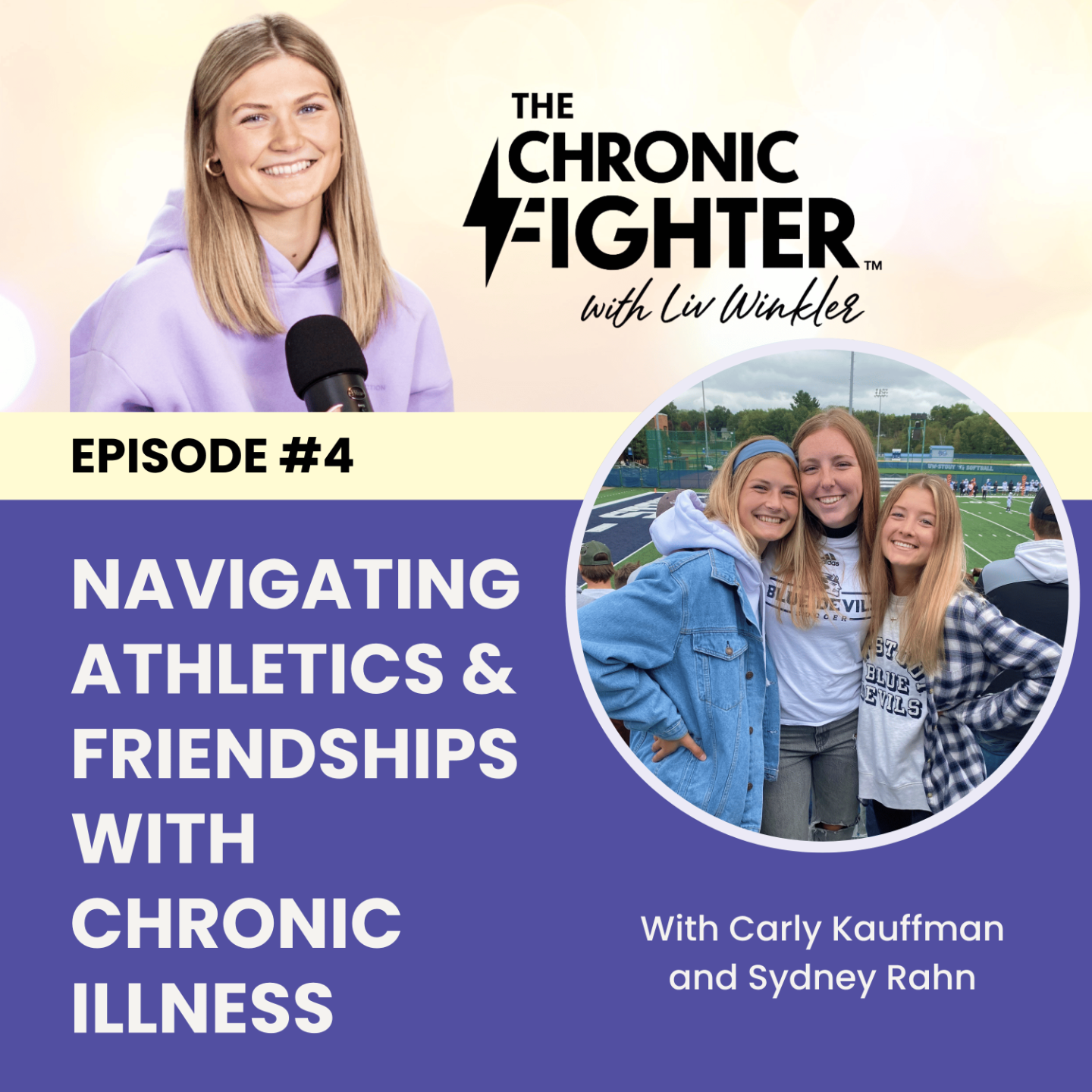
Episode 4: Navigating Athletics and Friendships with Chronic Illness
What is it really like to navigate chronic illness while being a college athlete, and what is it like to support a friend through it?
In Episode 4 of The Chronic Fighter, I sit down with two of my best friends and former college soccer teammates, Carly and Syd. They saw firsthand how much my health changed throughout college, from playing collegiate soccer to becoming bedridden.
We talk about the realities of balancing athletics and chronic illness, learning when to listen to your body, the power of opening up and letting others support you, the fear of being a burden, and what it really looks like to be there for a friend through different seasons.
This conversation is a reminder that good friends see the person, not just the illness.



What You'll Hear in This Episode
01:25 – Welcome and introducing my friends, Carly and Syd
03:44 – How my health changed from freshman to sophomore year of college
09:58 – Opening up to my friends about my health
16:28 – The impact of sharing my story online
21:15 – How my torn labrum impacted my soccer career and health
28:14 – How I had to fuel my body to play soccer
35:45 – Behind the scenes of an athlete with chronic illness
43:24 – What soccer meant to me
49:34 – How my friends really felt about my health
55:07 – Advice on how to support a friend with chronic illness
1:04:39 – What chronic illness has taught us
1:06:41 – Looking back on our college experiences
Biggest Takeaways
✔ Chronic illness can change from season to season. Your health, abilities, and needs can look completely different at different points in your life.
✔ You don’t always know what someone is going through. So much of what it takes to manage chronic illness happens behind the scenes, even when someone looks okay from the outside.
✔ Needing support doesn’t make you a burden. You don't have to hide what you're going through because you’re afraid of holding others back. Opening up about your health can help the people closest to you understand and support you better.
✔ Wins can look different with chronic illness. On a difficult health day, getting to the kitchen, eating a good meal, making dinner, or finding one small thing that brings you joy can be a win.
✔ Supporting a friend doesn’t have to be complicated. Sometimes the most meaningful support is simply reaching out, listening, and letting someone decide how much they want to share.
✔ It’s okay for your passions to evolve. What gives you a sense of purpose may look different throughout each stage of life, but finding something you care about can bring joy and direction, especially when other parts of life feel uncertain.
Resources Mentioned
The Chronic Fighter: Health coaching, membership, and additional resources: https://thechronicfighter.com
Business & Coaching Socials
TikTok: @thechronicfighterco
Facebook: The Chronic Fighter
Instagram: @thechronicfighterco
Threads: @thechronicfighterco
Podcast Socials
TikTok: @thechronicfighterpod
Facebook: The Chronic Fighter Pod
Instagram: @thechronicfighterpod
If You Enjoyed This Episode
I'd love for you to subscribe, leave a review, and share this episode with someone who needs to hear it.
Whether you’re navigating chronic illness yourself or supporting someone through it, I hope this episode is a reminder of how much connection, understanding, and support matter.
Thank you for listening, and I'll see you in the next episode.
Your Journey Doesn’t End Here
Explore more episodes of The Chronic Fighter Podcast and continue discovering tools, stories, and support to help you build a life you love—while caring for your body along the way.
Main PodcastTranscript
Navigating Athletics and Friendships with Chronic Illness
Syd Rahn: Being able to have you open, I feel like you got more comfortable, and like, we got more comfortable, as we could start talking to you about it.
Carly Kauffman: You were like proud of your, "Look at my bison meatballs that I have tonight!"
Liv Winkler: The mental aspect, the nutrition, the hydrating, the sleep, especially for someone with chronic illness. I mean, I could not slack on those areas or I wouldn’t be able to play.
Syd Rahn: You're not going to be a burden to the people that like... Matter. Relationships are never 50/50. Some days it's 70/30, some days it's 50/50, some days it's 100/0.
Carly Kauffman: All I can do is just pray for you and text you.
Liv Winkler: I mean, that meant the world to me. (Music Playing)
Liv Winkler: Today's episode is really special because I brought on two of my best friends: Carly Kauffman and Sydney (Syd) Rahn. We were roommates and played soccer together in college, and they've seen me navigate chronic illness in some of the most intense seasons of my life. I am truly so blessed to have these two. In this episode, we're talking about something that I don't think is talked about enough: what it's actually like to be an athlete with chronic illness, and what it's like to be the friend of someone going through health issues. If you've ever wondered, "Do people see me differently because of my health? Am I holding others back? How do friendships work when your health is unpredictable? Can I still chase my goals with chronic illness?"—this conversation is for you. Carly and Syd, welcome to the Chronic Fighter Podcast!
Syd Rahn & Carly Kauffman: Yay!
Liv Winkler: I'm so excited to have you on.
Syd Rahn: We're so excited to be here!
Liv Winkler: Well, it's officially been a year since you two graduated college. That's super exciting! I know, isn't it? How has the transition been from full-time student-athlete to full-time job? And what do you two do for work?
Carly Kauffman: I can go first. Yeah. Well, I was worried about after graduation, what am I going to do for 8 hours a day? Like, in college you have breaks and we had practice to yeah, break up the day. But it was actually a pretty easy transition. I'm a graphic designer for a civil engineering company. So I am at a desk all day. But thankfully I have a standing desk, so that makes things easy!
Syd Rahn: Yeah, no, I am a manufacturing engineer for a medical device company. It is very different, but also very similar because I do have that day-to-day where I get to go on the production floor and I'm not sitting at a desk 24/7. I think that's a big thing. Like when I'm at my desk more, I notice it. And I feel like it's also just very different in like terms of when do I get to go work out, when do I get to move, like I'm busy from 8:00 AM to 5:00 PM.
Liv Winkler: I love hearing about this, "Ooh, we don't talk about this enough!" Now we're adults! 03:05 I actually wanted to transition—Syd and I have talked about this a little bit—but it's kind of crazy. My relationship with health went in kind of a different direction than you two. I love hearing about how you're thriving, but unfortunately, I was struggling a bit more. I did graduate a year before you two, and I only played two seasons of soccer because of my torn labrum in my hip. But yeah, soccer had been a huge part of my life for 15 years, and then all of a sudden I went from being a collegiate athlete to barely being able to get out of bed while living with undiagnosed Crohn's disease. And so mentally, that was one of the hardest transitions I've had to go through. Thankfully I'm much better now, but I kind of wanted to open up this conversation to you two to hear about your perspective on that. You know different versions of me. You knew the soccer version of me who could keep up with everything with my lifestyle choices, and then going, from that to being in bed every day. I mean, I'm sure you can imagine how hard that was mentally, 'cause it was hard not to compare myself to that version of me. And being an athlete all my life, it's like, wow, this is a huge change-up. So, yeah, whoever wants to speak on that.
Carly Kauffman: Yeah, I mean, I think transitioning out of like playing a sport is just hard for anyone, But then having to see you struggling physically after that, and mentally too. I mean, it takes a toll. I think it just hurt my heart cause "Ah, like not only are you having to close that chapter with soccer, but now you can't like physically do what you were hoping to do after." And just not seeing you thrive in that way was really hard. And also at the same time, Syd and I were both still in school, and we're still on the team and like, obviously you were in manager roles and stuff, and helped out, supported where you could, yeah, for sure. You were like our super fan! But I mean, obviously I know that's not the same as being out on the field, so yeah, it was hard for me to watch you go through that. And also, in—I mean this is going back to freshman year—like I had no idea that you had struggled with any of this. I knew at that time that you were gluten-free, but like that was...
Liv Winkler: Just scratching the surface!
Carly Kauffman: Yeah, like that was all I knew and that's all I saw, 'cause you—I mean—you said freshman year was kind of better for you health-wise...
Liv Winkler: Freshman year for sure, yeah.
Carly Kauffman: ...which was odd 'cause it was such a big transition moving to college, but yeah, so I didn't even know that side of you until probably like what, sophomore year?
Liv Winkler: That's when, yeah, I slowly started, and then junior year was really tough.
Syd Rahn: Yeah, no, kind of same. And it was weird 'cause I lived with you all four years. Like, I truly could not grasp how different of a change it was. Like, yeah, you had some bad days, but like, didn't we all freshman year? So, I think it was a huge thing, again, it was super odd that you—that was probably your best year of school health-wise, yeah. And I didn't see any of that, and then we moved into our apartment and it was like slowly kind of creeping in and I learned a lot more than I knew. And I knew a little bit more than probably Carly did at that time just 'cause I did live with you, we kind of did have to talk about it in case something came up, but overall, like genuinely, sophomore year was a little bit of an awakening for—I think not only you, 'cause you just had this year where you did really, you had good stuff, like you were not struggling as much as you did kind of that sophomore into junior and then in senior. I think it got a little bit better as you started to get a little bit more answers, but it was a transition, and it was, I know, very hard for you to not be playing soccer with us and stuff. And I was so, so thankful that you were able to continue to participate with us, but at the same time, that was—I mean, that's hard! Like, you don't want to see your best friend struggling to not be able to play the game she loves, and I was like, I couldn't imagine if it was me, I'd be so torn up, 'cause like, you came here to do that! That's what you went to school for, that's what you wanted. Like, yes, you came for a degree, but, soccer was a big part of our lives in school, and especially freshman year learning what to do and how to play and how to manage everything, I think you did hold up very, very well, even regarding what you were going through, which I think is insane, because you didn't even want to show us the depth of it, and we could still see how much it was impacting you. So, I think it was a huge transition of like, just how much it can take a toll on you, and the combo of the health and the losing your eligibility to play soccer 'cause of your hip, yeah.
Liv Winkler: Playing for 15 years and then all of a sudden it's done, yeah! Like, I think that's just a really good representation of having chronic illness, is just there's good years, there's good times, and then there's bad ones, or not so great. And yeah, it is really hard on you physically and mentally, because it's like, okay, why was last year so good and now I'm struggling so much,
Syd Rahn: Yeah.
Liv Winkler: And I'm just interested to talk to you two about it because you got to see that. Like, firsthand, you got to see, okay, last year she was doing so well, why is she struggling with this? I haven't seen her do that before, I haven't seen this before,
Syd Rahn: It was the same as you not being able to go to events and stuff, like we'd want to go somewhere for the day and "I just can't do it today." It was super odd because you love to plan, you love to go places, you love to get activities going! It was sad sometimes when it was like, "Liv's not coming today."
Liv Winkler: Well, that's not my personality, so...
Carly Kauffman: No, not at all. And I know it was really hard for you to open up and be like vulnerable with us on your health and how bad it really was, but I think that really helped as a friend because I was able to know—like I trusted that if you just said that you weren't feeling good, like that's good enough for me, but knowing how we could help in this way or that way. ‘Cause not knowing kind of scared me as a friend, I'm like, I hope Liv's okay! So I'm really glad that you were able to be a little bit more vulnerable with us as we, what was that, probably junior year, senior year?
Liv Winkler: Sophomore into junior year, maybe. And with that is like, I kind of got to the point where I was like, I can't hide this anymore, especially living with other people! I mean, it was one thing growing up and like my parents knew about it, but my friends didn't see all the behind-the-scenes, like you guys saw more of that 'cause you lived with me! I could only hide so much, and then I'm like, you know what, I can't do this anymore. 10:27 And I'm so thankful I finally started opening up, I mean, I'm lucky enough to have such great friends who are there to support me, but I personally think it—like our friendship was better because of it. I think that you two understood me better, you could support me better. I definitely now, since then, advocate for people opening up and sharing that, because I truly think it is freeing, and you live a better life essentially because of it,
Syd Rahn: Yeah, you totally did, too. You'd have every once in a while weeks where it wasn't good, but a lot of times it was a day-to-day, like Friday you'd be great, Saturday you wouldn't, Sunday you wouldn't, and then the rest—next week you were great! I think it truly helped after you kind of got over that hump of like, "I don't want to feel like a burden, I don't want to put this on them." But, I mean, we were like, "Yeah! Like, what do you need? We're going out, do you need something? Do you need something from the store?" Being able to have you open, I feel like you got more comfortable, and like, we got more comfortable, as we could start talking to you about it, because it was—it was a little scary then, "She's in her room, and I don't know what's going on, and I just want to make sure she's okay." And sometimes that's a gray line where some people don't want to talk about it, and that's okay, like if you're not ready, but, I truly felt like you were able to just—it wasn't like, "Oh, I can't go today, I'm missing," right? Versus like, "No, my body says no, I can't do it."
Liv Winkler: Yeah.
Carly Kauffman: Yeah, I think we were able to support you better once we knew, for sure. But I also—I know you're so, you are so strong, like...
Syd Rahn: Oh, 100%!
Carly Kauffman: ...and even, I think you kind of wanted to hide it because you wanted people to see that you were just this strong part of yourself...
Liv Winkler: I wanted to be normal, yeah!
Syd Rahn: You didn't want it to define you, yeah, that's why.
Carly Kauffman: But like, once I found out the full depth—and I don't even know—I'm never going to understand all that you've gone through. Yeah, once I learned more, it didn't change the fact that I still saw you as being so strong.
Syd Rahn: Yeah, and it gets almost stronger when you can open up. Like, people don't do that, that's why there's therapy, that's why there's counseling for people to be able to do that. And I feel like you slowly started to just trust, "They're not going to look at me differently," and we didn't! We loved when you could come, we understood when you couldn't, and that's kind of how it kind of went, yeah.
Liv Winkler: Yeah, and I think that was a good point you brought up, I definitely didn't want to be looked at as different. I mean, part of the reason I'm so motivated to help other people with chronic illness is because although I had such good family and friends growing up, I didn't have anyone that could relate to my struggles, and so that was really isolating, 'Cause you guys are empathetic people, incredible people, so you could understand somewhat of what I was going through, but you didn't like exactly know what was going on...
Syd Rahn: We'll never know, either.
Liv Winkler: ...'cause you haven't gone through it, so then I'm like, you know what, I'm the only different one here, that's kind of how I felt at times. I don't as much now, but when I first was kind of hiding it or opening up, that's how I felt, and I just wanted to be known as a soccer player, a friend, a teammate, and...
Carly Kauffman: And I don't blame you for that either, like...
Syd Rahn: Same thing.
Carly Kauffman: You don't want to walk around with this label on yourself, and you didn't, even when after people knew, but...
Liv Winkler: But like I finally realized this is a part of my life. I just have to accept that, and I have to know this doesn't define me, it's a part of my life just like soccer's a part of my life, just like, being a daughter, a friend, a, whatever, whatever my interests are, whatever is a part of my life. It's a part of the whole thing. It's not I'm just the sick girl, I'm just the one with chronic illness,
Syd Rahn: Well, and I think it was super cool, like our senior year, you talked a little bit about gut health— that kind of stuff with the team, and I think it was super cool...
Carly Kauffman: Yeah, full circle!
Syd Rahn: Again, nobody was like, "Oh, Liv's doing this for attention." Like, everybody was very invested, and you had people come up to you and talk to you, I think that's so cool because, again, like me, I didn't know. I didn't have, like I had friends with some, but not to the extent of what you have gone through, and it was a huge difference for me to be like, "I didn't know this!" And I can't help you, and obviously I don't want to say the wrong thing, and like, I don't think you ever made me feel bad for accidentally saying something inconsiderate maybe, just based off what you did, but as you kind of talked through what you've gone through, what you're going through, like why you can't find answers—it was so eye-opening to be like, if you told me that freshman year, I never would have said, "Liv has any of..." I'd be like, "Nah, she's fine!" But again, I didn't know! Like, I didn't...
Syd Rahn: I didn't have friends or people in my life that had chronic illnesses, that I was like, "No, she was doing great, what do you mean? Like, Liv doesn't have that, what?"
Liv Winkler: And that's kind of what I have some questions for later, but like what I had to do, especially freshman year, to be able to do all I did, yeah, you didn't know what I was going through, but there's a reason, because of how much I did behind the scenes.
Carly Kauffman: When you first started your Instagram and everything, you were telling us how many people had been reaching out to you and even people that you knew, but like you knew them, but didn't know that they had chronic illness!
Liv Winkler: So true!
Carly Kauffman: So I'm like, that's so amazing that you were able to share so much, and have people come and relate,
Liv Winkler: 16:09 And that's my favorite thing is when people reach out, I love talking with other people, and it helps them and then it helps me feel less alone and have a community.
Syd Rahn: For sure. Well, and people like our parents' age, they didn't have influencers, they didn't have people like talk—you know, you have a couple influencers that you love to see what they post, "This is awesome!" And you don't need to be this multi-million follower page to actually make an impact. So, it is so cool, and it's fun to see you'll be like, "Oh my god, this person reached out to me!" It's so fun to hear, because it again, it is, like...
Carly Kauffman: Not that she—she doesn't name drop!
Syd Rahn: No!
Carly Kauffman: You know, you're not telling us all the—it's confidential!
Syd Rahn: Yeah, you're just like, “Somebody reached out to me talking about this." But like...
Liv Winkler: I'm glad you cleared that up!
Carly Kauffman: Yeah! I mean, I don't know...
Syd Rahn: But it's cool, because again, even when we were growing up with social media, there now is way more different than four, five, seven years ago for us. Even growing up, there was nobody that was doing this, that I could know.
Carly Kauffman: That's so true. Also, I feel like, have chronic illnesses kind of been a higher percent now? I know for food—I know for food allergies, it's been like...
Liv Winkler: Yeah.
Carly Kauffman: There were only kids that were allergic to like peanut butter, I feel like, growing up, and gluten!
Syd Rahn: Now it's talked about, exposed, true.
Liv Winkler: Well, it's also more like... Talked about, and people know more about it. Like, when I was first gluten-free when I was a kid, the food was awful!
Carly Kauffman: Yeah, I know, right? It was awful! Yes! You were talking about that... Gluten-free isn't bad! You have talked about that before.
Syd Rahn: And also people choose to be gluten-free now, too, so...
Liv Winkler: Yeah, at the restaurant, "Is it a preference or an allergy?" Well, I will die if I get gluten, so...
Syd Rahn: I will be on the floor in a ball, but thank you!
Carly Kauffman: It doesn't matter! Just give me the gluten-free!
Liv Winkler: No, that's so true. Yeah, chronic illnesses are, unfortunately, very common nowadays, especially in the US, and part of the reason is because of our food system. That's a whole 'nother topic, but I thought I'd drop that in!
Syd Rahn & Carly Kauffman: Yep, yep.
Liv Winkler: but yeah, it is really cool being able to be the person, like I say this all the time, be the person that I needed growing up. I know exactly how it feels to go through that— through different stages of life, to feel alone, and I love being able to help people however I can, with my experiences, and, it doesn't mean that I have everything figured out, but I have learned a lot along the way and I'm still trying to figure it out, and, I just want to be able to be there for people however I can. And yeah, I appreciate your guys's support so much, 'cause, you've just been amazing friends through it all, and there's definitely...
Syd Rahn: And now don't make me cry!
Liv Winkler: ...like genuinely, there's people who would be like, "You trying to start a business?" You guys have been nothing but supportive and I'm very lucky. I'm definitely someone who says like, "You know what, if you open up about your health struggles and people aren't supportive, then they shouldn't be in your life," The real ones will stick around and understand, and you know what, if you guys were going through something, maybe it's not health, but maybe it's something else, I'm going to have empathy for you and be there for you. Everyone has their stuff at some point, whatever that looks like.
Syd Rahn: Oh, for sure. I was going to say, it's different for other people, but like, it's not talked about with like chronic health and chronic illnesses, so...
Carly Kauffman: And you were saying that Syd and I have cool jobs, and you're saying that, but like, come on!
Syd Rahn: Yeah, this is sick! Like, look at where we are, what we're doing, yeah!
Liv Winkler: Well, it is—I just absolutely love what I do, and it's just great to make purpose of what I've been through, 'cause it's been very challenging. I mean, I'm thankful for all the good times throughout my life too, but I'm trying to make purpose of everything I've been through, and I really do feel like I've been through these things for a reason, and so it's cool to be able to hopefully help other people. But anyway, that was awesome! Right, this is a really good conversation!
Syd Rahn: 2-hour long podcast, yeah!
Liv Winkler: So, moving on, I kind of, before talked about how after I was done with soccer—I had played on a torn labrum for 3 years until I finally had no choice...
Carly Kauffman: Crazy.
Liv Winkler: ...20:42 I kind of wanted to talk about that mindset I had though, because I feel like in athletics that it’s common to push through pain. And because I loved soccer so much, that was part of my identity, I did that. But do you think there's a difference between resilience and ignoring your body, like what your body's trying to tell you? Is there a balance? Can it be unhealthy?
Syd Rahn: 100%. I mean, I've had teammates throughout my entire—not even just soccer, my entire sports career—that "Girl, you got to sit, and like, your body is telling you stop, and you're not listening, and yeah, you're young, you're fit, you can do that for so long, but I'm like, what are the long-term consequences of this?"
Carly Kauffman: There's definitely a balance. I mean, now, I feel like I've been seeing so many things about working out according to your cycle and stuff...
Liv Winkler: Yeah, that's very interesting.
Carly Kauffman: ...and yeah I can't speak on that, I know nothing really about that, but I just think about growing up playing soccer and none of that mattered! Like, you just go, rain or shine. Yeah, so I think there's two very polar opposite views on, at least working out and you're listening to your body, but yeah, it's kind of nice though being done with school and not being forced to work out when you don't—when your body's not feeling like it.
Liv Winkler: Listening to your body more, you feel?
Carly Kauffman: Yeah.
Liv Winkler: Now that I'm out of soccer and have been for several years, I listen to my body more, and now I can look back and be like, "You know what, there's a point to working hard, like I definitely think you should be working hard towards your goals and pushing yourself in that way, but if you are pushing yourself when you are clearly injured or, your health is suffering, in my opinion, that is not worth it, you know? And it's like, is that benefiting the team if you're on a team sport, too? I'm sure there's people on the bench who would love to play, that are healthier, and I just feel like there's definitely a fine line."
Syd Rahn: Oh, for sure. And you're 20! Like, you push yourself too far, you're never jumping around with your kids one day, we have a lot of life, and I think that's something with college, not even high school, but like college sports specifically, like "These are my last 4, like not really going pro playing D3.”
Carly Kauffman: Oh, dang it! Shoot, yeah!
Syd Rahn: ...like this is kind of like your last hurrah, but it's like at what point is it too much? At what point is it like—we had a few teammates that, were not able to continue playing like you due to their bodies being like, "No, I can't do it anymore," which I think is a really brave thing to do.
Carly Kauffman: Well, Liv, going back to your health just in general, was that hard for you to know when to push through? I feel like you would just have like hot flashes and things just come up randomly...
Liv Winkler: One example I feel like kind of sums things up is when I'd be in the weight room, and I had my torn labrum in my hip, and I would be trying to do exercises the same way as everyone else, and I couldn't. I mean, my body would not let me. And I feel like that's an example of listening to your body. Now I know that, but how can I adapt what I'm doing to still be building strength, but do it in a way that, my body can handle better, So, it's like you can still work hard and work towards your goals, but if there's a situation like that, it's okay to adjust, it's okay to do what you need to do.
Syd Rahn: That is one thing—some people do not have the, I guess, support system for that. My trainer at home, throughout my high school career, she was amazing! I sprained my ankle in a soccer game, it wasn't sit and do nothing, it was, "Okay, we're going to do these four exercises that are not going to hurt your ankle, but strengthen the rest of your body and help your body, because when you can put weight on that ankle again, your body is going to want to even itself out, it's going to want to hit equilibrium." But, she's like, "Nope, you played four basketball games and three soccer games this weekend, you're not lifting, your max, we're not doing that." And so she was really good about pushing me, but to the point where, "No, your body doesn't want that, I can see it, I can see your form going..."
Liv Winkler: And that's not benefiting you,
Syd Rahn: No, she's like, "You're not doing anything that'll help yourself right now, you're just hurting yourself," which I think in college you have a little bit more eye on that for some people, and sometimes you don't have that, certain coaches, certain people are not going to be able to help you with that.
Liv Winkler: And you have to advocate for yourself, too! Which I had to learn how to do, which is out of my comfort zone!
Carly Kauffman: 'Cause yeah, it's not—we weren't able to adapt, or you weren't in the weight room necessarily. I mean, unless you had to talk to the trainer...
Liv Winkler: Yeah, I had to talk to...
Carly Kauffman: ...and you had to like give a reason, yeah.
Syd Rahn: There were some obstacles to getting to that adapting, yeah. And if you say something, be like, "I can't. I know I can't, I'm not going to push through that, I know that I can't do it," and that's okay to say.
Liv Winkler: Mm-hmm.
Syd Rahn: And I think that was okay for you to say, too.
Liv Winkler: And the right coaches and the right trainers and whoever will support that and want that for you. And overall, I would say I've had good supportive coaches. To his credit, I feel like our coach in college was pretty understanding of injuries and stuff.
Carly Kauffman: Yeah, for sure, yeah.
Syd Rahn: Another one down, go to the... Take a break!
Liv Winkler: Yeah, but it—I mean, it is intimidating. I understand, I mean, I struggled at times, too, like going to them. It is intimidating, especially coming in as a freshman, you're trying to prove yourself and... And you know, the good thing, too, is that people learn pretty quickly the kind of person you are. Like, if you are a hard worker, they'll know that you're not exaggerating, like you need a break, Like we knew, I mean, we were pretty lucky for the most part, but if someone was slacking and they're like, "Oh, I have to sit down," it's like, you know...
Syd Rahn: You can see it.
Liv Winkler: You're going to know! Like, if either of you, which you didn't really, but if either of you needed a break, we'd be like, "Okay, something is wrong," So, I feel like that definitely helps people get an idea, too. 27: 28 Moving on, do you wish anything was done differently in athletics growing up or in college, now that we're kind of on that subject?
Carly Kauffman: Well, one thing I wish that we had more in college, and honestly in my high school and club soccer, too, was emphasis on nutrition.
Liv Winkler: Oh, I was hoping you'd bring this up!
Carly Kauffman: Yeah, and I know we were just talking about how you talked to our team senior year about it, but that was really all we heard! That was the best advice, that's why you had so many girls coming to you!
Syd Rahn: I know, we had something at the beginning of the year that was a little PowerPoint...
Carly Kauffman: PowerPoint!
Liv Winkler: Same one, same one every year! "Drink water."
Carly Kauffman: Yeah, that was it! Like, how are we so behind in this?
Liv Winkler: That's so true.
Carly Kauffman: I mean, I feel like there's been a big health movement, I think, just in general, and...
Liv Winkler: Well, mental health I feel like a little more, like we had mental health stuff, but the nutrition piece maybe.
Carly Kauffman: I know, and I'm like, we're working out so much during the day, and yet even our meals that we were getting as athletes, and I mean, I know when you go to a bigger school and play D1 athletics, you have your own athlete meals that you get at the dining—you have your own dining hall, but even just having different tips or like meal ideas, and I know for me, I definitely under-fueled my freshman year 'cause we were working out so much, and...
Liv Winkler: Probably didn't realize, 'cause it's just such a change!
Carly Kauffman: Well, yeah, and I was kind of into that whole, "smaller is prettier" type mentality, and...
Liv Winkler: Which is common, unfortunately.
Carly Kauffman: Yeah, but also I was like, I don't think I realized how much I was working out, and how many calories we were burning in a day, and I ended up going to a nutritionist and actually learning about it, and it just opened my eyes to what types of foods I need to be fueling myself with, and mainly how much, as an athlete, 'cause I think it kind of blows you away how much you really need to be fueling.
Syd Rahn: Well, you learn that, too, and like, yeah, I was listening...
Carly Kauffman: Did you feel like you had resources and nutrition in high school, too?
Syd Rahn: I think I have—my gym was really good about that, I did work with my nutritionist in high school, and I remember our high—but again, that was the gym I went to right? That was not everyone, and one year our soccer team went to a college camp for like 2 days, so we ended up going to St. Ben's, and we did a little nutrition half hour, 2-hour session. That stuck with me! That next season I was making sure I was doing this, this, and this at halftime
Liv Winkler: We got to talk about halftime, yeah, yeah, we do, we do!
Syd Rahn: But that was something that I remember stuck with me that year of sports.
Liv Winkler: 30:33 And I feel, with certain positions, like I was outside mid mostly, and that—I've heard you can run up to half a marathon in a game or so, depending on how much you play.
Syd Rahn: Yeah.
Liv Winkler: But, that's kind of insane if you think about it. I mean...
Syd Rahn: We had 10-mile workouts during preseason by the time we were done with the day.
Carly Kauffman: Yeah.
Liv Winkler: Like, the amount you have to eat before and after, and we were laughing because Carly and I would eat at halftime! I had those like waffles and runner chews, and then the GoGo squeeZes...
Carly Kauffman: Liv got me on the GoGo squeeZes! They're so easy. Okay, not the beef sticks, though! I wouldn't eat the beef sticks! Liv would eat the beef sticks!
Liv Winkler: I still eat beef sticks all the time! Pull it out of my purse, there's the beef stick! Anyways... But yeah, you just did what you had to do, 'cause I mean, otherwise, I would feel it. Like if I didn't refuel a little bit at halftime, I would feel it the second half.
Syd Rahn: Yeah, I agree with the position-based, too. I didn't—as a center back, I didn't come out, but I wasn't doing the sprints that some of you guys were doing, but still, I was like, "I have potentially 45 more minutes that I'm playing, I got to do something."
Liv Winkler: Do you remember I'd pull out like my steak meal?
Syd Rahn: Yeah, Liv would eat a full five-course meal!
Carly Kauffman: Can we talk about Liv's foods for a second? Well, first of all, I mean, Liv eats a lot, and that is linked to yeah, your metabolism and your body, like...
Liv Winkler: Yeah, I've struggled to absorb nutrients and stuff, so I have to eat more than the average.
Carly Kauffman: So, I did not know this! You're so fit and stuff, and yet you eat like five big meals every day!
Syd Rahn: Second dinner!
Carly Kauffman: Yeah, second dinner! And I did not know this about you...
Liv Winkler: Well, you learned that quickly!
Carly Kauffman: Yeah, I learned it really quick!
Syd Rahn: Her fridge...
Carly Kauffman: But I just also want to touch on how much that helped me, because seeing you actually eat like real meals and not like rice cakes and peanut butter, and that's your breakfast, like...
Liv Winkler: And I'm not ashamed of it, 'cause it is what it is...
Carly Kauffman: No, and you were proud of your, "Look at my bison meatballs that I have tonight!"
Syd Rahn: They were really good meals!
Liv Winkler: You were always interested in my meals!
Syd Rahn: Yeah, I know, "What are we eating?"
Carly Kauffman: Okay, but not the bad smelling stuff- the kale! Your door—no, no! In the dorms—I did not like going into you guys's room sometimes 'cause Liv had summer sausages, that's all she ate!
Syd Rahn: Well, and she had these microwave meals, and they'd like open, and I'm like...
Liv Winkler: I actually felt so bad for Syd! This poor girl, I took up the whole fridge, I cooked up all kinds of...
Syd Rahn: I didn't even mind it, 'cause I ate at the dorm halls! But it was, no, some days I was like, "Carly, I'm coming up, I can't with this microwave meal!"
Carly Kauffman: But for real, though, it was good for me seeing you actually eat regular meals, and I think you were way ahead of the game on all of us athletes just with how you were eating and fueling yourself, and it made an impact on others—I mean, I wasn't the only one who started having snacks at halftime with you!
Liv Winkler: Yeah, that's true, especially when I was helping coach—I mean, so many people pulled out foods at halftime! I was like proud, after my little speeches, I'd see people at Whole Foods, "Yep! There going to buy helpful things!"
Syd Rahn: People were at the coop a lot!
Liv Winkler: Oh my gosh, so proud! But, you know what, that's so true that there's a lack of information, lack of support, and it really does amaze me, because it's such a huge part of sports! It's such a huge part of everyday life, but sports? I mean, that helps you perform better. Like, how are you fueling yourself to be able to go do your best out there? So, it's such a missing piece that...
Syd Rahn: And for me, that was a kind of a wake-up call, 'cause my parents made my dinner- you know—I came home from sports and my parents made my food, and...
Liv Winkler: And in college in general, that's a time when people are known to slack, and when you're an athlete, you really can't! Yeah, I just think that sports has so many different pieces, you can't just focus on the physical piece, because like you guys touched on, the mental aspect, the nutrition, the hydrating, the sleep...
Syd Rahn: The sleep! Guilty, oops, yeah!
Liv Winkler: But like,—I was going to get into it, but these are things, especially for someone with chronic illness, I mean, I could not slack on those areas or I wouldn’t be able to play, I had to be disciplined in those areas.
Carly Kauffman: 'Cause the average person you notice a difference when you're not meeting these areas, but with chronic illness, like...
Syd Rahn: I can't even imagine.
Liv Winkler: I mean, I had my bedtime, I had my meals, I had 2 hours before the game I have to have this meal, everything was mapped out!
Syd Rahn: Yeah, you were very mapped out with everything.
Carly Kauffman: Yeah, and thankfully you're organized! (Laughter)
Liv Winkler: And I had to have that self-discipline. I mean, soccer was worth it to me to put in the extra effort, it just it was, and, I mean, other than you guys, people just didn't know what went into it to be able to play.
Syd Rahn: Well, people, especially when you kind of started opening up to all the people more and talking about it and started posting things, our teammates were like, "Wait, really?"
Carly Kauffman: Yeah, surprised, just didn't know.
Syd Rahn: "I never would have guessed," and like, yeah, there was just no—no idea for them. They had no idea that is what you went through, they'd be like, "Oh, why isn't Liv doing this tonight?" "Oh, she's just tired, " I didn't want to air out your laundry, but at the beginning, I was like, "She's just kind of tired," and then they find out later and they're like, "Oh..."
Carly Kauffman: "Oh!"
Syd Rahn: "Like that girl did not play soccer for that long," like...
Liv Winkler: I don't know how I did! I know the lifestyle choices, but genuinely, it's like, it's kind of crazy, the level and the commitment. I mean, to be honest, at least from my perspective, I did not think D3 soccer would be as involved and as competitive and as demanding as it was. I mean, I have friends that went D2, and our program—I mean, not to brag about our program, not that we were amazing, but it was hard work! Like, preseason was hard, it was harder than some D2 schools that my friends went to!
Syd Rahn: Preseason was a lot!
Liv Winkler: It was a lot, and it was hot, the heat didn't help. It was very hot. I mean, like you said, there's a lot that goes into it for athletes in general, but yeah, for me to be able to function, I mean, to cool me down, I'd be dumping water on, I'd have my fan, I'd have my ice-cold water, I'd have three different drinks, electrolytes, some water... There's just a lot, and I made a post the other day—I was telling you guys about the things, the behind-the-scenes of invisible illness, and you just don't understand really unless you've gone through it or you're around someone who does. I mean, this is a perfect example of the things I dealt with behind the scenes to be able to perform and do the things I wanted to do.
Syd Rahn: 100%.
Liv Winkler: And that went into everyday life, it still does, to be able to I mean, I would say for the most part I make it to everything, but I have to be strategic about how I do.
Carly Kauffman: Oh yeah, for sure. Like always having a backup plan in the back of your head in case you're not feeling good or something,
Liv Winkler: Whether that's me not spending the night, or going the entire time, or bringing my cooler, or, I'm going to drive so I have my car if I need to leave, or there's these things that go into place, and I wouldn't change that, I would rather go and it be a little more difficult than not go at all, And that's just part of my personality, too.
Syd Rahn: For sure. You are a social person, versus like, I am a little bit more like, "Let me sit on the couch at home all day,"---I'm okay missing a little bit of things, but to an extent...
Liv Winkler: To an extent, you were pretty social!
Syd Rahn: To an extent, but, in terms of you, you always wanted to be there, right?
Liv Winkler: Never wanted to miss!
Syd Rahn: No, and that was very hard for you sometimes where you couldn't go, versus, again, I have that more laid back where I was like, "If I can't go, I can't go," versus you were a little bit more like, "No, I really want to though," and, not that people don't want to go, but it was different, you had to be like, "I can't," or, "I have something important the next day, like I can't," yeah.
Carly Kauffman: Prioritizing, yeah, for sure.
Liv Winkler: Yeah, that definitely is something that is hard with chronic illness, like you said, it's one thing if "I don't feel like it," so it's not a big deal, but like...
Carly Kauffman: You didn't have a choice.
Liv Winkler: Yeah, I will pretty much always want to go to things, like with my friends and family and stuff, so when I don't really have a choice, like it's too much on my body, that's hard on me, personally.
Syd Rahn: Out of your control, out of your control is hard.
Liv Winkler: And I've had to accept that. I've gotten better at it, but yeah, that's definitely something that I can relate with other people out there with chronic illness is like, you can't always make it to everything, and that's hard, but that's just the way it is, Be proud of yourself for realizing that, or be proud of yourself for what you can go to or what you did do in the day, It's, again, all about perspective.
Carly Kauffman: Yeah, it really is.
Syd Rahn: Small wins.
Liv Winkler: That's huge— the small wins. Okay, well, we just talked a lot about the behind-the-scenes. I'm curious, I don't even know if I've ever asked you this, but did it ever change, once you knew what I did behind the scenes, did it change how you viewed me as an athlete?
Syd Rahn: Yeah, it was way more impressive!
Liv Winkler: Oh! I meant in a bad way!
Syd Rahn: No, no, that's true! No, it was just impression. Well 'cause, again, I'm like... What me and Carly had to do, you might have had to do a little bit more to be at the same... Yeah, yeah! It was just crazy.
Carly Kauffman: Yeah, you were good!
Syd Rahn: yeah! Dude, you were a good athlete!
Liv Winkler: Oh, I thought you meant at doing it! "Well, I got pretty good at doing it!"
Syd Rahn: No, you were good—dude, we still talk about your plays out on the field, and how fast you were!
Carly Kauffman: Yeah, you see Liv's long arms and legs running out... literally, when I was going up against you, I could not get the ball away from you because your legs were so long, and you could just...
Liv Winkler: For those of you that don't know, what are you, 5'... What?
Carly Kauffman: Yeah, 5'—no, 5'2"! I'm—if you round up, I'm 5 foot 2 inches, if you round up!
Liv Winkler: Okay, 5'2", and I'm almost 5'11", so it's pretty funny. I mean, to go against each other!
Syd Rahn: And, I will say, I am a little more big-boned, like "Grrr!", but you hit Liv, you hit a freaking wall! It was crazy! People were like...
Carly Kauffman: The elbows!
Liv Winkler: I did use the elbows, not against you hopefully, more against the other team!
Syd Rahn: But, it was genuinely—no, it was just so impressive watching you play, again, never would have guessed! Like, when I told my parents, they're like, "Your roommate? The one that's scoring goals and running up and down the field all game?" You put yourself—like held yourself together so well, and seeing the behind-the-scenes was even crazier, because "Oh my gosh, she's so prepared, she's so planned out, she's doing what she needs to do for herself to be the athlete that she is, and to be a good one, like..."
Carly Kauffman: There you go!
Liv Winkler: You guys are so sweet, I could go on and on about the players you were, 'cause you were just incredible, too! I mean...
Carly Kauffman: Yeah, but I don't know...
Liv Winkler: Syd was a wall back there, and Carly was doing moves around everyone!
Syd Rahn: Dribbling through people's legs!
Liv Winkler: Yeah, just dangling people, but yeah, I mean, I really appreciate that. It really does mean the world to me that you saw that, and I think that something that was super cool with soccer was it really was my escape, and I transformed into a different person!
Carly Kauffman: Your alter ego, Liv?
Liv Winkler: Yeah, beast mode! I mean, the college team there a little bit, but for sure club would be like, "Oh, there's beast face! There's beast mode!" Because I would have a scary look on my face when I'd run!
Syd Rahn: I was going to say, Liv had a soccer look, and it was scary!
Liv Winkler: I could not replicate it right now...
Carly Kauffman: You should try!
Liv Winkler: No!
Carly Kauffman: Do it!
Liv Winkler: I'm going to make that the thumbnail of this podcast!
Syd Rahn: Just, "Grrr!" It was like a growl, it literally looked like a growl!
Liv Winkler: Guys, I don't know. I'm just such a competitive person, so when I went out there, I was giving it 100%, and you guys can relate to that, but yeah, I mean, that was one of the coolest things about soccer was I could just be myself out there. I wasn't the girl with chronic illness, I wasn't this, I wasn't that, I was just a part of the team, I was just, contributing to the team.
Syd Rahn: Which from knowing you and watching you, and seeing you grow, again, I've only known you for 5 years, which is just crazy,
Liv Winkler: That is crazy!
Syd Rahn: But, I think that piece was so important. You had that outlet, you had that "I can be me, and I can do it well and I can do it and have fun.” I think that was so insanely huge for you. And how your mental health took a toll after, just because of the fact that you kind of lost that little bit of yourself.
Carly Kauffman: Can I ask you a question?
Liv Winkler: Sure!
Carly Kauffman: What's your outlet, what has kind of been your outlet now? Is it this, after soccer?
Liv Winkler: 44:27 Yeah, I was going to say that. It really made me reflect even more after I was done with soccer, because I was like, "Wow, this had more of an impact than I may have even realized for having a passion, having purpose outside of chronic illness." I mean, anyone, benefits from having a purpose, but, that was huge for me and for my healing process, and yeah, I mean, when I didn't have soccer, it was like I felt there's a hole in my life, there was an empty feeling, and so it actually transitioned to yeah, starting the business and helping other people, and that became my new passion! And it's super cool, now I'm advocating for people, it's like whatever your passion looks like, it could be, anything, whatever that is for you, doesn't have to be athletics, but it's huge, 'cause otherwise you can—I talked about this a little bit with my parents, but—otherwise it can be so consuming, with all the negatives of chronic illness and this and that, you have to have something that brings you joy in life.
Syd Rahn: Got to have grounding.
Carly Kauffman: Oh, for sure.
Liv Winkler: Yeah, grounding, yes! So whatever that passion looks like, and in me, it took me a bit to figure it out, but then, this became as big as soccer, if not bigger. Okay, so now we're going to get into some deeper reflecting. I'm going to preface...
Syd Rahn: Oh boy!
Carly Kauffman: Oh gosh!
Liv Winkler: No, no, no, it's not that deep! 45:57 but I'm going to preface, for most of my life, I had a difficult time asking for help, and never wanted my issues to affect other people, which you guys are very aware of that! I definitely struggle still to ask for help. Which was a big reason I hid my health for so long. I had worries like being a burden because my food allergies affected where we ate...or still do!
Carly Kauffman: "Oh, I'll find something...AKA "I'll bring my own!"
Syd Rahn: "Just go wherever you want, I'll eat before!"
Carly Kauffman: Yeah.
Liv Winkler: Or occasionally canceling plans because of a flare day, like we touched on. But something else is feeling like I couldn't be a good friend, because of my own struggles, which was something that was hard on me, too, 'cause my friendships and my relationships with my family and stuff, like those mean a lot to me. Those are one of the most important things in my life, so that was hard to feel like I wasn't showing up for them, too. So I'm just curious, what would you say to someone with chronic illness having these same thoughts? I always felt like I was too much for people, like that's something that weighed on me, but honestly that makes me so sad, like if someone told me that with chronic illness that they feel like too much, I would never think that about other people, I'm just hard on myself. So, wherever you guys want to go with those thoughts.
Syd Rahn: That makes me so sad, 'cause you will have your people that are not going to... Liv, I will honestly compare people to you a lot and be like, "Liv didn't need to be there for me, she didn't need to ask," I did not expect her to ask how my day was, and every time it was, "How was your day?" And it was like, "Girl, it's okay!" But that's how much you cared, and I think that's a huge thing, and being able to just like, if you're having those thoughts, you will find your people that are not going to make you feel that way, and that will understand. Those feelings are valid, those feelings are going to happen, but you're not going to be a burden to the people that matter, and such. So, I think that's a huge thing of, it's okay to be like, "I need help," it's okay to be like, "I'm sorry, I can't be your best friend," but relationships are never 50/50. Some days it's 70/30, some days it's 50/50, some days it's 100/0, that is part of life and don't feel bad, just do the little things you can, but overall, you guys are going to take turns.
Carly Kauffman: Oh, for sure. Yeah, that was really well said.
Syd Rahn: Well, thanks!
Carly Kauffman: Yeah! I think you were so wrapped up in like, "Oh, I don't want to be a burden," and here we were over here just wanting to support you in whatever way we could. So, I think yeah, just understanding that other side of it, you have people around you that love you and want to help you however you can, however they can. So, think it's just kind of realizing that, and yeah, just kind of getting out of your own head about it, you do have amazing family and a support system.
Liv Winkler: Which I'm so thankful for! And I just want to make it clear, you guys have never made me feel that way. No one in my life has made me feel that way. It's all just in my head. And again, if you guys had those thoughts, I would never think that about you, but like you said, it's just something that might come with chronic illness, to...
Syd Rahn: Yeah.
Carly Kauffman: Well, and also we knew how much you were struggling, and yet you were still showing up for us. That is amplified in the fact that maybe you weren't feeling good that day, but you still sent out a text or reached out, and...
Syd Rahn: Or been like, "How's your day?" Like... Yeah!
Carly Kauffman: Even if you weren't feeling good, still showing up for things, and going out for ice cream, sweet treat runs when you can't even get anything! But from our perspective, that means even more knowing that you're pushing yourself or like, doing things that seem normal, like just hanging out, going to the grocery store, whatever with all of us, but we knew that was tough for you to do, like that literally means the world.
Liv Winkler: Well, and even now hearing that makes me feel really good, because, yeah, in my perspective, "Well, this isn't a big deal," but like that's...
Carly Kauffman: You were kind of like, "Oh, I'm going to suck it up, 'cause this is what everyone does," but we’re over here like, we know how much it was for you to do that.
Syd Rahn: Well, and one thing to add with that is that, this can go for anyone, but especially people who do have those feelings and they feel like they're that burden, if you don't talk to somebody, first, you put yourself in this little hole that's really hard to get out of, especially if you're down, but second, I don't know if you don't talk to me, Right? And vice versa. So, Liv, you and I had a lot of conversations where I was like, when you would tell me how that was feeling, what that was, I genuinely was like, "Okay, what can I do to help?" But I think sometimes Carly and I probably both felt, before you kind of opened up, that it was like, we want to help, but there's a piece of "we don't want to overstep", but like...
Carly Kauffman: There's like a barrier, you're kind of straddling.
Syd Rahn: There's that, yes! And for some people, that's a little gray line, it's like if you take that wrong step, you make them upset, you make them feel bad, whatever, which is, again, so valid. But at the same time, it's like, if you talk to me, all I need you to say, "Not today, Syd." Fine! Perfect! Let me know when, and I will be there when you need me. I think communication can sometimes be the biggest blessing, even though it's scary. It's scary to open up to someone and hope that they trust you and love you and stay and stuff, but realistically, the people that want you will, and you're never going to be too much for the people that are supposed to be in your life.
Liv Winkler: Yeah, and like you said, people go through different seasons, and if you were going through something, I would show up more for you during that, and yeah, I am glad you brought up opening up about my health and how that helped with the communication, because I kind of wanted to ask you if you remember when I first started opening up—what that looked like, and I kind of want to hear your reaction with that, 'cause I've, voiced I've had concerns before doing it, did you... Yeah, let's ust...
Carly Kauffman: I mean, I think it was nothing but good, that you were opening up about things. I do have to say, maybe this is a little bit off topic, but it was hard for me knowing what to say when you were in that really low spot, and your health was really bad, because I try to be an encouragement and positive, but knowing that you weren't getting the answers that you wanted from the doctors, it wasn't getting better, you were feeling worse and worse every day, and, oh, that was so hard for me, 'cause I'm like, I don't even know what to say in the moment!
Liv Winkler: There's only so much you can say.
Syd Rahn: There's only so much you can do. Well, and just to be like, "It'll get better..."
Carly Kauffman: With chronic illness, you never know,
Liv Winkler: Yeah, and that's definitely what's hard, 'cause like you've said, you guys have both said, as a friend, it's probably hard to know when should I reach out, what should I say, I want to say the right thing, I don't want to say the wrong thing. But you guys, I mean, honestly, there was never a time where I was like, "Oh, really? Like, why did you say that?" Like, you two, for not necessarily having experience, you two did all the right things! I mean, I definitely think it's important to reach out, it's better, I mean I guess it depends on the person, but in my opinion, I think it's always better to reach out, and you can let them do it, "Hey, I'm thinking about you, like if you want to talk," you know, whatever — if you want to talk about your appointments, if you want to do this, if you want to just hang out —- leave it to them to say how much support they want in the moment...
Carly Kauffman: True.
Liv Winkler: ...you know, open up those doors, and just a little text — it means the world!
Carly Kauffman: Well, I know there were days where you couldn't even call, like you couldn't even do phone calls.
Syd Rahn: I was about to say the same thing! There were days where you'd take days to be able to talk about it or...
Carly Kauffman: Which, oh my gosh, I want to cry! That's crazy to me. I kind of forgot about that.
Syd Rahn: But there were days where "I'm just so upset, I can't talk about it right now," and then a couple of days later we'd sit down and talk about it, and we'd talk about it to the extent that you wanted.
Liv Winkler: And you were just there to listen and support.
Syd Rahn: Yeah, and I think that's a huge thing for people, like friends of people with chronic illnesses, especially if you haven't been through it. Sometimes not speaking is the best way to go about it, just in the sense of let them tell you what they want. When they're open, like on your good days, you'll like ask the question, but on your bad days, it's like, I don't want to pepper you with questions 'cause that's super overwhelming.
Liv Winkler: Or I just didn't have the energy.
Syd Rahn: And it's hard to explain, for you, it was very hard to explain to be like, "This is what's going on, and this is..." 'Cause you didn't know!
Carly Kauffman: No, the doctors didn't know!
Syd Rahn: Yeah, the doctors didn't know, where it's like, I'm not even going to tell you this 'cause it's going to change tomorrow probably.
Liv Winkler: How do you communicate that? I mean, that was so hard on me! Something I talked about with my parents on their episode, or my dad brought it up, but he's like, as devastating as cancer is, people recognize that diagnosis. For someone with chronic illness, like me, who had multiple things going on and unanswered questions, it's like, how do I communicate this mess of things to other people?
Carly Kauffman: I remember you were trying to but it kind of left me a little bit more confused, 'cause I was like, 'cause again, I was like, "Oh, I thought...", and you would have a breakthrough moment, at least so you thought, with a doctor or something, and then it turned out to be like not that...
Liv Winkler: Which was embarrass- it felt embarrassing for me, too.
Carly Kauffman: But, I mean, again, that's in your head. We did not think that at all! We knew that you didn't know answers, and obviously you're going to be hopeful for the best, and if a doctor's telling you, "Hey, this is what's wrong and we're going to get it fixed," "Great! I've been waiting for this my entire life!" You know, so it shouldn't have been embarrassing or awkward or anything, but...
Syd Rahn: But that's hard to not feel that way, yeah.
Carly Kauffman: Yeah, I mean, I get it, it's valid, but...
Liv Winkler: And yeah, again, things that were out of my control. But yeah, and another thing about that season a year and a half ago or so, that was new for me, keeping my friends somewhat in the loop, because again, I had amazing friends growing up in high school, but I hid it all! So, I did not really keep them in the loop with things. And they would have been there for me if I did, but it was weird for me, keeping you guys in the loop, but honestly, that was again, I'm just such an advocate for opening up. I wish I would have sooner, because having your support in such an isolating time, I mean, that was huge! I had my parents, but I needed more than that, And...
Syd Rahn: Some days they aren't seeing you every day. Like when you were with us, they weren't seeing the every day when it started to get bad, and then you ended up going home...
Liv Winkler: Yeah, but beforehand...
Syd Rahn: Yeah.
Liv Winkler: 57:28 And, to your point about how you don't always talk, we would literally just watch TV together in the living room, instead of me being in my room, and like that...
Syd Rahn: Or I'd come in and watch American Idol, like it was just little...
Liv Winkler: It's just the small things that go a long way, and then, as far as communicating after appointments and stuff, again, that was new to me, but what meant the most is that you genuinely wanted to hear about it,
Syd Rahn: Yeah.
Liv Winkler: And again, just the lesson is that the right people will want to be there for you, and opening up helps them understand you, better support you, and they don't need to solve your issues! And they can't expect them to, but just being there for you is more than enough.
Syd Rahn: I think that was a really big thing in my opinion that I didn't feel like I had to give you answers, and I didn't feel like you were looking at me for answers. I could kind of, as you kind of opened up, I could read you, it could be like, "Okay, not today for questions, or not the day to be like, 'It's okay, it'll be okay,'" because as much as that is sometimes really good to hear, when you have gotten no answers for as long as you did, it's like, stop, in the nicest way, stop talking, because it's not, and it sucks, and it hurts, and I want to feel those feelings, so it was really important for you to also feel those feelings, and then come to us when it was like...
Liv Winkler: Yeah.
Syd Rahn: ...that time.
Carly Kauffman: I never felt like I was in a spot where I could give you answers or advice or help, and I am naturally like a fixer, "Okay, let's come up with some solutions," you know, "Here's my advice," but, I think I just knew that it was way beyond anything that I could do, so all I can do is just pray for you, and text you, and support you in whatever way I can. So, I think that actually helped, because just realizing that I didn't even have to realize it, I just knew right off the bat that I couldn't fix your problems, the illness that you're going through.
Liv Winkler: But the biggest thing you could do was pray for me and be there. Knowing that you took the time to say those prayers for me, I mean, that meant the world to me, like putting together a text, or knowing that you were thinking about me, and for how long it lasted you continued to do that, you weren't like, over it or like, "Okay, this has been going on for so long," you know, like you continued to show up, and, that just meant so much to me, and I remember—was it the ending of your senior year? Yeah, I think so, when I came back...
Syd Rahn: Yeah.
Liv Winkler: ...and you guys had a little gift for me, that was so sweet to welcome me back and know you're thinking, it's literally just the small gestures, you don't have to overthink it as a friend, you don't have to do these huge things, it's just like put the effort in to let them know that you're thinking...
Syd Rahn: Oh, that made us excited! Like, "We're excited to get to see her, and we're excited to, we just want to show her that we love her!" That was kind of like all we wanted to do...
Carly Kauffman: We would have drove up and visited and literally just lay in bed with you all day, but...
Syd Rahn: That's true.
Carly Kauffman: We did what we could.
Liv Winkler: Yeah, you did. You went above and beyond! I mean, I'm just truly forever grateful for you guys, and all you did, and I definitely appreciate it. Another thing I can think of is just keeping me in the loop with everything going on, too, because again, I hated missing things, so you taking the time to be like, "Hey, this is what we're doing, thought of you, wish you were here," like, yeah, I'd be sad I wasn't there, but I'd rather know than be like, doing my own thing and being ignored. You guys kept me in the loop with what our friends were doing, what you guys were up to, how school was, and that kind of stuff is really nice, too, I'd say. Well, I just like, even talking with you today, it's like, "Wow!" I mean, freshman me would never believe where I'm at now, what I'm doing now, I mean...
Carly Kauffman: You would have been like an elementary school teacher! (Laughter)
Liv Winkler: I mean, I did think about teaching, but I just mean in all I'm sharing. I mean, I literally hid everything from the people closest to me, and now look at where I'm at!
Syd Rahn: I lived with you, and I barely had any idea!
Liv Winkler: Even in the dorm!
Syd Rahn: Yeah, and we shared everything!
Liv Winkler: It's pretty crazy, you never know where life's going to take you, and yeah, I definitely think I've grown as a person overall since sharing and going after this new passion. 1:02:17 As far as you two, how has your perspective changed? Like, what have you learned from the experience of just being friends with someone with chronic illness and stuff? You guys said it was kind of a new experience for you two, right? You hadn't really had friends with similar situations?
Carly Kauffman: No, and yeah, I think it just kind of opened my eyes to you don't know what people are going through, everyone's got their own story, and what seems like a little thing, like getting up in the morning and going grocery shopping, that might be all that someone does that day, and that might have been painful for them to even go do, but you don't know. Just also being able to sit with people in that, and yeah, you don't have all the answers, but you can just support people in whatever way you can, and also be aware of the fact that you don't know everyone's story.
Liv Winkler: Mm-hmm. For sure.
Syd Rahn: I agree. Carly said it pretty good. (Laughter)
Liv Winkler: Good job, Car. Well, what do you think people misunderstand the most about someone living with chronic illness? You kind of said a little bit.
Syd Rahn: I think it's just the depth of it. Yeah, ‘cause some people, there's no problem getting up in the morning, and some people that is the hardest thing for them, and it ebbs and flows, at least from our experience with you, it ebbs and flows a lot. You just never understand the depth, and I had heard people say when you started posting, our soccer teammates that were like, "Wait, Liv has had this like all four years?”
Liv Winkler: You get good at hiding it. I think it's so interesting to hear you guys's perspective, It's not like you've only seen me at my best or only at my worst, you've seen multiple things, and you know me, my personality, and so it's just interesting hearing what you have to say on these topics, but... Okay, I'm going to ask you one last question, I'm not going to bombard you with a bunch of other things, 'cause it's been long! 1:04:15 But when you think back on college, what comes to mind? Is it my health, or all the memories we have together?
Syd Rahn: Oh, memories.
Carly Kauffman: No-brainer! Memories.
Liv Winkler: I just felt like I had to ask that because of my own thoughts and people with chronic illness, again.
Syd Rahn: Genuinely, yes, that was a part of our journey, just understanding that about you, but we made so many fun memories, and even our memories differed from freshman year to junior and senior year, but genuinely, we had so much fun!
Carly Kauffman: All the random spontaneous things that we went and did, I don't even know, making random TikToks...
Liv Winkler: Of course.
Syd Rahn: ...making snowmen outside.
Carly Kauffman: Going out in the middle of the blizzard and making a snowman!
Liv Winkler: Our drives, I mean...we packed a lot in!
Carly Kauffman: Dance parties in your room! I came home from class and there's a disco ball and Kesha blaring in Liv's room! And we're just all dancing in there!
Syd Rahn: I did the same thing in the living room, I was like...”Hello...”
Liv Winkler: Yeah, you did!
Liv Winkler: You never know what you're coming home to!
Carly Kauffman: Just the funny, just randomness that we got to do during college.
Syd Rahn: The TikToks, the videos we have, the fun, it was good memories.
Liv Winkler: Playing pickleball —- Every week. I mean, we had some really good parties, holiday parties, our theme parties, we did something for every holiday! Painted pumpkins, Christmas lights...
Syd Rahn: We took holidays very seriously!
Carly Kauffman: Going to see the Christmas village and looking at all the lights, that was fun, too.
Syd Rahn: Even though it was the same every year, we always went!
Liv Winkler: Stargazing on the dugout!
Carly Kauffman: I was just going to say that!
Syd Rahn: Trying to get up, I cheerlead-stunted somebody up there!
Liv Winkler: Well Carly was easy — like, “Woo!”, chucked her up there! Yeah, that was fun. We climbed on a dugout across the street to stargaze. We did that a lot, the stars were really clear where we were at. Small town Wisconsin!
Syd Rahn: Turned off the lights at the baseball field and we were good! Liv: Yeah, our shopping trips, the rope swing... Carly: Oh, that was fun, yeah!
Liv Winkler: A little dangerous, but fun!
Syd Rahn: We survived, we lived to tell the tale!
Liv Winkler: Yeah, but I mean, that makes me so happy, 'cause again, that's why I kept it a secret so long, is 'cause I wanted to just have these fun memories and be known for these fun times, but I mean, it's encouraging to know, yes, it was a part of the story, but we had so many good times, I mean, truly, I'm so grateful for college and all the good times, because, truly, we made the most out of that experience, every, challenge thrown our way, and so...
Carly Kauffman: I will be forever grateful for college and that season.
Liv Winkler: I know we’re old now. People in college, live it up, take advantage of the time you have till you're working...
Syd Rahn: Yeah, you have to work the rest of your life, so lock in!
Liv Winkler: Make lots of friends, celebrate every holiday...
Carly Kauffman: Have dance parties! Play Wii, get a Wii!
Syd Rahn: Get a Wii! Get a Wii!
Liv Winkler: Oh my gosh, I didn't have a Wii all growing up, and I wanted one so bad, and Carly had one, and we played that like every day, low-key, and I've never been into video games!
Syd Rahn: I've never played more Super Mario Bros in my entire life!
Liv Winkler: And now, I bought one after college, I have it here!
Syd Rahn: Liv bought a Wii so she could play!
Carly Kauffman: Yep.
Liv Winkler: Oh, nothing like being a little kid, it's the best. Well, you guys, such an honor to have you on the podcast. I truly am so grateful for your friendships. People look for friends like this their whole lives, and I was lucky enough to meet them in college...
Carly Kauffman: Aww.
Syd Rahn: You are awesome. This is so cool. This is insane!
Carly Kauffman: Yeah, thanks for having us on!
Syd Rahn: Thanks for letting us chat!
Liv Winkler: Love you guys!
Syd Rahn & Carly Kauffman: Love you, too!