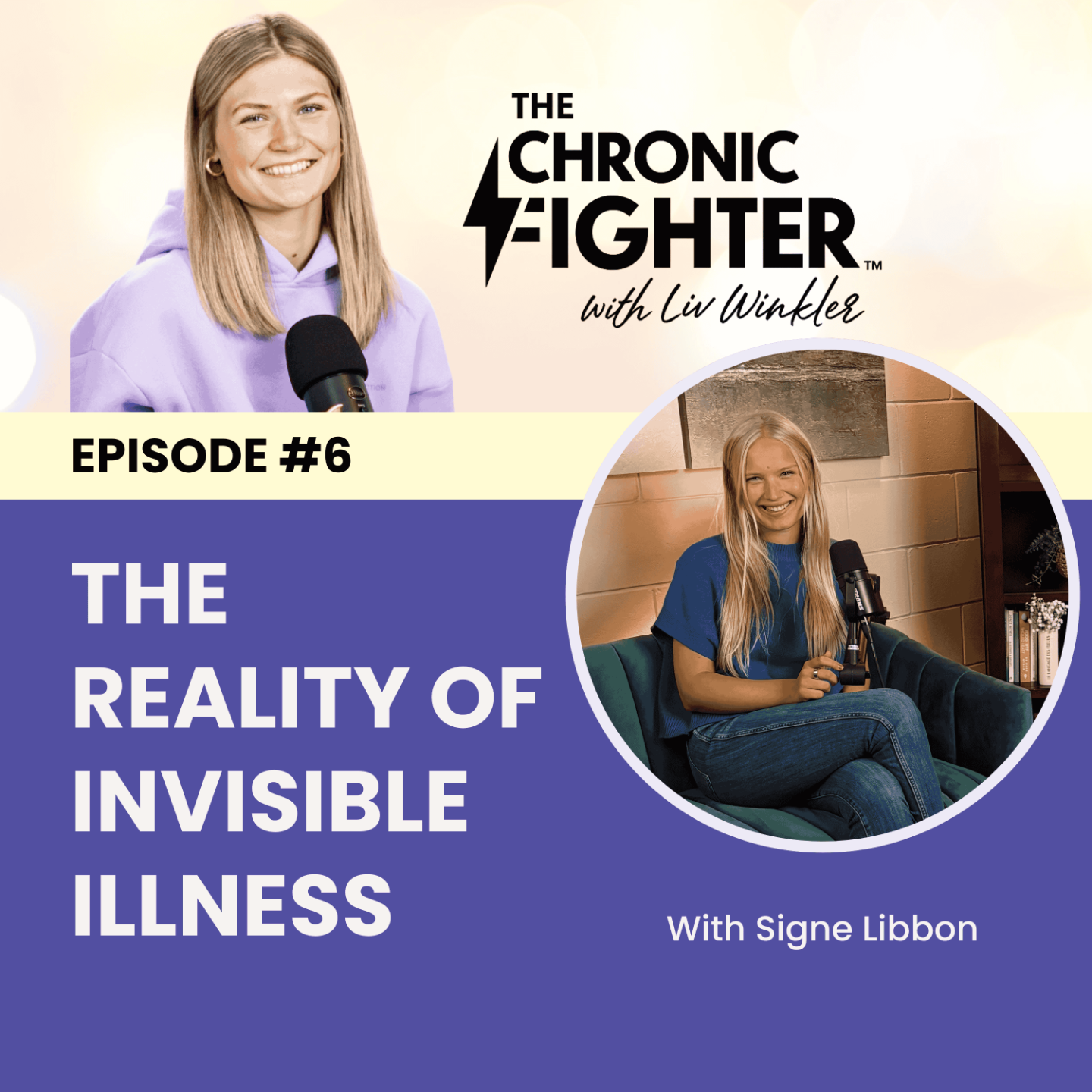
The Chronic Fighter with Liv Winkler
Episode 6: The Reality of Invisible Illness
People living with invisible illness often carry challenges others never see.
In this episode of The Chronic Fighter, I sit down with Signe Libbon, who was diagnosed with juvenile rheumatoid arthritis (RA) at just three years old. For more than two decades, she has navigated chronic pain, surgeries, flare-ups, different medication regimens, and the unpredictability of living with RA.
From a young age, Signe had to think about how her choices would affect her joints long term. That meant missing out on experiences like playing sports and grieving those limitations, while learning how to listen to her body, stay involved, and keep going after her goals. Signe shares personal stories about the day-to-day realities of RA, including how difficult standing can be and the rest and recovery that may follow an event.
We also talk about friendships and relationships with chronic illness. Signe shares how she became more open about her health with friends, how much they showed up for her, and how she and her now-husband, Drew, learned to communicate about her symptoms so he could best support her.
What stands out most in this conversation is the way Signe continues to live with so much joy and gratitude despite everything she has faced. A big part of that perspective comes from the role faith plays in her life.



What You'll Hear in This Episode
00:00 - Coming Up 2:10 - Meet Signe Libbon 3:06 - Diagnosed With Rheumatoid Arthritis at Age 3 5:22 - Growing Up With RA & Medical Complications 8:05 - Managing Flares & Learning Your Limits 11:04 - The Reality of Invisible Illness 14:34 - Opening Up About Chronic Illness 18:21 - The Daily Impact of RA & Medication 21:28 - What People Don’t See Behind the Scenes 26:26 - Grieving What Illness Limits & Finding Gratitude 37:07 - Friendship, Support & Feeling Less Alone 43:52 - Dating With Chronic Illness 53:14 - PT & Managing RA 58:44 - Faith & Hope with Chronic Illness
Biggest Takeaways
✔ Some chronic illnesses are invisible, making them harder for others to understand. Someone can look okay while still dealing with significant pain or symptoms.
✔ Respecting your limitations can help you keep doing the things you love. Accepting your limits doesn’t mean giving up. It means making adjustments so you can still participate in the things that matter to you.
✔ Treatment can change over the years. What helps manage chronic illness at one point may not work forever, and finding the right treatment can involve adjustments along the way.
✔ Opening up can make invisible illness feel less isolating. Letting trusted people know what you’re really experiencing gives them the opportunity to support you better.
✔ Grief and gratitude can exist at the same time. It’s healthy to grieve what chronic illness has changed or taken away while also recognizing and appreciating what you’re still able to do.
✔ Chronic illness doesn’t make you less worthy of love. Your person will love every part of you and see what you’ve been through as a source of strength and resilience, not a reason to walk away.
✔ There is hope in difficult circumstances. Even when chronic illness brings pain and uncertainty, faith can be a steady source of strength.
Resources Mentioned
The Chronic Fighter: Health coaching, membership, and additional resources: https://thechronicfighter.com
Business & Coaching Socials
TikTok: @thechronicfighterco
Facebook: The Chronic Fighter
Instagram: @thechronicfighterco
Threads: @thechronicfighterco
Podcast Socials
TikTok: @thechronicfighterpod
Facebook: The Chronic Fighter Pod
Instagram: @thechronicfighterpod
If You Enjoyed This Episode
I'd love for you to subscribe, leave a review, and share this episode with someone who needs to hear it.
Chronic illness can feel deeply isolating when so much happens behind the scenes, but opening up and allowing others to support you can make a meaningful difference. As Signe shares, we aren’t meant to do life alone.
Thank you for listening, and I'll see you in the next episode.
Your Journey Doesn’t End Here
Explore more episodes of The Chronic Fighter Podcast and continue discovering tools, stories, and support to help you build a life you love—while caring for your body along the way.
Main PodcastTranscript
So I was diagnosed with juvenile rheumatoid arthritis when I was three. When I was nine, there was this discrepancy. So my right leg and foot were getting shorter and shorter than my left leg and foot. And my parents were just absolutely distressed and you know went from doctor to doctor. Wow, like two weeks ago at this time I was actually in significantly more pain than I am now. And yet I was walking around the college campus and no one around me could tell. Drew loved me not regardless of my rheumatoid arthritis, but he loved me more because of it. And he saw it as a source of strength and as a source of resilience and so wanted to be there for me.
Liv Winkler (00:52.206)From having three seizures a day to starting my own podcast and business. Welcome to the Chronic Fighter Podcast, where we help teens and young adults with chronic illness take their lives back. I'm your host, Liv Winkler, a health and nutrition coach, founder of the Chronic Fighter Health Coaching Business, Lifelong Chronic Illness Girl with a degree in psychology and concentration in health coaching. This podcast meets you exactly where you're at in your health journey and offers science-backed tools that changed my life and can change yours too. I would love to be the person for you that I wished I had growing up.
Liv Winkler (01:30:000)Today’s episode is with my friend Signe, who has navigated chronic illness for nearly her entire life. Through so many ups and downs, she’s learned how to navigate both the physical and mental challenges of living with an invisible illness. We talk about what it looked like for her to open up about what she was going through, let her community support her, and lean on her faith, which has been a constant source of hope since she was young. Signe is an amazing example of what it looks like to live a full life while honoring your body and its limits, and I’m so excited for you to hear her story.
Liv Winkler (02:10.376)Signe Libbon, welcome to the Chronic Fighter Podcast. I am so happy you're here.
Signe Libbon (02:14.686)Thanks so much, Liv. I just I still love your heart for people with chronic illness and share a lot of your same passions. So I'm really excited to be here.
Liv Winkler (02:23.314)You’re just the sweetest. I have been really looking forward to this conversation. Well, how are you feeling about it?
Signe Libbon (02:26.390)Me too. Good. Yeah. I'm excited. It's not very often that I go through just the history of chronic illness and how it's impacted my life. So I feel like it was even therapeutic for me to kind of look back on in preparation for this conversation and am excited to talk about it.
Liv Winkler (02:43.978)I feel that. Like every time I do an interview, I feel like it's healing me in a way. Yeah. 'Cause I kept things hidden for so long. I'm like, my gosh, I'm actually working through this at the same time as helping other people.
Signe Libbon (02:55.058)Love that. Yeah, I can totally see that.
Liv Winkler (02:57.490)All right. Well I kinda just want to jump in. Yeah. I'm just excited. All right. So I wanna have you start by explaining your chronic condition. Wherever, you know, you wanna go with that, however you wanna explain that.
Signe Libbon (03:00.574)Yes, let's do it.
Signe Libbon (03:09.604)Mm-hmm. Yes. So I was diagnosed with juvenile rheumatoid arthritis when I was three. and for abbreviation, we can just call it RA. but essentially RA is an autoimmune disease where your immune system attacks the lining in your joints, which causes a lot of pain and swelling and stiffness. So it's a pretty young age to be diagnosed at the age of three. And then was diagnosed with iritis at the age of five, which is when your immune system attacks your iris. And I don't have pain in my eyes, but I have regular checkups still for the iritis because if the inflammation isn't addressed, it can lead to things like cataracts. So I've had, you know, been on and off different medications throughout my life, but I've had both of those diseases for over two decades now.
Liv Winkler (04:04.082)Wow, I was surprised to hear how young you were diagnosed. Are you comfortable explaining a little bit of what that process looked like?
Signe Libbon (04:13.072)Yeah.
Signe Libbon (04:13.072)Yeah. Mm-hmm. So I think by the time you're three, you know, you're walking. You know, you're a toddler wandering around. But my parents noticed swelling in my knees first. And so brought me to our family doctor. And I was really grateful that she directed my parents, I think right away, to a rheumatologist. So I was diagnosed pretty soon after my parents noticed the swelling in my knees and was put on medication soon after. I think I had joint injections when I was young.
Liv Winkler (04:49.918)Okay this actually sounds pretty familiar. I have HSD it's called and with that it's like hypermobility, and I have a lot of joint pain as well. So I can kind of relate to that in a way. but I didn't learn about that till I was twenty one. So I'm happy to hear that you found answers from a young age and as difficult as that probably was, at least you kind of learned more about it and what you had to do for that. You said you got injections and medications, right? Was it helpful from a young age doing that? Did that help?
Signe Libbon (05:27.090)Yeah, so you can get steroid injections in your joints and those have been helpful for me throughout the years. And I think that was helpful for me for a while, but then was put on more systemic medications, which like I said, because RA is when your immune system attacks your joints, the systemic meds attack your immune system. So they're immunosuppressant. But then they bring down your immune system a little bit so it doesn't attack your joints as much, if that makes sense. So I've been on immunosuppressant drugs for a good portion of my life. But I think being diagnosed at such a young age, you know, most of my life I've been in and out of chronic pain. And that's led to other complications and other well, I don't know if that's something that we you wanna get into next, but when I was nine my leg and foot stopped growing and my left leg and foot continued to grow. And there was this discrepancy. So my right leg and foot were getting shorter and shorter than my left leg and foot. And my parents were just absolutely distressed and you know, went from doctor to doctor and no one was able to give them answers as to why this was happening to me. Yeah, super scary. And I'm so grateful that my parents continued to advocate for me during that time. And then after about two years, they found that I had an undetected fracture in my right heel bone that led me to walk incorrectly and stunted the growth there. So that led to like multiple corrective surgeries on my right ankle. I think I was on crutches for like nine out of twelve months recovering from those. Yeah. And then got the growth plates scraped out of my left leg, eventually had surgery on my left leg to shorten my entire leg so that now my legs are the same length. So have had other complications as a result of the rheumatoid arthritis.
Liv Winkler (07:27.134)So kind of a domino effect. And that's just what's so common, unfortunately, with chronic illness. I can relate to that - like you have one thing and then it leads to another. And especially when you can't resolve something right away. Then it leads to these other issues. And you're putting out this fire and then you're putting out this fire. It can be a lot. And you're like, okay, why do I have all these different issues? But it's very common to have multiple issues that affect each other.
Signe Libbon (07:51.600)Mm-hmm. Absolutely. Yeah.
Liv Winkler (07:55.186)I just can't get over from such a young age. So you were nine, did you say, on the crutches for almost a year?
Signe Libbon (08:01.224)I was about eleven at that time. I was nine when my legs were kind of started to be different lengths.
Liv Winkler (08:08.786)All right, and then, so you were on these meds throughout the years. Is that kinda what helped you? 'Cause you’re in a better place overall it seems like.
Signe Libbon (08:18.734)Mm-hmm. No, that's a good question. Yeah. So a lot of times my symptoms of pain and stiffness can be manageable on medications. And I'm really grateful. I'm on really probably the best medication regimen I've ever been on right now. So I'm really, really grateful for that. Yes. but of course, there are times as there are with many autoimmune diseases of flare ups. and sometimes that can be hard to predict. Unfortunately there's not a perfect formula that I've discovered that, you know, A plus B equals flare up. That just doesn't exist for me right now. So it can happen at unexpected times that I'll get this flare up of disease activity. And during those portions of time the symptoms become much more unmanageable.
Liv Winkler (09:00.312)yeah, I relate to that too and it can be frustrating because you're like, I feel like I have this groove and then this happens. Right. How do you stay, you know, positive through those times? How do you manage flares?
Signe Libbon (09:14.862)Mm-hmm. Mm-hmm. No, that's a really good question. Yeah. I mean, I think in terms of managing flares, I think it's been really important for me to be more aware of when things are getting worse and try and get ahead of it and recognizing things that I know are helpful for me, like resting more, not pushing it. I think I notice when I am aware of what my limits are and recognize and respect them. It's really, really helpful for me. But yeah, the inconsistency of rheumatoid arthritis is definitely a challenge.
Liv Winkler (09:51.856)Yeah. I feel for you. That is really hard. And it's hard, you know, physically, mentally. But I love what you said about you know, being proactive and recognizing when things happen because, you know, it can be frustrating, like I have this symptom. I wanna go do this, but I have to rest. But you know what, that's better than having a full on flare because you went and did something and pushed yourself too much.
Signe Libbon (10:14.372)Absolutely. Yeah. I think sometimes it's difficult because it feels like, I don't want my limitations to hold me back from reaching my goals, right? But I think I've realized that recognizing my limitations actually supports me in attaining my goals. And so that's been a really big realization, I think, more in my adult life that I've recognized.
Liv Winkler (10:36.072)I love that. It's kind of an acceptance. Like you accept that you have these limitations. That doesn't mean that you're not capable. It just means like, okay, how am I gonna work with my body to still do the things I love? And that's like one of our biggest missions with The Chronic Fighter is that you know, it doesn't mean that you can't live a meaningful life. It's just like you know making adjustments so you can do certain things.
Signe Libbon (10:59.996)Right. And we all have limitations. Right? And so I think it's yeah, it's really healthy to acknowledge.
Liv Winkler (11:06.940)I love that. Well, I think that your story is going to resonate with so many people, and not just those with rheumatoid arthritis, but really anyone living with invisible illness. I'd love to spend some time talking about that because I think it's something a lot of our listeners can relate to. Do you feel like people have a hard time understanding your illness because they can't visibly see something wrong with you? And what do you think people misunderstand most about invisible illness?
Signe Libbon (11:32.030)Mm, mm-hmm. That's a great question. In college, I had a pretty significant flare up where I actually had a cyst in my left ankle because there was so much inflammation. And so I had another one of those steroid injections and then walked with a boot for a while. And it was interesting because during this time period, I had so many people come up to me in the hall and say, like, you know, are you okay? Or like, what happened? And I remember feeling a level of cognitive dissonance because I was thinking, wow, like two weeks ago at this time I was actually in significantly more pain than I am now. And yet I was walking around the college campus and no one around me could tell. That is so I think that that right. And that's that's I think a perfect example of us. Yes. And so I think as a hu as humans, you know, we all have this desire to feel seen and heard and understood and with a chronic illness.
Liv Winkler (12:12.614)So interesting. I think that is a perfect example.
Signe Libbon (12:29.552)Yes, And so I think as humans, you know, we all have this desire to feel seen and heard and understood. And with chronic illness, it can feel like there are barriers to feeling seen and heard and understood. And that can be really hard and that can be really isolating.
Liv Winkler (12:37.222)I think that was perfectly said. That is interesting. And I feel like it's hard when people you know, I've talked about this before, you can have friends that are sympathetic for what you're going through but especially when they can't see certain things, you know, it's hard for them to fully understand. Like you said, like a boot, okay, I can understand that that's an injury. But, you know, if I have a Crohn's flare up, for example, they don't fully understand what's going on there. You know, or or how much pain I'm in.
Signe Libbon (13:02.750)Mm, mm.
Liv Winkler (13:06.556)I might put up a good front, like I'm fine, but really I'm not. That is something people don't realize with chronic illness.
Signe Libbon (13:15.038)Totally. For sure. And I think in a lot of ways there's more of a responsibility of the person with the illness to communicate how they are doing in order to be supported. And there's a learning curve there, for sure. I'm still learning, to be honest.
Liv Winkler (13:31.556)It's and it's not straightforward and back to what you were saying before about how you'd have good times and then there'd be a flair and and I talked about this on my parents episode, but it's hard to communicate when it's not consistent too. Okay, I'm having a good day today, but then tomorrow isn't great. And then you explain that to them and they're like, but I thought you were doing good.
Signe Libbon (13:54.382)Right? Be able to go for a long walk one day and then the next day wake up and be like, my gosh, I need help getting to the bathroom. I'm like, this makes no sense. It's not logical. And I think too, there's a level of, at least for me, inconsistency both physically in the way that we just described, but also emotionally. Like I think that there will be times that I'm like, I'm so discouraged and I'm in pain right now. And there will be other times that I'm like, I'm in pain right now, but I'm listening to Taylor Swift and doing my makeup and totally fine. Like I'm just living. So I think I also have learned that I need to communicate both how I'm doing physically, but also like how I'm doing and processing it emotionally. I think that communicating both the physical and the emotional part have been important.
Liv Winkler (14:36.284)And that's come with age too. Like for me, I did not talk about any of this growing up. And it was college when I finally started to communicate those things to my family and friends more. My parents knew, but other than them - And I just helped me so much being able to communicate those things. And I had more support. And like we've said, it can be hard to navigate how to do that.
Signe Libbon (14:36.284)Mm. Mm-hmm.
Liv Winkler (14:36.284)I don't think there's any shame in doing that and I think it's so helpful letting people into your world. Otherwise they would have no idea what you deal with on the daily.
Signe Libbon (15:10.054)For sure. Absolutely. And we're not meant to do life alone. We're meant to do life in community. The Bible talks about bearing each other's burdens. And it's such a gift to be able to do that in community. But then you need to communicate what your burden is in order to be helped in that way. It goes both ways. Exactly. Exactly. So I'm in agreement with you. I wasn't as open about it in high school, but in college, once I started being more honest with the people around me, it was such a blessing to feel some of those burdens lifted as people were helping me bear.
Liv Winkler (15:44.318)And they want to help, you know? Like the ones that are meant to be there will want to. Just like you want to be there for them or to help them if they're going through something. Do you look back and wish that you had been open sooner? I know I do.
Signe Libbon (15:58.256)Mm-hmm. Absolutely. Yes, completely. I do. yeah, I think in high school, it almost felt like I kinda was carrying around this secret or I had to do some kind of like disease reveal to people in my life. Like I made such a big deal about it in my head when really I think it would have been helpful for me to sort of normalize and just say, like, yeah, like it didn't have to be this deal I made it out to be in my head, to share about it and to be honest about it. and like I said, really normalizing it. Like everyone has different struggles. For some, it's more emotional, more mental health, more relational. whatever. So I think yeah, it definitely would have helped me, I think, to be more open.
Liv Winkler (16:44.862)And it's honestly made my relationships with my friends more authentic and meaningful too. You know, like being able to share every part of my life and then, you know, they can hopefully do the same. And it was very isolating growing up for me personally too, because I didn't have anyone in my life that could relate to what I was going through. And, you know, that's a big reason that I do The Chronic Fighter and the podcast and the business is because you know, I wanna spread awareness and like you said, normalize it because a lot of people are going through these things. And you don't have to be ashamed of what you're going through. And it's not this big deal like you said. And I thought it was something that made me so different and you know, at times I questioned what I was capable of. And I don't want people to ever feel that way. 'Cause yeah, the biggest thing is everyone's going through stuff.
Signe Libbon (17:26.590)Absolutely. Mm-hmm.
Liv Winkler (17:41.162)And honestly now I look at it as it's made me a stronger person because of it.
Signe Libbon (17:46.056)Mm-hmm. That's so good. Yeah. I think that is something - reframing it as something that's built resilience in my life has been easier as I've let people in because they've spoken that over me and they've said, I've seen this make you stronger in this way. And that was something I missed out on when I wasn't as open about it.
Liv Winkler (18:07.878)I love that. That is so true. It's like this thing that I thought, like I said, would make me feel so different and you know, incapable. It's like actually people are seeing you as even stronger. They're like, you guys you did that with chronic illness. Yeah. Like it's cool. Like the reframe, like you said. That's awesome. Well, I was wondering what are some everyday things people don't realize can drain your energy or affect your body?
Signe Libbon (18:31.782)Hmm. Mm-hmm. For me, on a very basic level, standing. Standing for long periods of time is pretty difficult for me. I also think looking back throughout my journey of rheumatoid arthritis, side effects from medication at times have been more challenging than symptoms of arthritis themselves. That's a thing. It's really hard, right? It is a balance because it's like, okay, it's not good for my body to be flaring and have high levels of inflammation because I don't want long term damage. And yet I want to find a medication regimen that's gonna help me in that way, but also be bearable in terms of side effects. And so there was kind of a constant back and forth with those two factors and variables. So yeah, I remember I got off a medication in high school and feeling like, my gosh, I didn't know my head could feel this good. Like I had lived for so long with this sort of headache from a side effect from this medication that I didn't even realize that I had it because I was living with it for so long. So yeah, I think side effects are a big one.
Liv Winkler (19:45.458)That's a good point you brought up. I've dealt with that too before. Has it been years of trying different medications and stuff? Like did it take a while to kind of figure out what worked for you?
Signe Libbon (19:58.810)Yeah. The interesting thing with RA is that your body can actually build immunity to your medication. So because I have a hyperactive immune system, I think that's the medical term. You get the idea. My immune system, yeah, can learn how to effectively fight it. So because of that, some of the medications I've been on I kind of think of it like they've had expiration dates. Like they only worked for a certain amount of years and then I need to find something else to try.
Liv Winkler (20:35.950)That's challenging having to start over. Wow, there's just all these layers to it. And how it affects your body in so many different ways. I just think that you are such a cool person and inspiration because you have such a positive attitude and you've gone through so many different things for such a young age. I mean that is pretty cool. It’s definitely a testament to the kind of person you are.
Signe Libbon (21:04.228)That’s sweet.
Liv Winkler (21:05.116)Well, I mean it. Wow, that's really cool. You could have gone different ways with how you've handled it and how cool. I'm happy to hear that you're in a better place now overall.
Signe Libbon (21:15.622)Yeah. Yes, thank you. Yes, that means a lot.
Liv Winkler (21:18.590)And with chronic illness, I mean, it can take years to find answers and to get the right treatment plan and this and that. So that can be very hard. I feel like a lot of people with chronic illness can relate to that. All right, so you know, continuing on your day to day schedule, while people see the version of you that makes it to work, church, dinner with friends or a family gathering, what they don't see is everything it took you to get there. So do you want to expand a little bit?
Signe Libbon (21:28.456)For sure.
Liv Winkler (21:46.830)On the behind the scenes of what that looks like for you.
Signe Libbon (21:49.656)Mm. Mm-hmm. You know, I would say for me, the bigger portion of going behind the scenes is what happens maybe after a big event. Instead of before it. Like for example, my husband and I were recently at a wedding and I danced my heart out. It was so great. And then the next morning he like literally had to help me around our apartment and it was not good, which maybe is an example also of me not recognizing my limits - like I said, always learning. So I think sometimes recognizing that different, you know, big things like weddings or events or times that we are on our feet a lot or maybe going on walks with friends even, I will come home and be in pain in result of those things, which is hard because you wanna enjoy those parts of life. So I would say that kind of going behind the scenes, that's sort of how I would frame that, what that looks like for me. Yeah.
Liv Winkler (22:52.840)So okay, say you know that this wedding is coming up and you're like, well, I wanna allow myself to dance and have a good time. Are you able to like clear the next day? So it's like, okay, I know what's gonna happen. I wanna rest my body and, you know, recover from that. Is that something you think about too?
Signe Libbon (23:12.630)Mm mm. That is a really good question. I would say that that's probably something I could improve upon, honestly.
Liv Winkler (23:24.764)Yeah. Well, I mean it's hard to always do that, but you know sometimes I think about that for bigger things in my life.
Signe Libbon (23:30.974)Right, right. Absolutely. Yep. Yeah. I think that that's really good 'cause I think you're able to set yourself up for success in that way. So I think that's awesome. Definitely something I could work on.
Liv Winkler (24:10.468)Yeah, and I mean, you can look at it as this sucks that I have to spend a whole day recovering or whatever that looks like. Or you could be like, I'm glad that I could still do this. You know. So that's again, that's where the perspective comes in. For me, behind the scenes, I have to if I know I have like a big cabin weekend coming up, I personally have to pace my energy and I have to rest beforehand too, to prepare for that. 'Cause if I'm going hard the first couple of days before that, I know that I'm gonna crash and burn. So that's another thing, like I know my pattern. I know what tends to happen. So I prepare in that way. And again, that's something that takes time to learn your body signals. But I'm grateful that I can do certain things that allow me to still enjoy my life and do the things I wanna do. It's a lot better than not doing those things at all.
Signe Libbon (24:42.778)Totally. That sounds like really healthy self awareness. That's great.
Liv Winkler (24:48.658)Well thank you. But did you say that you rest a little bit like beforehand or do you, you know, eat certain meals beforehand or do you hydrate? Like are those the kind of things you do before those kind of things?
Signe Libbon (25:01.040)Yeah. So I have an as needed kind of medication that can be helpful in those times or for those types of events. And also honestly going back to what I was saying about sitting, there's a really big difference. If I'm standing for long periods of time before events like that, like truly that's probably the biggest thing. And I sit as much as I can before doing physical activity. It makes a world of difference. I know that sounds like a small thing, but it's a really big thing for me.
Liv Winkler (25:30.886)No, I can definitely understand that. I mean yeah, your illness is centered around, you know, what you're physically able to do. So it makes sense to, you know, listen to those signals and and know what you're capable of.
Signe Libbon (25:45.086)Mm-hmm. The thing too I'm realizing - I didn't notice this, but my primary areas with arthritis are my ankles and my feet and my elbows as well. So that's why standing is such a big thing is because it really impacts my ankles.
Liv Winkler (25:59.400)Sure, that makes sense. So yeah, it can be any body part for anyone that has RA. Okay.
Signe Libbon (26:07.034)Mm-hmm. Yeah, I've had it in like my toes, my back, my knees. Where else? Yeah, but right now the primary places are my ankles and my elbows.
Liv Winkler (26:16.808)Okay. That's interesting how it's changed.
Signe Libbon (26:18.822)Isn't it? Yeah. Odd. And why my elbows? That one always gets me. The elbows. I'm not a power lifter by any means. Like there's no reason my elbows should be inflamed.
Liv Winkler (26:28.222)So okay, now I'm curious. I just thought of this. So growing up, were you involved in sports and stuff? Were you capable of doing them?
Signe Libbon (26:36.702)Good question. No, I wasn't. That was definitely something that was hard growing up. Like I actually couldn't even do like phyed or gym. My mom assigned kind of like a recess teacher to tell me to stop running around and playing kickball because I would try. But I mean that was really an important limitation, but it was really a hard limitation. I'm really grateful because I don't have any long term damage because I've never overdone it in a way that's damaged my joints. So like I said, really important that I didn't push it. However, that was really hard.
Liv Winkler (27:28.080)How did you handle that as such a young kid?
Signe Libbon (27:31.974)Yeah. That has definitely been a big thing. I've had to grieve missing out on those things. Yeah. It was hard. I think my parents did a really good job of shaping my mindset. They gave me so much compassion and they gave me so much empathy, but they didn't like pity me in a way that made me feel like a victim. Yes. And I think they helped me to grieve the things that I couldn't do, like being active and like sports, and process through that in a way that allowed me to get out of that grief and live with gratitude for what I could do. Yes. And so I mean, I was in all the things like I did sewing classes, I did plays, I did speech. So I was totally involved.
Liv Winkler (28:27.622)That's amazing. It's like, okay, what are your limitations and how can you still do things you love? How can you still find ways to be involved? I love hearing that you did other things. It's you know, it's whatever that looks like for you and that's amazing. Like I love hearing you found stuff you're passionate about still.
Signe Libbon (28:50.226)Yes. And I'm so grateful for how my parents helped me frame that. And I mean I love sports. My cousin had an amazing collegiate volleyball career and I loved cheering her on there. I managed football in college. So there are ways that I could kind of still be involved. Yeah, mm-hmm even on kind of the sports side. So grateful for that.
Liv Winkler (29:12.978)Yeah. Wow, I just love hearing that your parents helped you through that too because that definitely can be hard for anyone. But then when your kid, it's like, well I wanna be like the other kids doing this and that.
Signe Libbon (29:26.782)Absolutely. I remember in high school, feeling like I could not wait for the day that I was an adult and I would be asked, What's your job? instead of what sport do you play? I just felt like, I can't wait until I get beyond that threshold. Which again it sounds like funny to say that now, but it really felt like such a big deal at the time. And it was a big deal at the time. Yeah.
Liv Winkler (29:49.424)That's your whole world being involved with activities.
Signe Libbon (29:53.214)Yeah, exactly. It's a big point of conversation.
Liv Winkler (29:57.838)Do you think that you understood at that age that it would have affected you long term if you did play sports and you did PhyEd? Like I just don't know. I'm trying to picture myself at that age and I remember not understanding everything too when I had to do things differently than my friends.
Signe Libbon (30:16.958)Mm-hmm. Yeah, that's a good question. Honestly, like I said, I feel like my parents just really did a good job helping me to have awareness in that way and consider potential long term consequences. But like I said, I mean I had to have a recess monitor. I can't say I was always following the rules. But yeah, I mean it's hard to conceptualize for sure when you're that young. It is possible to grow out of rheumatoid arthritis. I think before the ages of like 18 or 21 or something. And so I think yeah, I feel like I always had maybe a hope of that. But yeah, I don't know that I thought all that long term though.
Liv Winkler (31:36.932)Okay. Mm-hmm. Yeah, 'cause I'm like, as a kid are you thinking that far down the line? So your parents were luckily. But yeah, I love that you brought up the grieving process because that is so true. That is so true like especially for people who, you know, either develop chronic illness later in life and they're comparing themselves to the past version or they're comparing themselves to people without chronic illness. Like, I want to be like them and do this and that. So I think that it's very healthy to grieve that, but then not stay, you know, in that place forever. Like you did. Okay, well, how else can I get involved? You know, how can I do this? That's so important. And it's so important to find something that you love. No matter what that looks like. There's always something you can find no matter what your limitations are. That's such a good example of that.
Signe Libbon (32:03.454)So good. I think another example that comes to mind is, like I said, I was never able to do things like PhyEd. So I could never do track and field day. But instead of, you know, keeping me home and kind of coddling me or something, I went to school on track and field day and my mom would come to track and field day and would bring my scooter and she would cheer me on as I scootered the mile. So I think that's just a sweet example of recognizing, you know, like I definitely grieved at times. Like it's hard to not be able to run the mile like the other kids. But then get out of that grief and live with gratitude. I'm like, I can scooter it. That's super fun. I can still be with my friends.
Liv Winkler (32:47.838)Love that. I love that. That makes me think of, so I've always had food allergies and so obviously I couldn't have like, you know, the cupcakes at school with my friends and this and that. But I'd bring my own little gluten free thing. Yeah, my mom was always good about still making sure I was included too. But yeah, it does help to be just grateful for what you can do.
Signe Libbon (35:31.736)Yeah. It does.
Liv Winkler (35:31.736)‘Cause you know, it's exhausting and draining thinking about, okay, well, you know, I wish this, I wish that. I wish, you know, I could go do the same things as my friends. I wish I was capable of this. But when you switch that to I'm grateful I can do this at all, I mean what a difference that makes. What a better way of living.
Signe Libbon (35:31.736)Mm-hmm. For sure. For sure. and I think that's why I like that you've kind of framed this part of the conversation, recognizing the relationship between grief and gratitude and acknowledging the importance of when you have a chronic illness, there is loss there and it's healthy to grieve. But then, like you said before, also important to get out of that grief and to live with gratitude. So yeah. That's so good.
Liv Winkler (35:55.890)And it's not like it’s healthy either to just ignore things. It's not healthy to be like, Okay, I'm just gonna ignore and suppress feelings of not being able to do this. It is healthy to recognize that. You have to have balance.
Signe Libbon (36:08.988)Yeah, I've heard it described recently that suppressing emotions is like trying to keep a beach ball under the water and it takes a lot of effort and eventually it will pop back up in an unexpected place if you try and suppress it, right? It wasn't me, but I heard it somewhere.
Liv Winkler (36:08.988)That's so good.
Signe Libbon (36:08.988)But I think that that's a really helpful way to understand the importance of working through emotions instead of suppressing them or pushing them down.
Liv Winkler (36:38.492)Yes, exactly. And if we don't,that can cause more flares and stuff too. I know like when I have that stress that I'm not dealing with, that yeah, can result in flares, can result in physical symptoms.
Signe Libbon (37:04.299)Mm-hmm.
Liv Winkler (37:08.270)There's just so much importance in knowing your body's needs, recognizing your signals, you know, working through things. Just being really in touch with, you know, your feelings and what you need is so important, especially with chronic illness. Well, I'm curious what it was like growing up talking to your friends about having RA. Like how did that go over ‘cause I know you had said that you kept it pretty private growing up. Were you open with any of your closest friends? Like how did you navigate that?
Signe Libbon (37:29.050)Mm. Absolutely. Yeah, I would say in elementary and middle school, I went to a Christian private school and so I felt so supported by that community. Yeah, you know, my friends would do prayer requests for Signe's appointment. So I was super encouraged by that community. And then yeah, my church has always been so supportive and prayerful over me. And so I would say that yeah, both of those places were super encouraging and supportive for me as a kid. But yeah, it was really in high school that I felt like I was much more private about that part of who I was and experienced a lot of loneliness as a result and a lot of isolation. Because I wasn't maybe fully being honest with other people or myself in some ways and maybe kind of masking it as a way to cope instead of yeah, being honest. Yeah.
Liv Winkler (38:59.176)High school was the same for me. I feel like part of that is, you know, middle school, high school, it's like you have so many other things you're dealing with and it's hard enough and then you have that whole piece and so, again, I wish I would have been open sooner, but I definitely relate to, you know, putting on this mask and acting like I was fine and keeping that a secret and just being known for being a friend, being a soccer player, this and that. So yeah, I relate to that. But it definitely was isolating and hard. It's crazy 'cause you can have the support from your friends and family, but if they don't know the full thing, it's like you can't fully feel supported, you know?
Signe Libbon (39:22.876)Mm-hmm. Yeah, for sure. And yeah, it's really hard. A story,though, that I'll share from high school. Just a testimony to God's goodness amidst what was so hard about high school is that it was just always a prayer in my heart and a desire of my heart, that the Lord would just show me that, you know, I wasn't alone in that. And I think it was my junior year, my sophomore year. I was called down to the nurse's office and there was a woman who had RA rheumatoid arthritis that had recently passed. And in her will, she'd written a letter and set aside some jewelry and set aside some, I think actually some money as well and had set it aside for a girl in Marshall with rheumatoid arthritis. And I got to meet with her husband and he told me all about her life - like what it was like for her to grow up with rheumatoid arthritis from a young age. And I just felt so overwhelmed by the Lord's goodness because it was like, wow, I am not alone. I'm seen and heard by the Lord and He just blessed me by giving me this physical representation of that in a way that was so unexpected.
Liv Winkler (40:49.904)Just gonna say you were praying about this and you probably had some ideas in your mind, but never something like this.
Signe Libbon (40:53.958)I know, I know. Right? So I think just the blessing of meeting with her husband and reading the letter and just feeling less alone and less isolated. Yeah.
Liv Winkler (41:03.400)That's incredible. Wow. That is such a cool story. You have so many cool stories from along the way. My goodness.
Signe Libbon (41:10.711)Well it's been a couple of decades I guess at this point, yeah.
Liv Winkler (41:13.768)Well, those are the kinds of things that keep you going.
Signe Libbon (41:16.194)Yeah, absolutely right. The Lord is so good and so faithful through it. Mm-hmm.
Liv Winkler (41:20.174)Yes. And just like those moments are knowing that he's there with you and then he's listening and that he hears you. That in itself makes you feel less alone. You know?
Signe Libbon (41:34.032)Absolutely. I'm already fully known and loved by the Lord.
Liv Winkler (41:37.810)Yes. And this isn't something that is a punishment or something. He wants the best for you. And he's there. So yeah, I love hearing those kinds of stories. I mean that's so good. That's really powerful. Wow. How did you communicate your RA in college to your friends?
Signe Libbon (41:57.242)Yeah, so I had some pretty significant flares in college. When I get sick with pretty much anything, I have to go off all medications because my medications are immunosuppressant. and so that can lead to pretty significant flare ups. And so living communally in close quarters with friends, my friends could see that I was struggling on the day to day. But I also was so much more honest and they were so loving and caring in meeting me where I was at in those moments. And I think back to what I said about just how the Bible talks about bearing each other's burdens. It was such a blessing too because it really felt like they helped bear my burdens in a number of different ways. And yeah, a couple of examples that I can think of is that one of my best friends who was literally communications major, like nothing medical related at all, watched YouTube videos to learn how to give me a certain medication that made me feel sick. And that was just, my gosh. This medication was such a burden in my life. And so it was such a gift that she would do that for me. And yeah, I had another friend that made a basket of prizes and whenever I would do this medication that made me sick, I would open a new prize. Isn't that so sweet? It was something my mom did for me when I was younger and she got wind of that. And so then she was like, well I think you need a prize box in college as well. So so sweet. Yeah, those are just two examples of many but my friends have been so, so supportive and I'm so grateful.
Liv Winkler (43:51.830)My gosh. I love hearing that. And I'm sure you did the same for them. Okay, well I'm curious what it looked like when you first opened up to your now husband when you first started dating, if you’d like to share that.
Signe Libbon (45:03.430)Yeah. Such a good question. So Drew is going to school right now to be a PT. So he has a really amazing understanding of the human body. Which is such a blessing. So he's like done all kinds of research on rheumatoid arthritis and probably understands it better than I do. Yeah, that's such a gift. But I think when we started dating, I had a really hard time knowing how to communicate about the pain that I experienced on the day to day because it felt like when I would tell him about it, I just didn't want to bring him down. So that was so hard. And actually at first I thought I had this bright idea. I was like, okay, Drew, what about you just assume I'm in pain and then I'll just tell you the good news when I'm not in pain? Not a good idea, not a good idea. And I think what I had to learn is that it wasn't kind or loving for me to expect him to read my mind, right? Like men can't read women's minds. We know this. So I think I came to realize that Drew loved me not regardless of my rheumatoid arthritis, but he loved me more because of it. And he saw it as a source of strength and as a source of resilience and so wanted to be there for me. And I think that made it so much easier, to be honest. And so I guess just practically I can explain kind of the system, the way that we would communicate in dating. We found it helpful just in the morning, he would text, you know, like good morning, whatever, yada yada, what joints are hurting today and how can I support you today? So then I would say, like, okay, both elbows and this and that. Kind of back to the piece we were talking about earlier, that there's a physical and an emotional kind of side of communicating in terms of how it's impacting me. And so by starting the morning that way, that was just a really good, clear way for us to communicate. So that worked really well for us in dating.I'm sure it can look different, like from couple to couple, but that's something that worked really well for us.
Liv Winkler (46:28.336)I think that is so true what you said about he loves you more because of it. Because for so long I felt like I would just be such a burden, you know, to my partner. And I feel like a lot of people with chronic illness unfortunately feel that way. But you know, when they truly love you, they're gonna want to love every part of you and be there to support you. And there is this balance because you know, when I first started dating my boyfriend, I didn't know how much to tell him right away. And I didn't want to bring him down. I wanted to be, you know, positive and I didn't want to tell him everything because I didn't want that to affect his day. But then there's this layer of not being totally honest with him and feeling like I'm keeping things from him. So I feel like that's a good idea to just start every day with that or just be like, hey, just so you know, this is how I'm feeling right now, but I still wanna go do this activity with you. So it's like you still tell them, but then you put a positive spin on it, you know?
Signe Libbon (47:31.646)Right. And I think too it sets us up in a way to communicate about other things too. Like checking in in the morning. I wanted to hear about how late did he stay up studying last night and did he get enough sleep and how is he feeling? So I think it kind of set us up to communicate just in general about how we were doing in a healthy way.
Liv Winkler (47:50.866)That's a good point. Yeah. I do the same thing. It's like, okay, but how are you doing? You know? And it's obviously not the same kind of things you're talking about, but you still wanna, you know, hear about them and so it's not just all about you, it's also turning it back to them and other conversations. So that's really good.
Signe Libbon (48:06.354)And thinking back to what you were saying too about sort of the initial conversation of and just anxieties around that. I definitely was anxious about first explaining rheumatoid arthritis to Drew. And during our first date, actually I was experiencing a pretty significant flare up and we went on a walk at a park, which is a great idea for a first date, but I was unfortunately flaring. Yeah. So at one point we sat down and I honestly just kind of had to tell him I have rheumatoid arthritis. I'm just kind of in pain and seriously Liv, I shared this with him and his response blew me out of the water. I explained just on a very basic level, you know, I've had this since I was three, yada yada. And he's like, my gosh, like that is so attractive. And I was like what?? Yeah, but I think just right away he was like, my word, there's this huge part of you that when he saw that more was happening underneath the surface, he was like, my goodness, that's amazing. And of course he doesn't want me to be in pain, but again, I think he just saw it as a source of strength and as something that built resilience for me, just kind of from the onset, which was really, really encouraging and healing in a lot of ways.
Liv Winkler (49:29.498)Healing. Yeah. And you know, unfortunately there are gonna be guys out there that aren't going to respond like that, but that's not the person meant for you. Like the person that, you know, God has for you will, like you said, love you for every part and will see that as, Wow, that is amazing, everything you've done. What you do on the daily, you know, with that. So I think that's just a testament to the kind of person he is and that he was meant to be in your life, clearly, you know? So that's pretty cool. I love hearing that he said that. And from day one. I mean you're probably like, who is this guy? You’re probably like, okay say less.
Signe Libbon (50:08.933)Yeah, I called my mom, and told her and she cried.
Liv Winkler (50:20.894)I love hearing that. I think that's just so encouraging though to people out there listening that again, their person will be there for them and that'll never be a reason not to be with them. If anything, like you said, it'll be a reason to be with them, seeing all they've been through and how resilient they are and how capable they are.
Signe Libbon (50:39.536)And the deeper part of their life too. Yeah.
Liv Winkler (50:41.576)Yes. Yes. And the fact that I mean good for you for, you know, letting him in and letting him in early on. I mean, that's hard. But it is not easy. But that shows your courage and your strength doing that. I'm happy to hear that you did that from the start too.
Signe Libbon (51:01.243)What was it like talking about your chronic illness with Evan?
Liv Winkler (51:06.834)I mean again it was hard to know where to start. Like do I start from the beginning, this has been twenty three years.
Signe Libbon (51:14.172)Right. Maybe like a multi part conversation kind of.
Liv Winkler (52:14.834)Yes, and I think that's something I had to recognize was I'm not gonna be able to explain everything right away. Well, actually with me too, obviously I share stuff online, so before we even went on our first date, he saw a lot online. Like, at least I know he's not scared of it, but it's just something where I had to, you know, tell him on a surface level right away and then I kinda figured as things came up, that's kinda when I brought it up. So like, hey, this is what I'm experiencing today. And then, you know, say it's PNES, you know I have non epileptic seizures. I'd be like, I had a flare today and then kind of go into explaining a little bit about what that is. So I'd tell him about a flare and then I kinda explain a little background on what that means. So it just kind of was something that as it came up I'd explain so it wasn't so overwhelming at once. And I was lucky 'cause he was just so compassionate and was there to listen and he hadn't heard about a lot of this stuff, which I mean, how would you if you haven't experienced it or no one in your life has it? But he was there to listen and he wanted to learn. You know, he wanted to learn how to help. And again, just the right person will want to do that. Just like you and I would want to help them with anything they're going through and support them. So for sure. I feel like that's one of the reasons I wanted to talk about this today is because I feel like so many people out there feel like they're too much. And I don't want them to ever feel like that. I've felt like that at times and it's an awful feeling, you know? So hopefully this is encouraging to someone out there that they don't have to settle for less because of a chronic illness or whatever they're going through. And it's nice to be a team too, to have that support and it goes both ways.
Signe Libbon (53:08.840)Yeah, that's so good. For sure, for sure. Yeah. Like I said earlier, I think I've seen ways that it's built our communication..
Liv Winkler (53:14.824)I love hearing that. And I was also wondering, okay, so you talked a little bit about how he is in PT school, right? So do you want to talk a little bit about how that has worked out in your favor? Has he made exercises around having RA and how has he supported you through that?
Signe Libbon (53:40.494)Yeah, it is such a gift that he's a PT student. You know, I think we're at the point in our relationship where he can pretty much tell if I'm in pain watching me walk for like five seconds alone. He just understands the human gait patterns, things like that. Yeah, so very grateful for that. But yes, I mean in times that my elbows have flared, he knows techniques to work them in a way that's helpful. He has written a couple different lifting routines that put less pressure on my joints. So that's been super helpful. He also goes to all my appointments and asks the doctors really good questions. And he also actually does all of my med regiment stuff at this point, which is huge. So he does my injections for me.
Liv Winkler (54:44.254)Gosh, that's so nice. It's probably such a weightlifted off of you.
Signe Libbon (54:47.836)Mm-hmm. Yeah, that's really been such a gift.
Liv Winkler (54:51.004)Had you done PT prior to knowing him? Like is that something you did growing up?
Signe Libbon (54:55.088)Yeah. When I had the surgery that shortened my femur bone, I had a ton of PT around that. Yeah, my left leg was like dead weight, so I really had to rebuild it. Yeah, and then with my right foot as well. I would say yeah, I've done a good amount of PT. And then at other times of life have tried a tens machine, or I've had different braces on my ankles or up to my kind of like calf area to help me walk and yeah, there's been multiple different interventions that have been prescribed by PT, I guess.
Liv Winkler (56:04.144)Okay. That's interesting. I do PT currently for my HSD 'cause my joints get so tight and so it’s helpful. It's something that is not so much short term as it is long term. I won't necessarily go to PT in a flare and then feel better immediately, but over time I've learned ways to support my body better. And I carry so much tension in my neck and shoulders. So learning to build strength has definitely been helpful. I've done PT for years too. When I was playing soccer, I would do it for my hip and all kinds of things. But yeah, super beneficial. And it's really good hearing that you have PT specific to RA because it's good to know what you're working with to help target specific areas. Cool. And then you've mentioned some tools. Are there any other tools that have worked to help with short term and long term?
Signe Libbon (56:46.820)Sure. yes, I think just practically pain journaling has been really helpful for me. I just always really dreaded the question whenever I would go to the rheumatologist - he'd ask me, Okay, in the last two weeks, how much have your joints been hurting on a scale of one to ten? I'm like, I have no idea. Like, I think I just said five usually. I don't know.
Liv Winkler (57:09.886)I know I get that question.
Signe Libbon (57:15.010)But then I think having conversations with my mom and rheumatologists, recognizing it's really, really valuable for the doctors to know how to best help me. For me to actually answer that question well. And I think especially around a time when I was, like I said, trying things like tens machines or having the brace, tracking which kind of interventions were helpful or not helpful or times of day that I was in more pain than other times. So yeah, writing that down. I would just have a little flip journal and I'd put it in my back pocket in school. I don't remember how many times a day I did it. I wanna say it was like three times a day at school and then maybe once again at night or something like that. But it was really, really beneficial for sure. And yeah, I did that a little bit in college. But I think it was particularly more helpful for me when I was younger. I think the older I've gotten, the more self aware I've been and the more I'm able to just recognize and track on my own. But I think that was a really good tool for me when I was younger.
Liv Winkler (58:20.336)I love that. It's hard to remember everything. I mean there's a lot, you know, that's going on and it depends what time of day, like you were saying. So I think that's super valuable. I love that you got more specific with it. So then when you get asked questions, it's like, Okay, well what day and what time? Let me pull it up.
Signe Libbon (58:36.944)Exactly. Talk about an upgrade next time I saw my rheumatologist!
Liv Winkler (58:46.112)I love it. Okay, well something that is really evident to me is how important your faith is too. I wanna know how your faith has shaped how you live your life with your chronic illness and how it's helped you through uncertainty.
Signe Libbon (58:59.216)Yeah, that's such a good question, Liv. Well, I think two things I'll say. Okay. First, I mean, throughout this conversation, we've just talked about how isolating it can be to live with a chronic illness. And so, I think it's so peace giving to feel seen and heard and understood by the Lord and to recognize like God knows me better than I know myself. and that is just such an amazing blessing. So that's number one. Number two is living with an eternal perspective. And I can explain a little bit more about what that means for me. So when God created the world, he created perfect harmony. The Bible says God saw all that he made and it was good. But then man turned their back on God and sin entered the world, death and disease, and there was separation between man and God. But then God made a way to bridge the gap. And John three sixteen says that for God so loved the world that he sent his only son, Jesus, so that whoever believed in him shall not perish but have eternal life. And by the life and death and resurrection of Jesus, when I put my hope in Jesus, I recognize and receive the gift of complete healing and or complete spiritual healing, and then also can receive the blessing of the promise that one day I will live without pain in eternity with the Lord forever. and yeah, the Bible says that the pain that we are feeling cannot compare to the joy that's coming. And so living with an eternal perspective recognizes that. and that's such a gift that gives me so much hope and that gives me so much strength.
Liv Winkler (01:00:52.036)I love that so much. That was so well said. But I think that that is just so encouraging because yes, you could be going through so much pain today, but knowing that it's not forever, I mean, gosh, if you don't have much hope in anything else, you can have hope in that. So I think that yeah, anyone that's experiencing hardship can, you know, have that kind of perspective and what a shift that makes. Yeah, I can't even put into words how powerful that is. I think that’s freeing, yes. I think that that is incredible. That is so cool. Have you had that perspective for a lot of your life? I don't know if as a kid as much, but do you feel like that's helped you through years of uncertainty and pain and overall?
Signe Libbon (01:01:47.558)Yeah, that's definitely something that I would say, yeah, since I was a young girl, both of my parents instilled in me for sure and really supported me in that. So I'm very grateful for that.
Liv Winkler (01:02:02.844)Yeah. How life changing. I've always had faith, but I got into it a lot more in college and I saw such a difference in just how I lived my life and I was just happier and it made the hard times so much more manageable. It can be at times too much to carry. You know, it could be too much. I felt like I just couldn't do it anymore. I couldn't handle it on my own. And then there was a point where I just had to give it all to Jesus. I literally picture taking it off of me and giving it to him.
Signe Libbon (01:02:48.872)That's so good. Yeah. Psalm fifty five twenty two, cast your cares on the Lord and he will sustain you. He'll never allow the righteous to be shaken. So that's so good. And you know, it doesn't invalidate what's so hard about right now, but it says my hope is in Jesus. He is greater than my circumstances right now.
Liv Winkler (01:03:11.334)Wow. That's really powerful. Well, I usually like to end these conversations with a few reflection questions. I'm wondering what would you tell your younger self when she was first experiencing symptoms?
Signe Libbon (01:03:23.678)Mm, I think I would go back to what we were talking about earlier and I would encourage her and say that it's a source of strength and that it will build something that will build resilience for me. I definitely would say that.
Liv Winkler (01:03:40.926)That's so cool. I like to say your resilience is your superpower. It is just empowering to think of it that way, which it's so true. And then also I was wondering what has chronic illness, invisible illness taught you? What are some things that's taught you and that you're now grateful for? I mean, you've kind of touched on that a little bit. I don't know if you have anything else you want to say.
Signe Libbon (01:04:07.175)Yeah. Well, we know that God is always present, but the Bible says you know that the Lord is close to the brokenhearted and saves those who are crushed in spirit. And so, I'm grateful for the ways that I have grown closer to the Lord through it.
Liv Winkler (01:04:26.140)Yeah. Like I said, I can totally relate to that. I think that is definitely a blessing. Through hard times. And then finally, what are some things that bring you the most joy in life?
Signe Libbon (01:04:41.502)I’m super super close to my family and to Drew's family and so any amount of time with the family. Both of our families have family farms and so yes we love spending time in both of those places with people that mean so much to us so that always gives me a lot of joy when we can do that.
Liv Winkler (01:05:06.824)That sounds amazing, I'm jealous.
Signe Libbon (01:05:08.190)In the summer, Drew and I've played a lot of pickleball. So it's pretty much my number one goal at the moment to beat him, which I never have. So hopefully by the end of the season, by the first snowfall, I will have accomplished that goal.
Liv Winkler (01:05:22.718)You're able to do pickleball?
Signe Libbon (01:05:22.718)Right? Exactly. That's encouraging. Yeah.
Liv Winkler (01:05:22.718)That's super encouraging. How cool. Yeah. Well I need to talk to you about where you go play.
Signe Libbon (01:05:31.870)Yes. Our apartment complex. Yeah. my gosh. Yeah, I secretly train. That's what I need to do.
Liv Winkler (01:05:40.200)Well we should practice.
Signe Libbon (01:05:40.200)Okay, let's do it. I'm down.
Liv Winkler (01:05:40.200)Well, Signe, you're just the best. I think you're just such a positive light and I just wanna thank you so much for sharing your story and being so open about it. I really think it's gonna be relatable and help a lot of people. So thank you for having this conversation today with me.
Signe Libbon (01:06:00.510)That means so much, Liv. Thanks. And again, I just so believe in what you're doing at The Chronic Fighter. And just really encouraged by you and your mission. So thank you. You're so sweet.